Snowflake Cortex and Cowork vs Contextflo
Hi, this is Vivek, building Contextflo. I share practical notes on getting answers from your data, a couple of times a month.
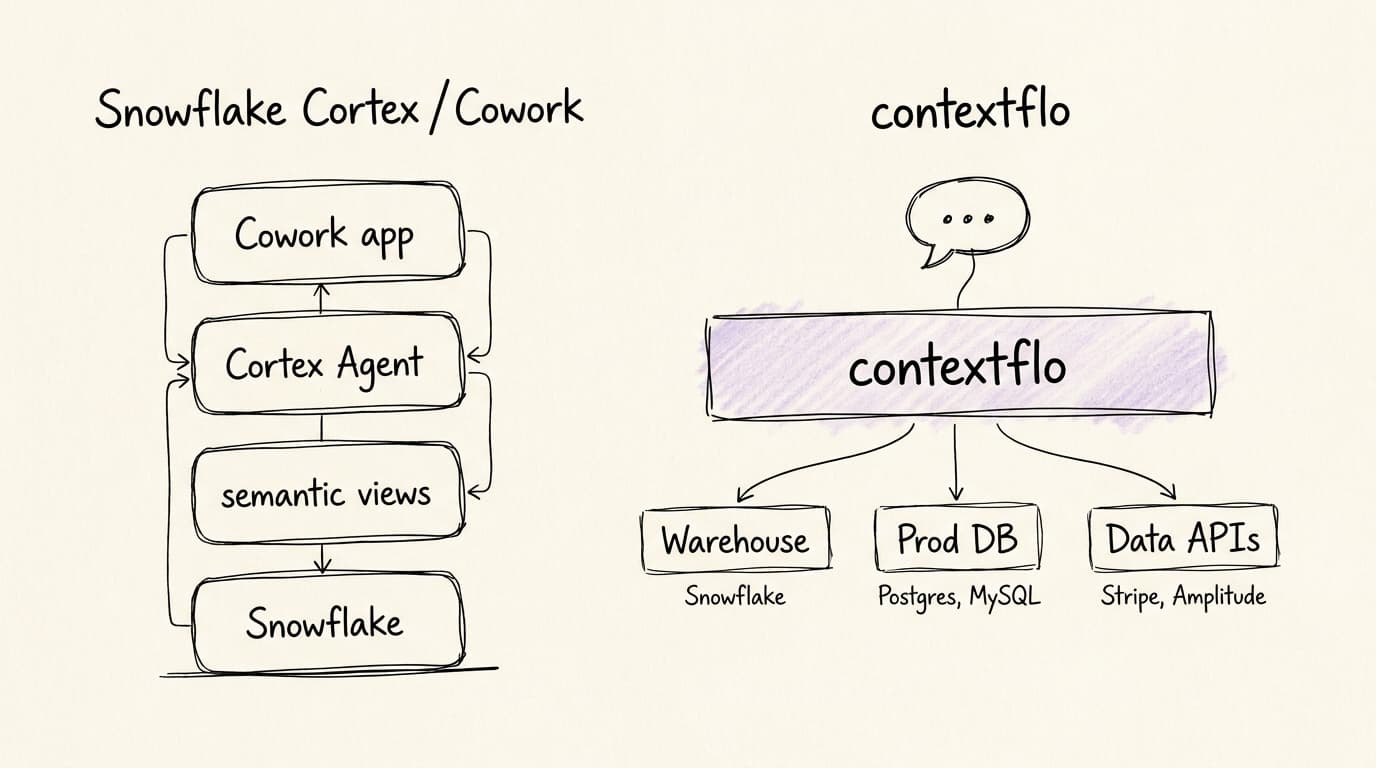
Snowflake now solves this problem inside its own stack. Cortex Analyst turns questions into SQL, Cortex Agents orchestrate it, and Cowork wraps the whole thing in a chat app that is genuinely nice to use.
If you are a Snowflake shop evaluating both, the honest answer is that the interface gap people used to complain about is closed. What is left is a narrower question about who builds the layer underneath, and what happens to it when your data stops being only in Snowflake.
What Cortex and Cowork actually give you
Cortex Analyst is Snowflake's text-to-SQL engine. You define a semantic model (a YAML file on a stage, or a newer Semantic View) covering metrics, dimensions and relationships, and it converts questions into SQL using Snowflake-hosted models (Claude, GPT, Mistral). Cortex Agents sit on top, adding multi-step planning and Cortex Search over unstructured documents. Cowork is the app: polished chat on web and iOS, with charts and file upload.
The app is good. It is also the easy part.
For Cowork to answer questions about your data reliably, someone has to build the agent underneath: author the semantic views, stand up Cortex Search services, configure the agent, grant the right permissions. That work does not go away because the front end ships pre-built. It is the same modelling project it always was, now with a nicer window onto it.
Where Cortex is strong:
- Native to Snowflake, using the roles and governance you already have
- Data never leaves Snowflake, which matters for some compliance postures
- The semantic model is fine-grained, and for genuinely complex metrics that precision is worth something
- No external dependency, no extra vendor
What Contextflo does differently
Contextflo lets your team handle their analytics workload, from dashboards and reports to metrics and ad hoc questions, inside the Claude or ChatGPT they already use, with no separate BI tool and no data team required. Underneath, a governed context layer keeps the answers reliable: it reads your schema, plus source code and docs you point it at, and generates table descriptions, column meanings, relationships and metric definitions. You review and correct them rather than authoring from an empty file.
Those definitions are served to Claude or ChatGPT over MCP, so people ask questions in the tool they already have open.
Where that helps:
- Definitions start generated, not blank. There is no YAML file to write
- It runs in Claude or ChatGPT, so there is no new app to roll out
- Warehouse-agnostic: Snowflake, BigQuery, Postgres, MySQL, ClickHouse, Redshift, Databricks
- Per-seat pricing, no per-question fee
Side by side
| Cortex / Cowork | Contextflo | |
|---|---|---|
| Setup | Build the agent: semantic views, Search services, grants | Generated from schema, then reviewed |
| Time to first query | Hours to days | ~15 minutes to connect |
| Where people ask | Cowork app (web, iOS) or Snowsight | Claude or ChatGPT, desktop or web |
| AI model | Snowflake-hosted (Claude, GPT, Mistral) | Whichever agent you already use |
| When the schema changes | Update the semantic views by hand | Re-syncs daily, definitions regenerate |
| Warehouses | Snowflake only | Snowflake, BigQuery, Postgres, MySQL, ClickHouse, Redshift, Databricks |
| Pricing | Per-message Cortex credits plus warehouse compute | $75 per user per month |
| Dashboards and reports | Cowork charts plus Snowsight | Built-in dashboards, scheduled reports, saved queries |
| Access control | Snowflake roles | Per-table, per-user, layered on top of your DB roles |
| Query audit | Snowflake query history | Every question and query, attributed to a person |
The three differences that actually decide it
It is Snowflake only. Cortex Analyst, Cortex Agents and Cowork all operate on Snowflake data. If some of your data sits in Postgres, or a BigQuery export, or a production database nobody has moved yet, that is a hard boundary rather than a temporary gap. The same applies if you might switch warehouses in the next few years: the semantic layer does not come with you.
For a company that is all-in on Snowflake and intends to stay there, this is not a real cost, and it is worth saying so plainly.
It is another app. Cowork is one more destination with its own login and its own habits. That is a rollout, and rollouts to non-technical teams are where most analytics tools quietly die. The counter-argument is that Cowork is a good app and people may well prefer it to a chat window. Whether "one more tool" is a cost or a feature depends on how your team already works, and you probably already know the answer.
Someone still owns the semantic layer. This is the durable one. Cowork's answers are only as good as the semantic views behind them, and those need authoring up front and upkeep every time the schema changes. If a column gets renamed and nobody updates the view, the answers get quietly wrong rather than loudly broken.
Contextflo does not eliminate that work so much as change its shape: definitions are generated from the schema, source code and docs, and you review a draft rather than write from scratch. When a table changes, the daily re-sync regenerates the definitions. Someone who knows the business still has to read them, because no schema records that orders before the 2024 migration used a different status vocabulary.
When to pick which
Cortex Analyst, if:
- All your data is in Snowflake and always will be
- You have people who will build and maintain semantic views
- Compliance requires that data never leaves Snowflake
- You would rather have the warehouse and the analytics app from one vendor
Contextflo, if:
- Your data spans more than Snowflake, or might later
- Nobody has the bandwidth to build and maintain semantic views
- You want answers in Claude or ChatGPT rather than in a new app
- Non-technical people need to ask questions where they already work
- You want per-seat pricing with no per-question fee
If you are already deep in Snowflake with an analytics engineer on staff, Cortex is a reasonable default and this comparison should not talk you out of it. The case for us is strongest when the data is spread out, or when the semantic layer would otherwise be nobody's job.
Here is a more in-depth look at Contextflo and how it works.
What is Contextflo?
Contextflo is a governed context layer between your data and the AI your team already uses. Connect your warehouse once, and your team asks questions in their own Claude or ChatGPT. The model writes and runs the SQL; Contextflo supplies the definitions, the per-user access control, and the audit that make the answers trustworthy. Your data never moves, and you do not need a data team.
How it works
Your team queries in their own Claude or ChatGPT over MCP, so you bring any agent rather than a locked-in bot, and every answer comes back with the SQL shown and access enforced per user.
Find out if Contextflo is the right fit for you.
See how teams use Contextflo

Related posts

Keep reading
Conversational analytics: 5 ways to set it up, compared
7 min read
How to connect Claude to BigQuery? What works and what doesn't in 2026
8 min read
How to connect Claude to Postgres without giving it write access
7 min read

How to build a BI dashboard with Claude that your team can actually trust
8 min read
How to give Claude read-only access to your database (it isn't always the default)
7 min read

You connected your warehouse to Claude, now what?
5 min read
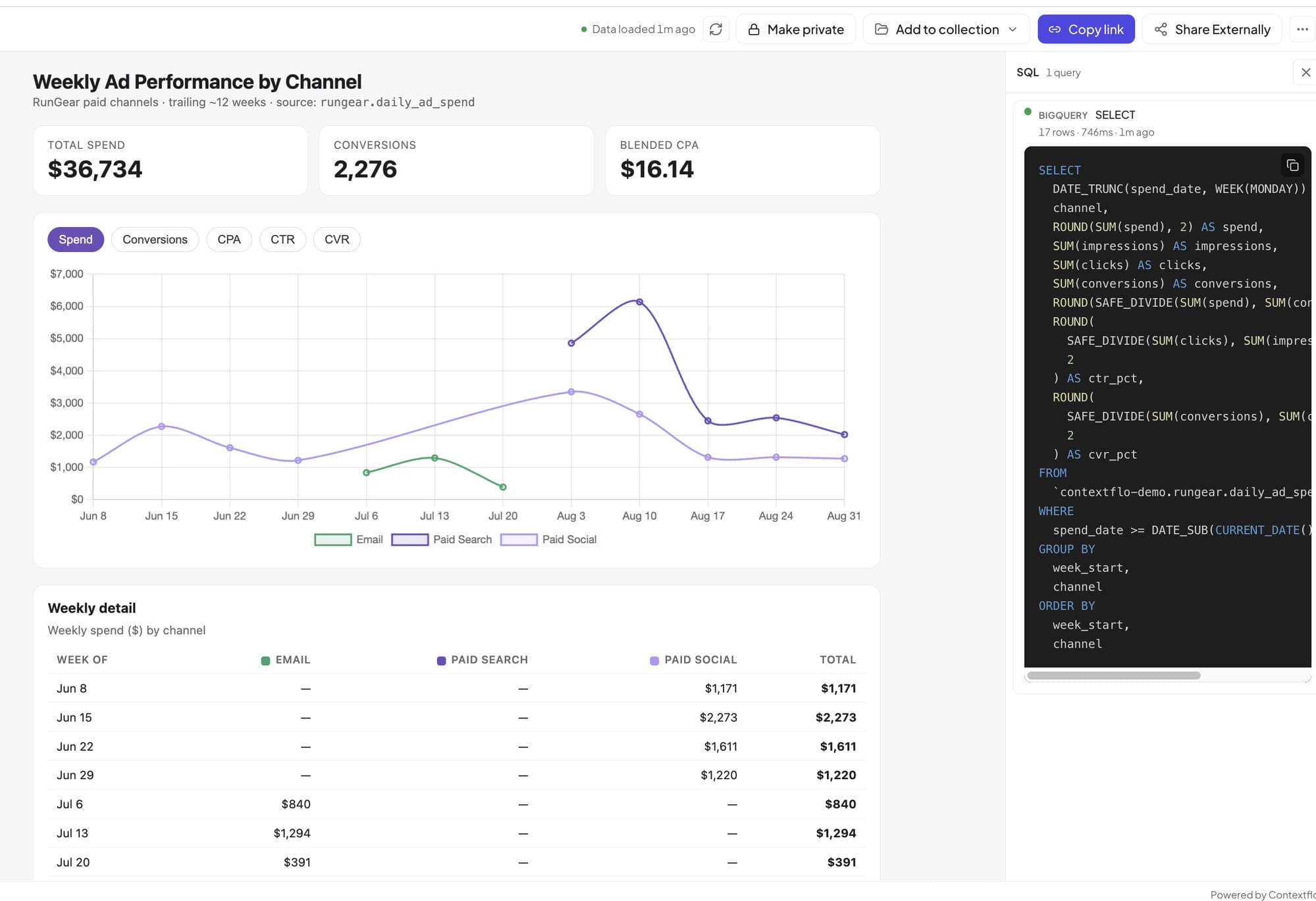
How to host and share Claude artifacts with your whole team
3 min read
The official Postgres server for Claude is archived. Here's what to use instead.
7 min read
Why is the team missing sprint goals? How to analyze Jira data with AI
8 min read