How PE funds use external data for deal sourcing and diligence
Hi, this is Vivek, building Contextflo. I share practical notes on getting answers from your data, a couple of times a month.
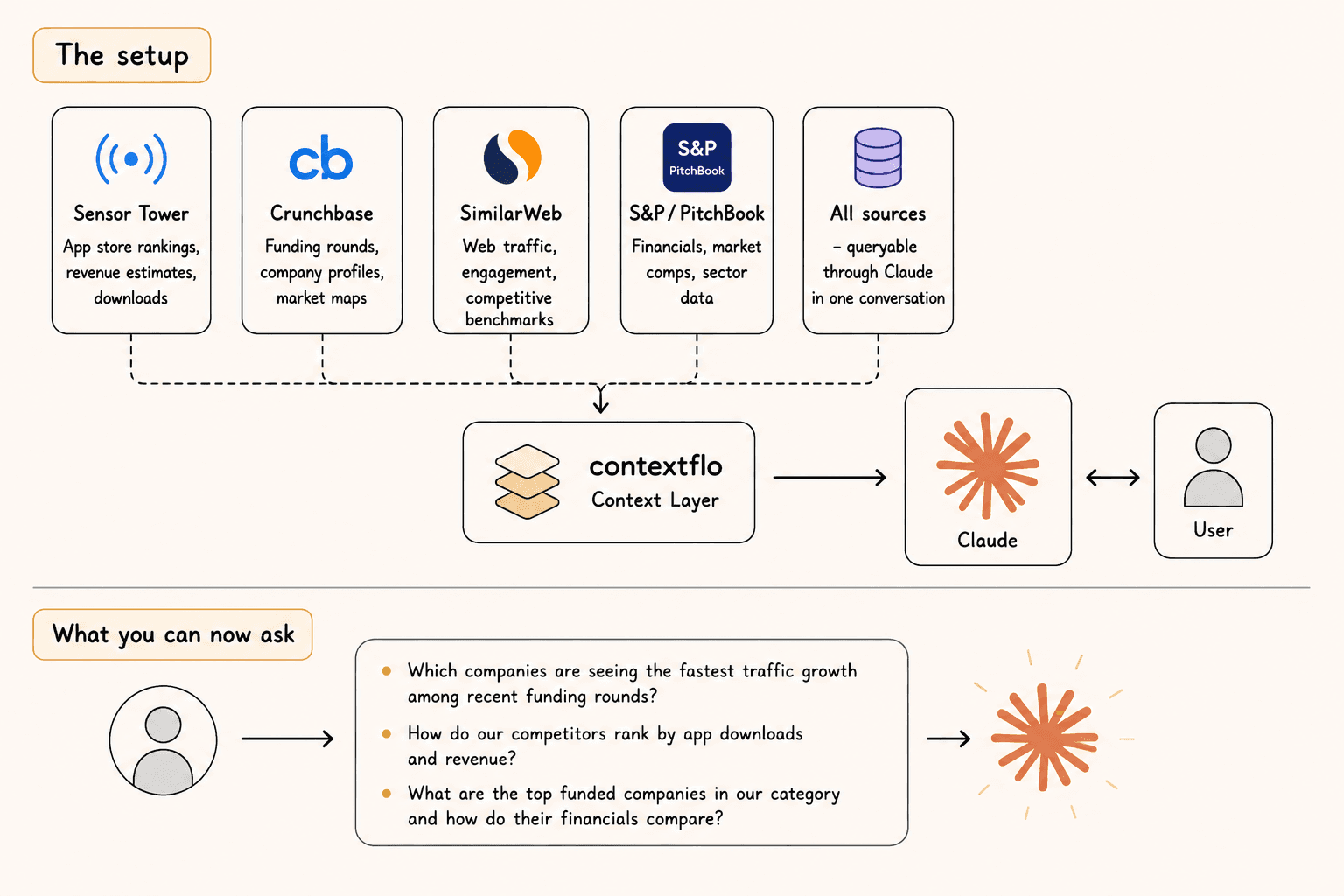
Your investment team spends hours a week pulling from Crunchbase, S&P, app store rankings and platform analytics just to decide whether a company deserves a second look. The data exists. It is scattered across a dozen external sources with no way to ask one question of all of them.

The problem
Funds run on external data. Sourcing means scanning market signals: app store ratings, revenue estimates, public financials, traffic trends. Diligence means cross-referencing those signals against each other, because any one of them can be explained away and the interesting thing is when several agree.
Today an analyst copies numbers from several platforms into a spreadsheet, builds a one-off comparison, and emails it. By the time it reaches a partner the data has moved and the reasoning behind it is gone, so the next question starts the whole process again.
The setup
- Sensor Tower → Contextflo, for app store rankings, revenue estimates and downloads
- Crunchbase → Contextflo, for funding rounds, company profiles and market maps
- SimilarWeb → Contextflo, for web traffic, engagement and competitive benchmarks
- S&P or PitchBook → Contextflo, for financials, comps and sector data
- All sources → queryable from Claude in one conversation
No warehouse and no pipelines. Each source connects directly, which matters here more than in most stacks, because none of this is your data and you would never want to be maintaining a copy of it.
What you can ask once it is connected
Which consumer apps in our pipeline have the fastest-growing app store ratings over the last six months?
Compare Sensor Tower revenue growth estimates for these five companies against their last reported ARR.
Show me every company in the pipeline operating in a category where S&P shows above-average growth.
What's the web traffic trend for Company X over the last year, and how does it compare to its top three competitors?
Estimates are estimates
Everything in this stack except the filings is modelled. Sensor Tower infers revenue from ranking data. SimilarWeb infers traffic from panels and clickstream. These are useful and they are not measurements, and the gap between the two is where diligence goes wrong.
The right way to use them is directionally and comparatively. "Is this growing faster than its three closest competitors, measured the same way" is a question the data can answer well. "What is this company's revenue" is not, and any answer you get should never reach a committee deck as a fact.
This is one place where having the sources in one conversation genuinely helps rather than just being faster. When the ranking data, the traffic data and the last reported figure all point the same way, that agreement is the signal. When they diverge, that is the actual finding, and it is the thing that never survives being copied into a spreadsheet one source at a time.
From spreadsheet diligence to live queries
The shift is from static snapshots to questions anyone on the deal team can ask. Instead of an analyst building a comparison that is correct on Tuesday, the partner asks directly and gets current data, along with the ability to immediately ask the obvious follow-up.
One of our customers is a fund where a director now queries across several external sources without writing SQL. They connected their sources and started asking, and the change was less about speed than about who is allowed to be curious.
Here is a more in-depth look at Contextflo and how it works.
What is Contextflo?
Contextflo is a governed context layer between your data and the AI your team already uses. Connect your warehouse once, and your team asks questions in their own Claude or ChatGPT. The model writes and runs the SQL; Contextflo supplies the definitions, the per-user access control, and the audit that make the answers trustworthy. Your data never moves, and you do not need a data team.
How it works
Your team queries in their own Claude or ChatGPT over MCP, so you bring any agent rather than a locked-in bot, and every answer comes back with the SQL shown and access enforced per user.
Find out if Contextflo is the right fit for you.
See how teams use Contextflo

Related posts

Keep reading
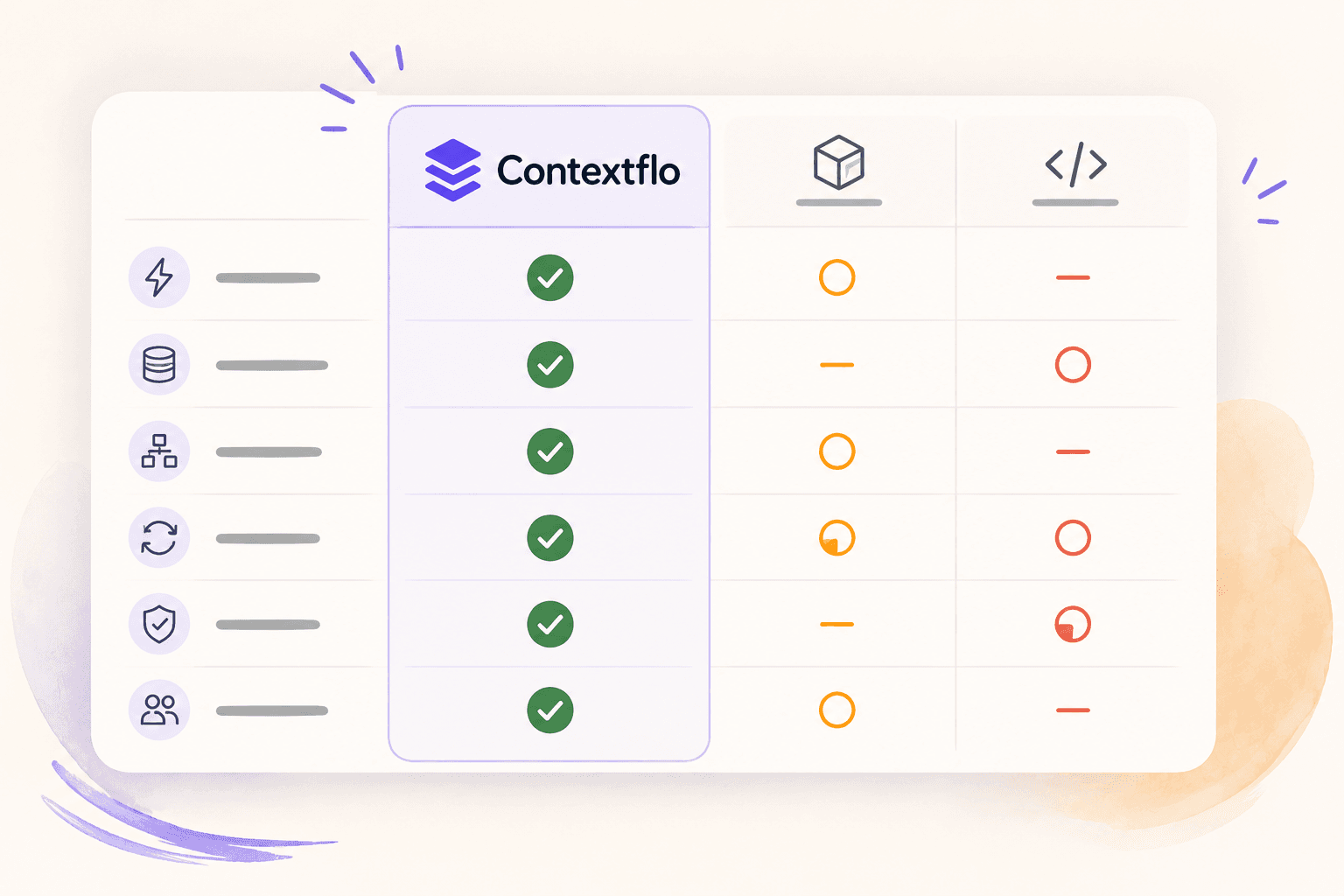
Conversational analytics: 5 ways to set it up, compared
7 min read
How to connect Claude to BigQuery? What works and what doesn't in 2026
8 min read
How to connect Claude to Postgres without giving it write access
7 min read

How to build a BI dashboard with Claude that your team can actually trust
8 min read

How to give Claude read-only access to your database (it isn't always the default)
7 min read

You connected your warehouse to Claude, now what?
5 min read

The official Postgres server for Claude is archived. Here's what to use instead.
7 min read

Why is the team missing sprint goals? How to analyze Jira data with AI
8 min read
Are my ads actually profitable? How to analyze Facebook and TikTok ads together with AI
7 min read