
The Data Challenge
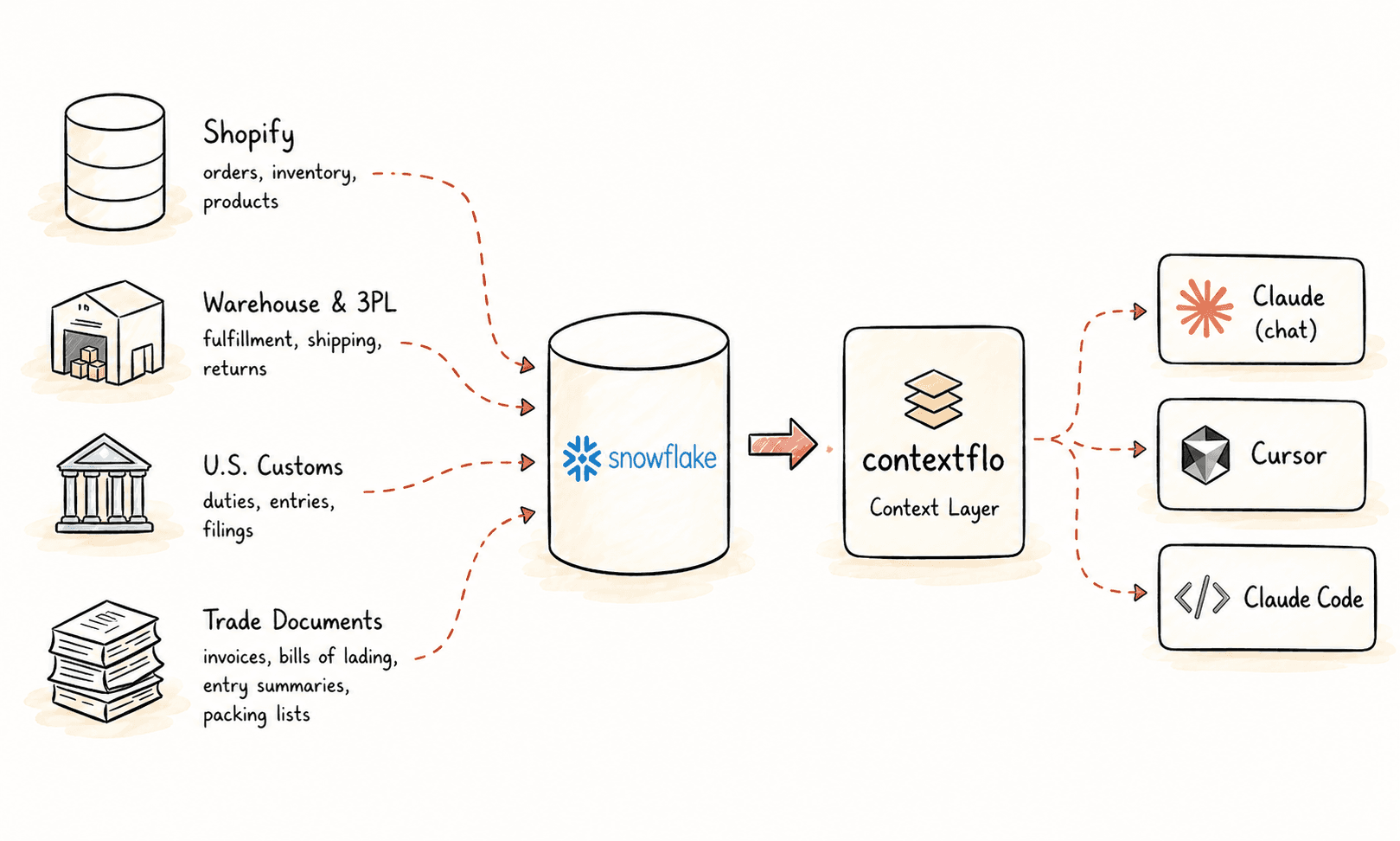
Evana consolidates merchant, logistics, customs, and trade-document data into a central analytics environment, pulling data from more than a dozen sources via APIs, PDFs, and CSVs. The data is often unstructured and varies from client to client.
Millions of rows across hundreds of tables and columns. And these aren't clean, self-explanatory tables.
Prices are sometimes stored as text, not numbers. Product information often sits inside nested JSON arrays. A single drawback eligibility check requires joining across many different source systems and filtering on specific combinations of statuses and destinations. Column names don't always tell you what they mean, and the relationships between tables are frequently unclear.
This is the kind of warehouse where even a skilled analyst needs hours just to orient themselves before writing a query.
The Bottleneck
Before Contextflo, generating reports for clients meant manually pulling CSVs from Snowflake, trimming them down, and uploading them to Claude's chat interface to get analysis. Questions like "how much drawback-eligible duty did this merchant pay last quarter?" or "which SKUs have the highest recovery potential?" required manual analysis and deep domain expertise, making them slow to answer consistently.
~20 hours per week was spent on data wrangling. And even then, Claude chat has upload limits. You can only paste so much context into a conversation. For a company managing a growing book of merchant accounts across multiple data sources, that ceiling hits fast.
The core issue wasn't intelligence. Claude could do the analysis. It was access. The AI couldn't see the data directly.
The Unlock
Contextflo connected Claude to Evana's Snowflake in minutes.
The setup: point Contextflo at the warehouse, sync the tables, connect Claude. That's it.
Contextflo adds context around each table: what the columns mean, how they relate to each other, what quirks to watch out for. So when someone asks Claude a question, it's not guessing at the data. It knows.
What Changed
Before: A team member compiles CSVs → uploads to Claude chat → gets partial analysis → repeats for next question
After: Anyone on the team opens Claude → asks a question → gets the answer with live data
The kinds of questions that used to take hours of manual work:
- •"How many documents did our review team process this week, and who reviewed what?"
- •"Which clients have the most drawback-eligible orders right now?"
- •"Do the warehouse shipment records match what Shopify says was fulfilled?"
- •"What's the total duty paid on imports for this merchant last quarter?"
These aren't pre-built dashboards. They're ad-hoc questions, different every time, that would have previously required someone to write SQL, pull exports, or spend hours assembling CSVs.
The Impact
Afternoons → seconds: Questions that took an afternoon now take seconds.
Anyone can talk to data: Insights are no longer limited to a small number of technical team members. Everyone with Claude access can query the data directly. Operations and client-facing teams can access relevant insights without relying on a technical analyst.
0 data hires needed: Evana manages a growing number of merchants, each with complex multi-source data. Before Contextflo, scaling meant either hiring a data team or relying on senior technical staff for recurring analysis. Now the data layer scales with the business.
More time on the work that matters: Less time compiling CSVs, more time acting on what the data says, more confidence in the output. Identifying high-recovery clients, catching filing errors, spotting patterns across merchants.