Omni Analytics Alternatives: Pick the Shape Before the Logo
Hi, this is Vivek, building Contextflo. I share practical notes on getting answers from your data, a couple of times a month.

The teams typing "Omni alternatives" want one of two things. Some want a lighter, faster BI platform than Omni. More and more do not want a dashboard platform at all: they want answers in the Claude or ChatGPT they already use, grounded in their own data. This post maps both, with what each option actually costs you.
Where the Omni details come from. Everything here about Omni comes from their public docs. Hands-on access goes through a sales call, so you can't try it before talking to them, and neither could we. The Contextflo side you can check yourself in 10 minutes.

What Omni is
Omni is a modern BI platform. The team came out of Looker, and it shows: the product is built around a governed semantic model, the idea that your metrics live in one central definition so revenue means the same thing on every chart. You model your data once and everyone's dashboards inherit that model. If you have people whose job is to build and maintain that model, Omni is a strong pick.
The catch is the same catch every real BI platform has. Someone has to build the semantic model, and someone has to keep it alive as your data changes. Pricing is sales-led and enterprise-shaped, and standing the thing up is measured in weeks and months, not an afternoon.
Here's what that looks like in practice. This is a real job posting from a company running Omni: a 6-month contract-to-hire BI Platform Engineer to "own and administer the Omni platform" and "design and optimize scalable semantic data models and topics within Omni."
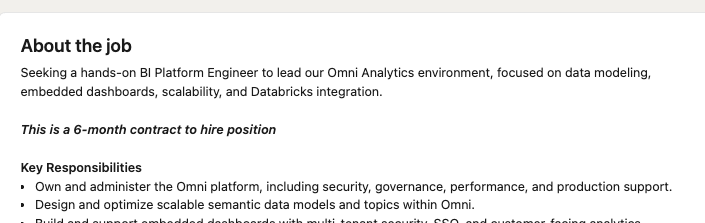
For a company with a data function and the budget for it, that's a sensible hire. For a small team on a tight budget, it's a lot to take on before anyone gets an answer.
None of that is a problem if a maintained semantic model is what you want. It becomes a problem if you would rather not spend the next few months standing one up, which is why a lot of people go looking for alternatives in the first place.
The real fork: a platform to maintain, or answers where you work
Before you compare logos, get one decision straight, because everything else follows from it: do you want a dashboard platform your team maintains, or do you want answers in the tools your team already uses?
A dashboard platform is the right shape when you need governed reporting that finance and the board will trust, with a shared semantic model, permissions and versioned metrics. Omni fits here. So do Looker and Sigma. If that is what you are buying, buy one of them.
The other shape is newer. Instead of building and maintaining a modelling layer so people can open dashboards, you connect your data to Claude or ChatGPT and ask. The context the model needs is generated from your schema, code and docs rather than hand-written and kept alive by someone. You give up the pixel-perfect governed board deck. You get answers the same week, in the tool people already have open.
Neither shape is the small-team option or the enterprise option. It is a question of what you want to own. Everything below hangs off which one you picked.
If you want the Omni-class thing
Say you have decided you do need a full platform. Good. Omni is not the only one, and depending on your stack another might fit better.
Looker is the incumbent Omni was reacting to. Google-owned, deeply enterprise, built on its own modelling language. Heavy, powerful, and a real commitment. If you are already deep in Google Cloud it is a natural look.
Sigma takes a different angle: spreadsheet-style analysis running directly on your cloud warehouse. Teams that live in spreadsheets and do not want to learn a modelling language tend to like it. Worth a demo if that is your crowd.
Hex is more of a notebook-style workspace, aimed at analysts who want to mix SQL, Python and narrative in one place. It leans toward people who can code a little, which is either exactly what you want or exactly what you do not.
Metabase is the one I would point budget-conscious teams at. It has an open-source edition you can self-host, plus a paid cloud version if you do not want to run it yourself. It is the cheapest entry into real self-serve dashboards, and for a lot of teams it is plenty. If someone tells you you must spend enterprise money to get dashboards, Metabase is the counterexample.
That is the BI-platform shortlist. Demo the two that sound right.
If you want answers in Claude or ChatGPT
Now the other shape, which is the reason Contextflo exists.
Contextflo connects Claude or ChatGPT to your data (warehouses like BigQuery, Snowflake, Redshift, Databricks or Postgres, plus SaaS sources and CSVs you upload) through MCP. You ask in plain language, the model writes and runs real SQL against your data, and the answer comes back in the chat with the query shown so you can check it. No dashboard to maintain, no modelling language to learn.
The part people do not expect is the context. Every BI tool needs some version of a semantic layer so the machine knows that rev_usd is revenue and which table joins to which. In Omni you build and maintain that by hand. Contextflo generates it from your schema, your source code and your docs, so you are not writing YAML to explain your own database to a tool. Setup runs about ten minutes.
It is not a thinner BI tool with the governance stripped out. It does the jobs you actually open a BI tool for: dashboards, scheduled reports, governed metric definitions, and access control where admins set which schemas and tables each person or group can query, with every query attributed to a user and logged. What it adds is the part a dashboard tool cannot, asking across your whole stack in the AI your team already uses. Team pricing is $75 per user per month for unlimited queries, on the pricing page, with no usage meter running while your team explores.
Where Omni is the better call: a finance team that needs one blessed, versioned definition of every metric on a board deck. That is what a hand-governed semantic model is for. Where Contextflo is the better call: you want answers across your whole stack this week, in the tool your team already uses, without standing up and babysitting a modelling layer first.
If you want the head-to-head, I wrote up Omni vs Contextflo, and Cube vs dbt vs Contextflo for the semantic-layer angle.
How to actually choose
Skip the feature matrix. Answer two questions.
What do you want to maintain? If you want a governed model your team owns and keeps alive, you are shopping for a platform. Look hard at Omni, Looker and Sigma, and if budget is tight, start with Metabase and move up when it hurts. If you would rather not maintain a modelling layer at all, an AI-analytics layer answers the same questions without one.
Where do you want the answer to show up? In a dashboard someone opens, or in the Claude or ChatGPT window your team already has open. Metabase and Sigma are the gentlest on-ramps to the first. Contextflo is built for the second.
If you are not sure, start with the cheaper or faster option. It is far easier to graduate from Metabase or Contextflo into Omni later than to unwind a six-month enterprise BI rollout you did not need.
FAQ
What's the cheapest Omni alternative? On the BI side, Metabase's open-source edition is the cheapest real option, since you can self-host it. If you don't want a dashboard platform at all and just want to ask questions of your data in Claude or ChatGPT, Contextflo starts at $75 per user per month for unlimited queries.
Do I need a data team to replace Omni? It depends on what you replace it with. Omni, Looker, and Sigma assume someone will build and maintain a semantic model. Contextflo generates that context layer automatically from your schema, code, and docs, so you can set it up in about ten minutes instead of running a modelling project.
Is Contextflo a full BI platform like Omni? Not in the pixel-perfect-dashboard sense, and for most questions that is the point. Contextflo gives you governed, access-controlled answers in Claude or ChatGPT, with dashboards and scheduled reports when you want them. Omni is the better fit when a finance team needs one blessed, versioned definition of every metric on a board deck.
When should I pick Omni over the alternatives? When you have a data team, need a governed semantic model that finance and the board will trust, and want deep, versioned enterprise reporting. That's what Omni is built for, and it's good at it.
Whichever way you go, the expensive mistake is the same one: buying a platform because it looked complete, then watching it gather dust because nobody had time to configure it. Pick the tool that matches how your team actually wants to get answers.
Here is a more in-depth look at Contextflo and how it works.
What is Contextflo?
Contextflo is a governed context layer between your data and the AI your team already uses. Connect your warehouse once, and your team asks questions in their own Claude or ChatGPT. The model writes and runs the SQL; Contextflo supplies the definitions, the per-user access control, and the audit that make the answers trustworthy. Your data never moves, and you do not need a data team.
How it works
Your team queries in their own Claude or ChatGPT over MCP, so you bring any agent rather than a locked-in bot, and every answer comes back with the SQL shown and access enforced per user.
See it on your own data.
Connect your warehouse and your team can ask Claude about it the same day, without waiting on a data team. Want a walkthrough first? Grab 20 minutes.
Book a 20-minute callSee how teams use Contextflo
Related posts

Keep reading
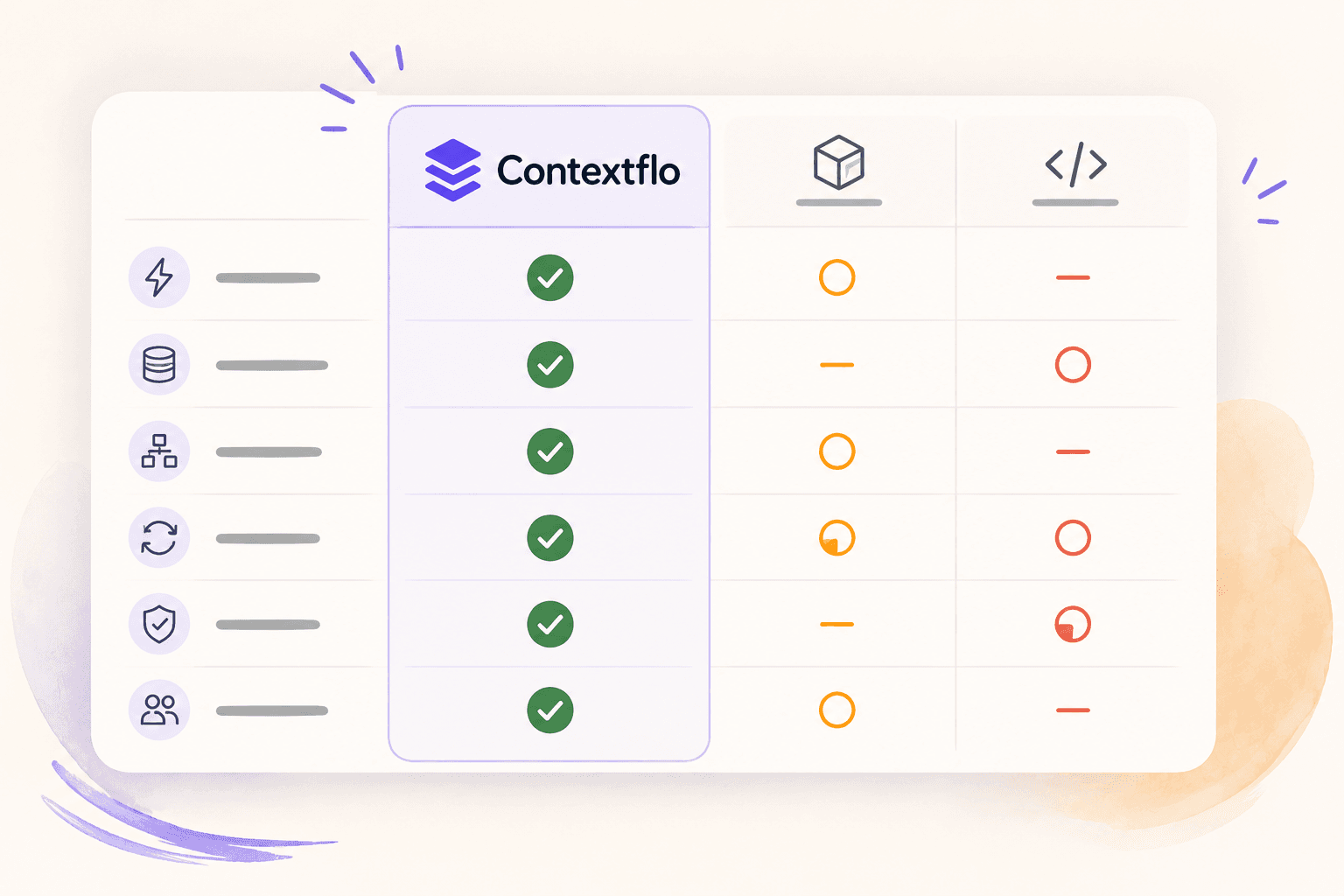
Conversational analytics: 5 ways to set it up, compared
7 min read
How to connect Claude to BigQuery? What works and what doesn't in 2026
8 min read
How to connect Claude to Postgres without giving it write access
9 min read

How to build a BI dashboard with Claude that your team can actually trust
8 min read
How to give Claude read-only access to your database (it isn't always the default)
7 min read

You connected your warehouse to Claude, now what?
5 min read
How to use Claude to identify user fraud
6 min read
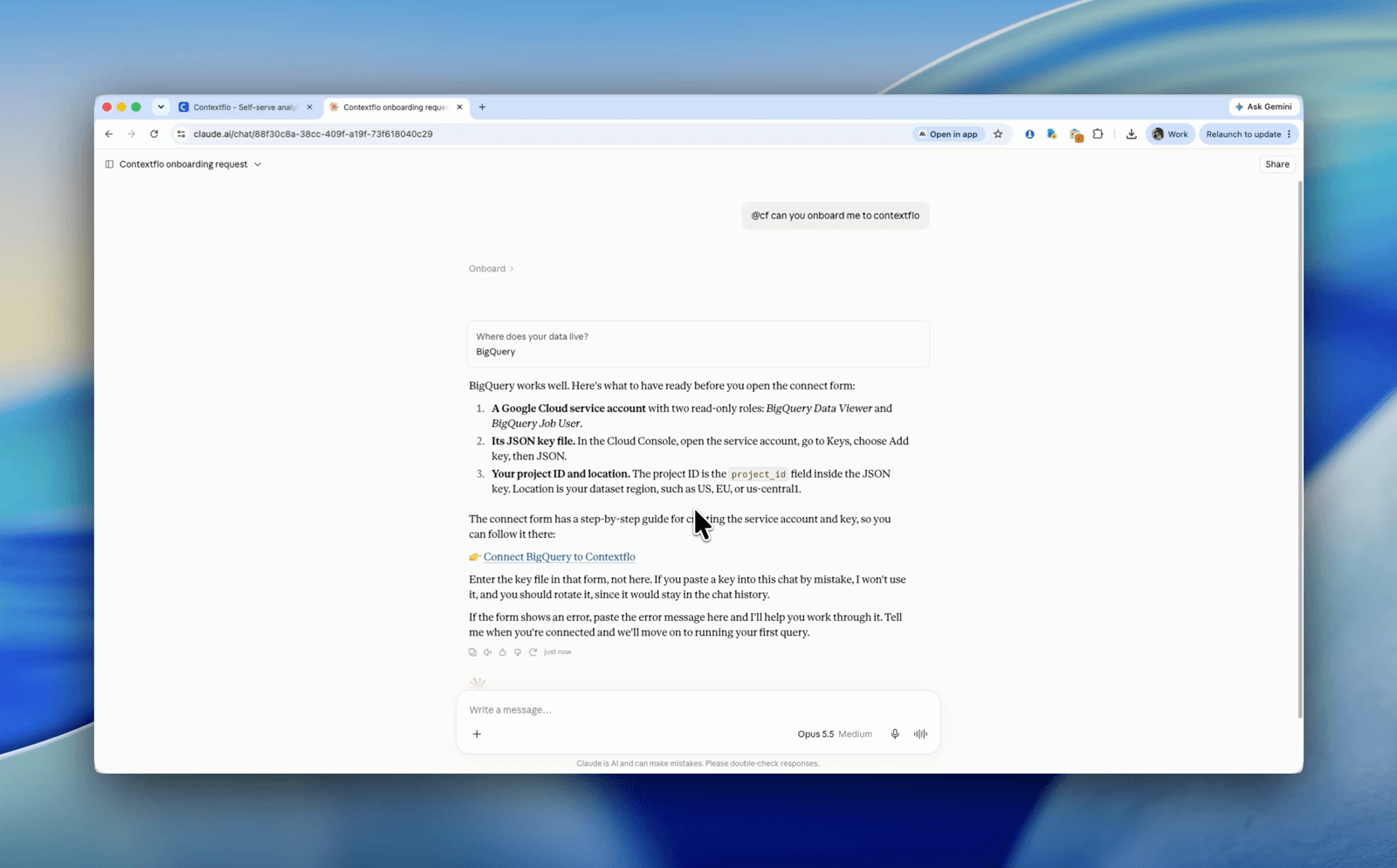
Set up Contextflo from inside Claude: onboarding is now a conversation
3 min read
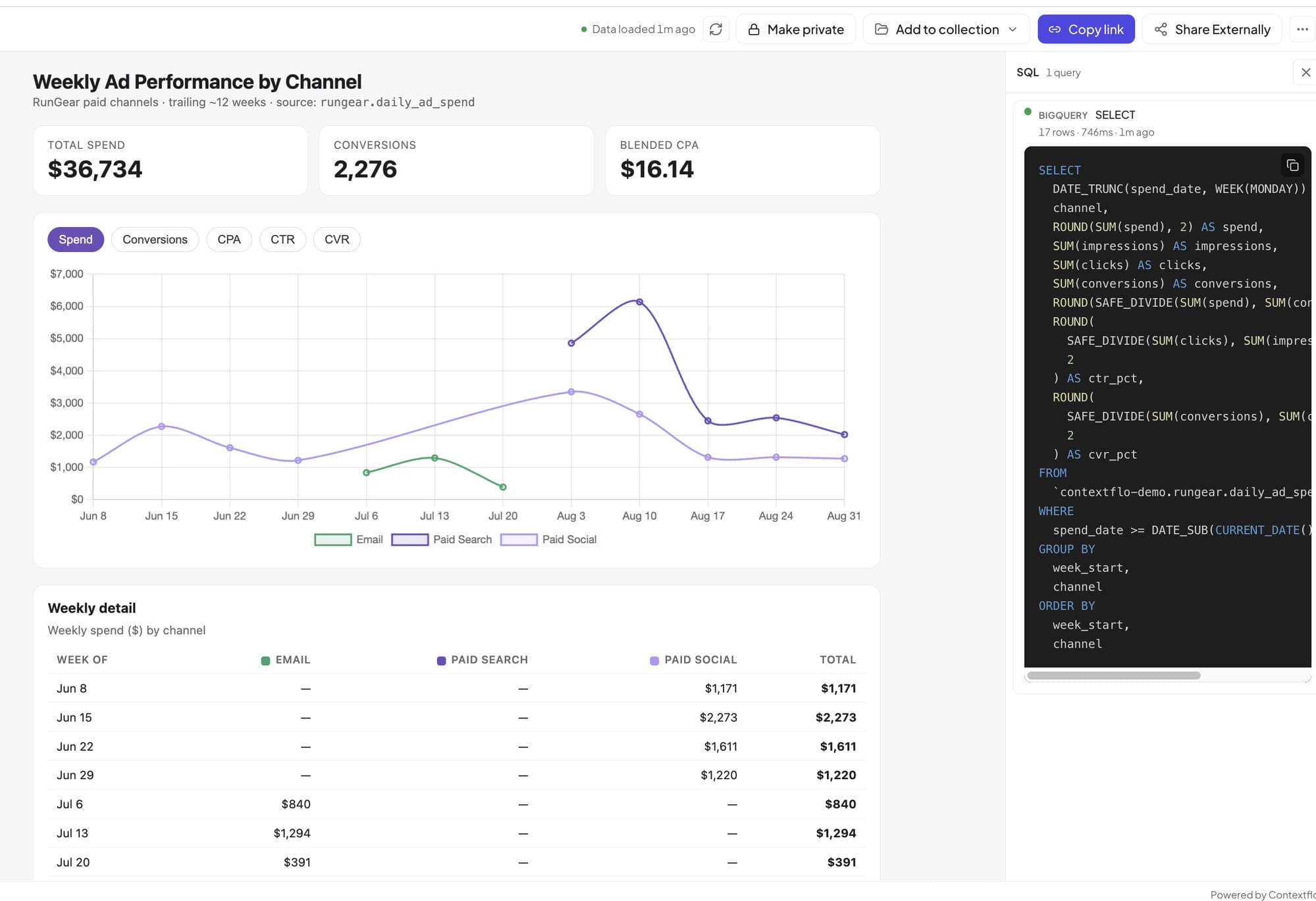
How to host and share Claude artifacts with your whole team
3 min read