Omni vs Contextflo, After Using Both
Hi, this is Vivek, building Contextflo. I share practical notes on getting answers from your data, a couple of times a month.
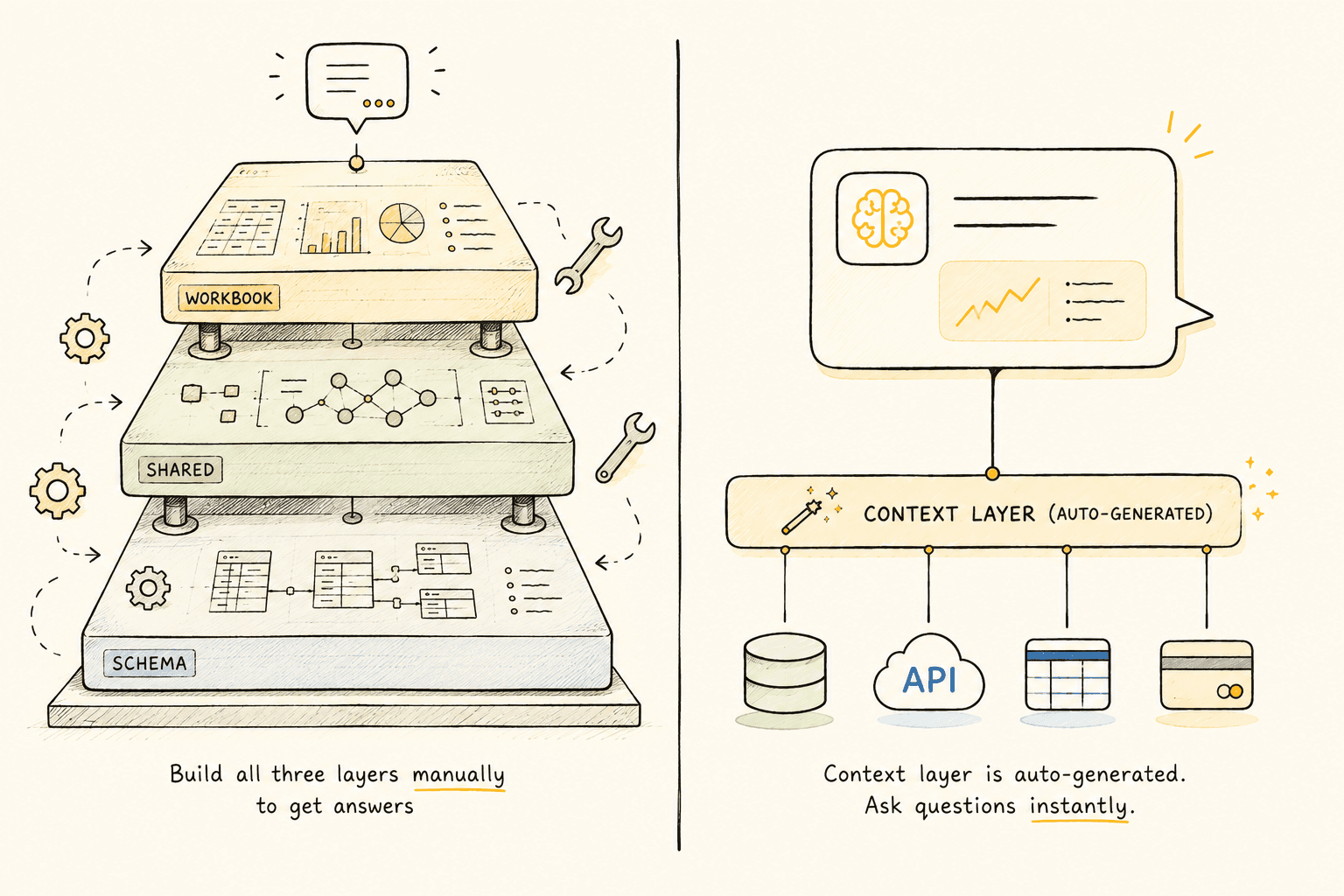
Omni is a $1.5B BI platform built by ex-Looker executives. Contextflo does the jobs teams open a BI tool for, dashboards, scheduled reports, governed metrics, and table-level access control, and adds the part a dashboard cannot: your team asks in the Claude or ChatGPT they already use, across your whole stack. Both are real options if you are shopping to replace Omni, so here is where each one fits.
What Omni is
Omni is a modern BI platform that replaces Looker and Tableau. You get dashboards, workbooks, SQL, spreadsheet-style formulas and an AI assistant, all grounded in a governed semantic model. It raised $120M in April 2026 and is built for enterprise teams replacing legacy BI.
Omni's AI uses Claude via AWS Bedrock and is grounded in a three-layer semantic model: Schema, which mirrors your database; Shared, for governed global metrics; and Workbook, an ad-hoc sandbox. You can also query Omni's governed data from external tools like Claude, ChatGPT and Cursor through their MCP server.
The catch is that someone has to build that semantic model. From people who have implemented it, that takes months and dedicated resources. Omni does not publish pricing; it is custom enterprise quotes.
What Contextflo is
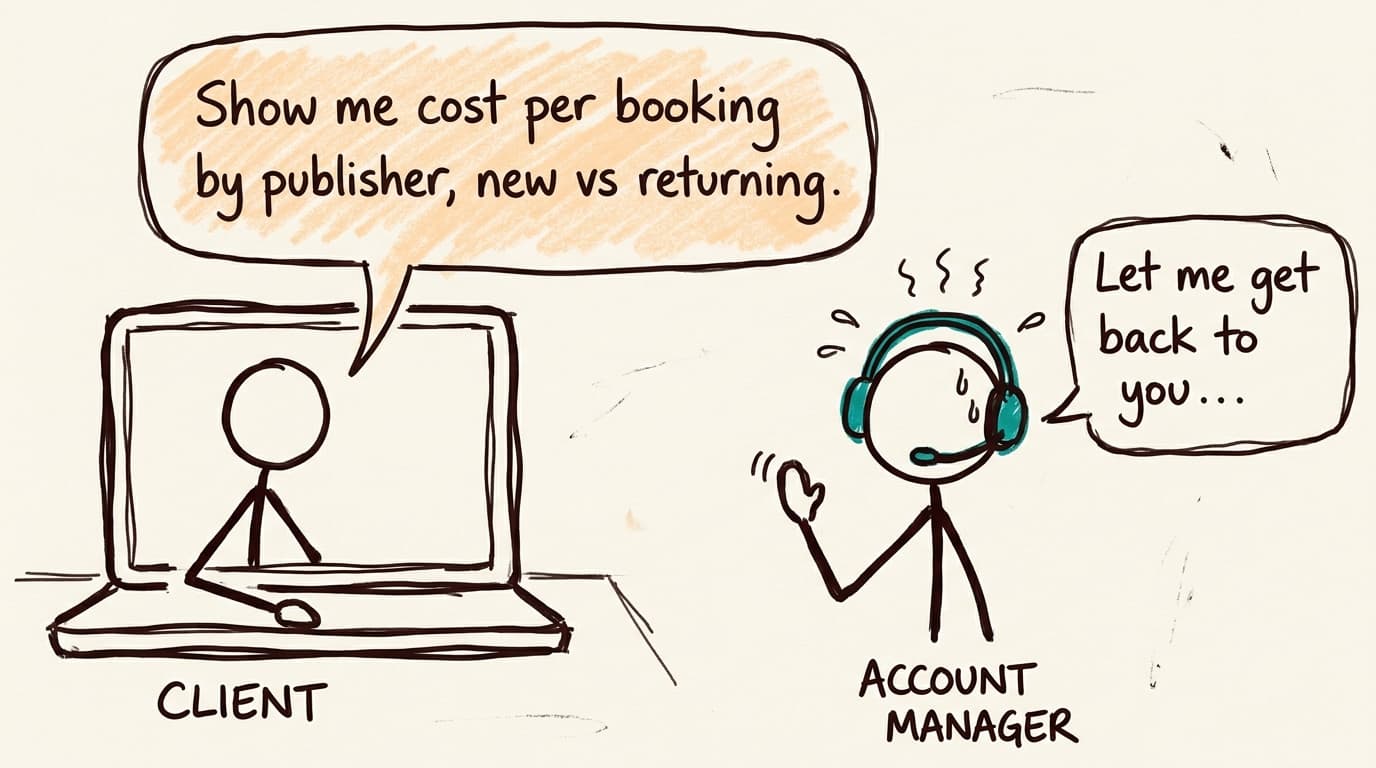
Contextflo does what teams actually use a BI tool for and puts an agent on top of it. You get dashboards, scheduled reports, governed metric definitions, and access control at the table level, with every query attributed to a user and logged. What it adds is the part a dashboard tool cannot: anyone on your team asks questions in plain English, in the Claude or ChatGPT they already have open, and the answer comes back with the SQL shown so you can check it.
There is no semantic model to build. Contextflo generates table relationships, column descriptions and metric definitions from your schema. Setup takes about ten minutes. Pricing starts at $75 per user per month, flat, with no per-query charges.

The core difference: what it takes to get started
| Omni | Contextflo | |
|---|---|---|
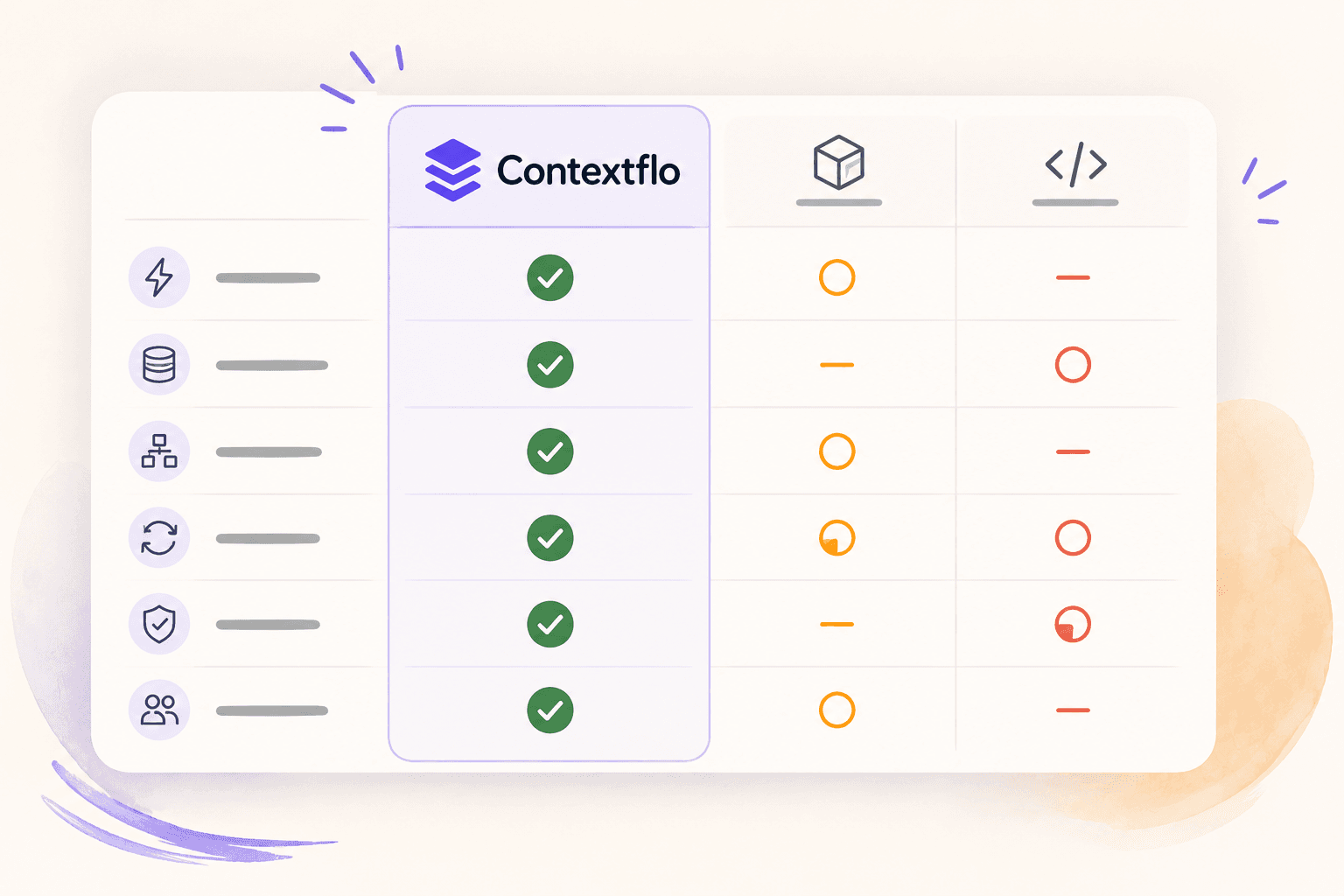
| What it is | Full BI platform, replaces Looker/Tableau | An AI analytics tool: dashboards, reports, governed metrics, and answers in your own Claude/ChatGPT |
| Setup time | Weeks to months (semantic model implementation) | ~10 minutes (context generated) |
| Needs a data team? | Yes, to build and govern the three-layer semantic model | No |
| Data sources | Warehouse-centric, ETL everything in first | Warehouses plus APIs (Stripe, Amplitude, GA, HubSpot) in one conversation |
| AI model | Claude via AWS Bedrock, plus a BYOM option | Connects to your own Claude subscription |
| What you get | Dashboards, workbooks, SQL, governed reporting | Answers to questions, plus dashboards and reports if you want them |
| Pricing | Custom enterprise quotes, no public pricing | From $75/user/mo, unlimited queries |
Omni's AI is good, if you build the foundation first
Omni's AI assistant is genuinely well-built. Because it is grounded in a semantic model, the answers are governed and consistent, close to what a trained analyst would produce. You can even query Omni data from Claude and ChatGPT externally.
The question is whether you can afford to wait months and dedicate people to building that foundation. For an enterprise team with data engineers replacing Looker, that investment makes sense and pays back. For a 20-person startup that needs an answer this week, it does not.
The one place a hand-built semantic model genuinely earns its keep is the finance-signed-off board deck, where every metric needs one blessed, versioned definition and no ambiguity. Contextflo generates its context from your schema, code, and docs, and that generated context is a draft a person reviews before it carries a number that consequential. For the everyday questions a team asks in a week, that draft is ready the same day and nobody has to hand-write it.
When to use Omni
- You are an enterprise replacing Looker or Tableau and want a modern alternative
- You have a data team that can implement and maintain the semantic model
- You need a versioned, finance-signed-off semantic model the board will trust
- You have months and budget for a proper BI implementation
When to use Contextflo
- You need answers from your data this week, not in three months
- You want the dashboards and governed reporting without a months-long modelling project first, whether or not you have a data team
- You want to query across several sources without ETL-ing everything first
- You want pricing you can budget for rather than "contact sales"
At Tilt, a live-auction marketplace, the team connected their warehouse and started asking questions the same day. Most of the company now self-serves, running around 6,000 queries a month. No semantic model, no implementation project, no data team.
Can you use both?
Yes, though most teams find they do not need to. If you already run Omni for finance's versioned board deck, Contextflo covers everything else: the dashboards, the scheduled reports, and the ad-hoc questions nobody built a dashboard for, all answerable in the Claude or ChatGPT your team already uses. If you are starting fresh, Contextflo does the BI jobs and the agent layer together, so there is one less platform to stand up.
Here is a more in-depth look at Contextflo and how it works.
What is Contextflo?
Contextflo is a governed context layer between your data and the AI your team already uses. Connect your warehouse once, and your team asks questions in their own Claude or ChatGPT. The model writes and runs the SQL; Contextflo supplies the definitions, the per-user access control, and the audit that make the answers trustworthy. Your data never moves, and you do not need a data team.
How it works
Your team queries in their own Claude or ChatGPT over MCP, so you bring any agent rather than a locked-in bot, and every answer comes back with the SQL shown and access enforced per user.
Find out if Contextflo is the right fit for you.
See how teams use Contextflo
Related posts

Keep reading
Conversational analytics: 5 ways to set it up, compared
7 min read
How to connect Claude to BigQuery? What works and what doesn't in 2026
8 min read
How to connect Claude to Postgres without giving it write access
7 min read

How to build a BI dashboard with Claude that your team can actually trust
8 min read
How to give Claude read-only access to your database (it isn't always the default)
7 min read

You connected your warehouse to Claude, now what?
5 min read
The official Postgres server for Claude is archived. Here's what to use instead.
7 min read
Why is the team missing sprint goals? How to analyze Jira data with AI
8 min read
Are my ads actually profitable? How to analyze Facebook and TikTok ads together with AI
7 min read