DIY MCP server vs Contextflo for teams
Hi, this is Vivek, building Contextflo. I share practical notes on getting answers from your data, a couple of times a month.

A local MCP server answers one question: can Claude reach the database?
That is a real question, and open-source MCP servers answer it well. There are solid ones for Postgres, BigQuery, Snowflake and just about every database that matters. If you are one technical person exploring your own data, install one and you are done. You do not need Contextflo.
But if you are evaluating this for a team, the connector is answering the wrong question. The ones that matter for a team are:
- Who is asking?
- What are they allowed to see?
- What context should the model use?
- What query actually ran?
- How do admins control any of this?
A connector has no opinion on any of them. Here is each gap, what building it yourself looks like, and where the honest build-vs-buy line sits.
What a DIY MCP setup looks like
The standard pattern: each person installs an MCP server locally, configures it with a database connection string, and points Claude or ChatGPT at it.
Each laptop: AI tool -> local MCP server -> database
It works. Everyone has a working connection in ten minutes. Now walk through what is missing.
Gap 1: identity
With a shared connection string, the database sees one user: the MCP role. It cannot tell your CFO from your intern from a contractor whose laptop was stolen last week.
Building it yourself means separate database users per person, credential distribution, a rotation policy, and an offboarding process. Postgres makes this possible. Nobody enjoys maintaining it, and it gets worse with every database you add.
Gap 2: permissions
Everyone with the connection string queries every table the role can see. There is no concept of marketing seeing campaign tables but not payroll.
You can build this with database-level grants per group, or views that pre-filter sensitive columns, replicated across every schema change. It is real work that somebody owns forever. In practice most teams skip it and hope nobody asks the wrong question.
Gap 3: context
The connector hands the model your raw schema. Table names like usr_acct and columns like amt_net. The model guesses what they mean, and two people asking the same question get different guesses.
The DIY answer is a shared prompt document describing tables, metrics and business rules, then maintaining it through every schema change, and making sure all ten people paste the same current version into every conversation.
This is the gap teams underestimate most, because it is invisible until a wrong number shows up in a decision. The other four announce themselves. This one does not.
Gap 4: audit trail
No log of who asked what, what SQL ran, or what came back. When someone makes a call based on an AI-generated number, there is no way to trace how that number was produced.
Building it yourself means query-logging middleware between the MCP server and the database, storage, and some way to search it. Feasible, but you are now building an internal product.
Gap 5: admin workflows
Someone joins: they need setup instructions, credentials and the context doc. Someone leaves: rotate the shared password everywhere. Schema changes: update every laptop's mental model. Database migration: every person edits their config.
Building it yourself is hardest here, because there is no single system to build. It is operational glue, and it lands on whoever set the thing up.
Side by side
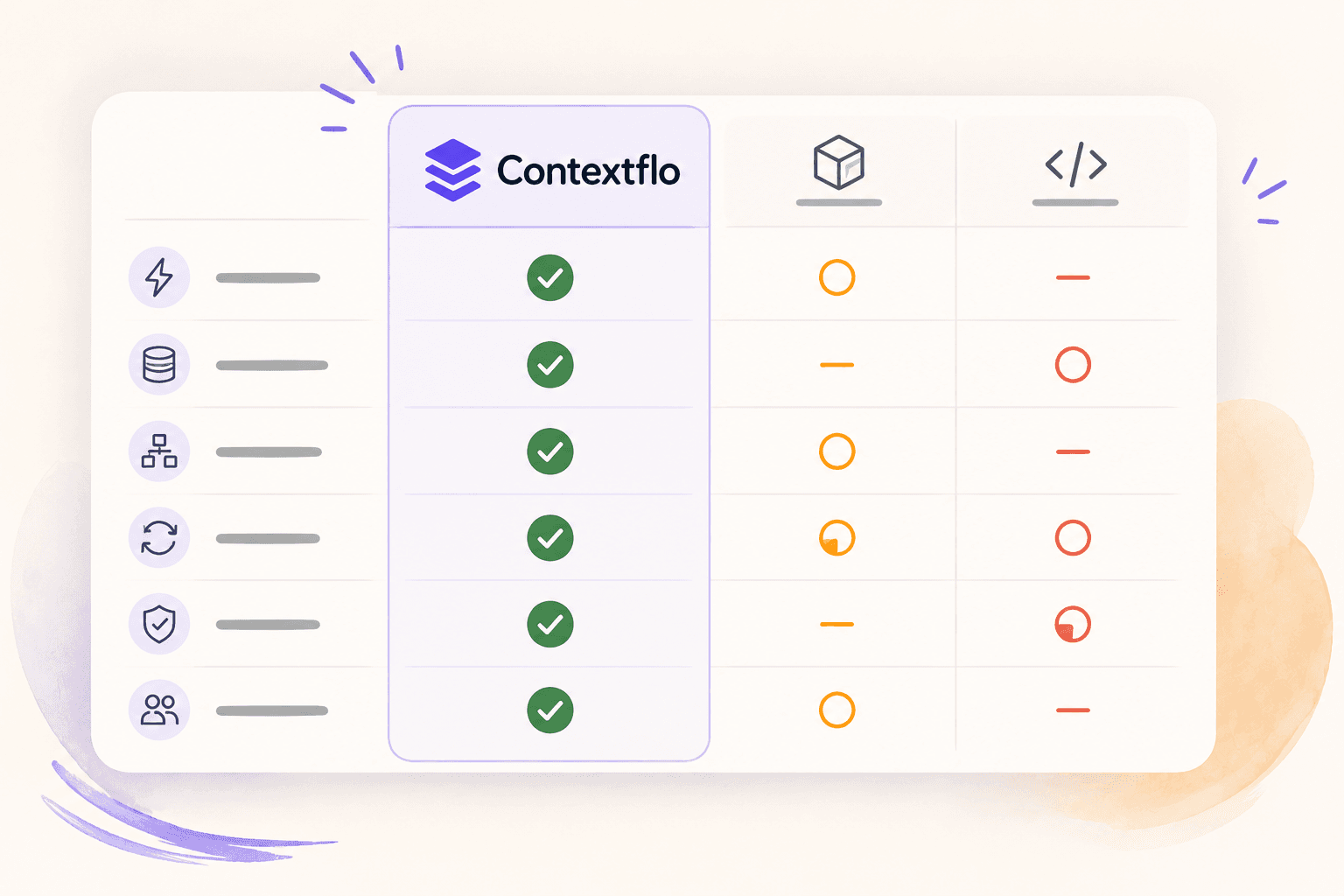
| DIY MCP server | Contextflo | |
|---|---|---|
| Time to first query | ~10 minutes | ~15 minutes |
| Who it identifies | One shared role | Each individual user |
| Table permissions | DB grants you maintain | Per-user/group scoping in the app |
| Business context | Each person's own notes | Generated once, shared, stays in sync |
| Metric definitions | The model guesses | Defined once by the data team |
| Query logs | None | Every question and query |
| Credentials | On every laptop | Centralised, never exposed |
| Offboarding | Rotate shared secrets | Revoke one account |
| Cost | Free, plus your time | Free tier; team plans from $75/user/mo |
The last row matters. DIY is free the way hosting your own email is free. The connector costs nothing; the identity layer, permission model, context maintenance and audit logging cost your team's time indefinitely.
When DIY is the right call
There are real cases where I would tell you not to use us:
- One technical user. All five gaps are about teams. Solo, they mostly do not exist.
- A short-lived prototype. If it gets thrown away next month, do not buy infrastructure for it.
- A genuinely non-sensitive database. Public datasets, test data, toy projects.
- You want to learn how MCP works. Building a connector is a good weekend project and we would encourage it.
When it isn't
The moment any of these becomes true, the DIY setup starts accruing risk faster than it saves money:
- A second person wants access
- The answers feed real decisions
- The database holds customer data, financials, or anything you would mind leaking
- Someone asks "wait, who ran that query?" and there is no answer
The build-vs-buy math
A capable engineer can build identity, permissions, context management and logging around an MCP server. We estimate a quarter for a rough version, and a permanent maintenance tax after that, because schemas change, people join and leave, and definitions drift.
For a platform team at a 500-person company, building might well be right: you have the people, and you probably have opinions about how it should work. For a team where the data platform is one engineer who also ships product, that quarter is better spent on the product.
That is the gap we fill: the team layer around AI data access, without the internal-product project.
Here is a more in-depth look at Contextflo and how it works.
What is Contextflo?
Contextflo is a governed context layer between your data and the AI your team already uses. Connect your warehouse once, and your team asks questions in their own Claude or ChatGPT. The model writes and runs the SQL; Contextflo supplies the definitions, the per-user access control, and the audit that make the answers trustworthy. Your data never moves, and you do not need a data team.
How it works
Your team queries in their own Claude or ChatGPT over MCP, so you bring any agent rather than a locked-in bot, and every answer comes back with the SQL shown and access enforced per user.
Find out if Contextflo is the right fit for you.
See how teams use Contextflo

Related posts
Keep reading
Conversational analytics: 5 ways to set it up, compared
7 min read
How to connect Claude to BigQuery? What works and what doesn't in 2026
8 min read
How to connect Claude to Postgres without giving it write access
7 min read

How to build a BI dashboard with Claude that your team can actually trust
8 min read
How to give Claude read-only access to your database (it isn't always the default)
7 min read
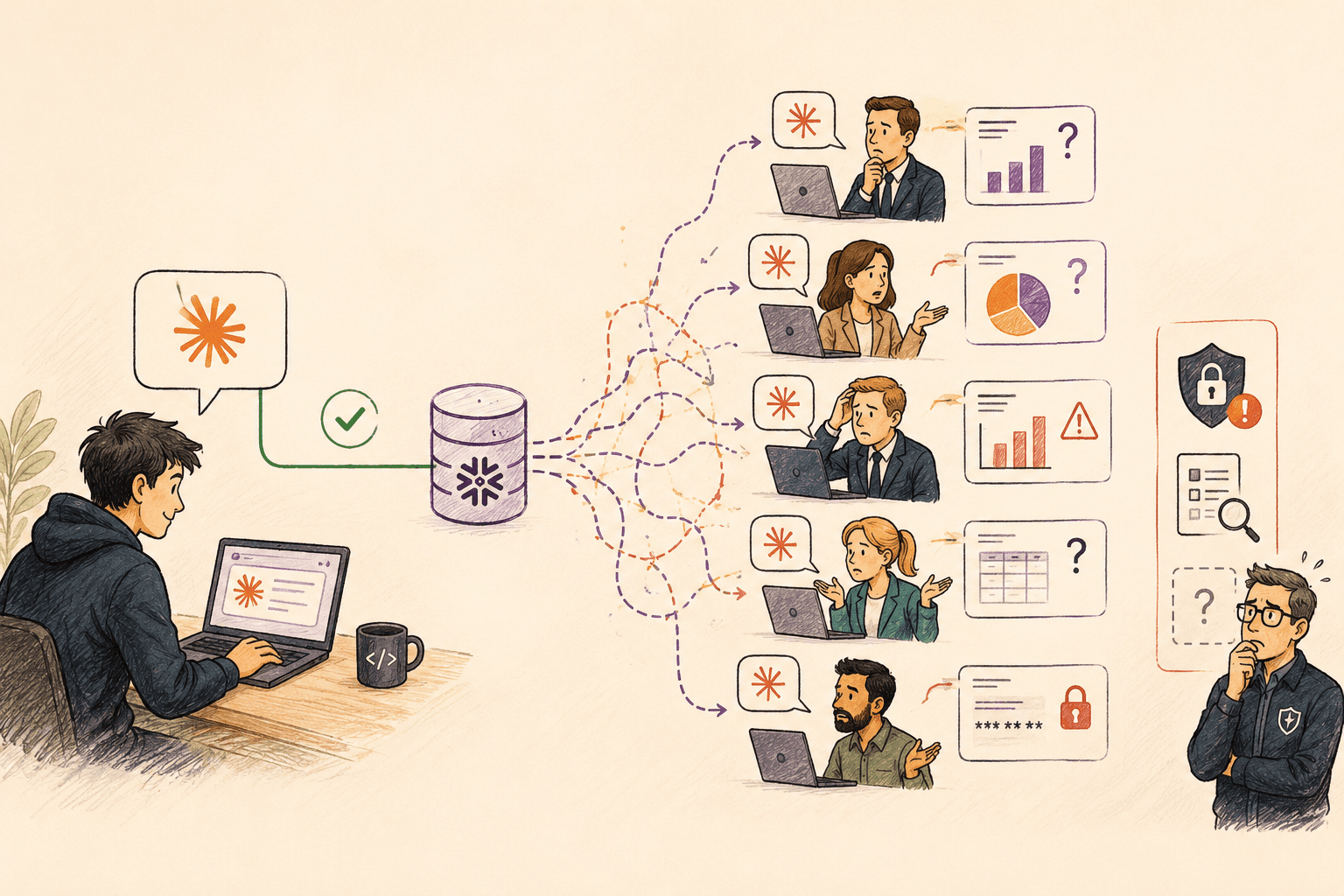
You connected your warehouse to Claude, now what?
5 min read
Why is the team missing sprint goals? How to analyze Jira data with AI
8 min read
Are my ads actually profitable? How to analyze Facebook and TikTok ads together with AI
7 min read
Still building the weekly KPI report by hand? How to automate it with Claude
7 min read