Hex vs Contextflo: I Used Both. Here's the Honest Take.
Hi, this is Vivek, building Contextflo. I share practical notes on getting answers from your data, a couple of times a month.
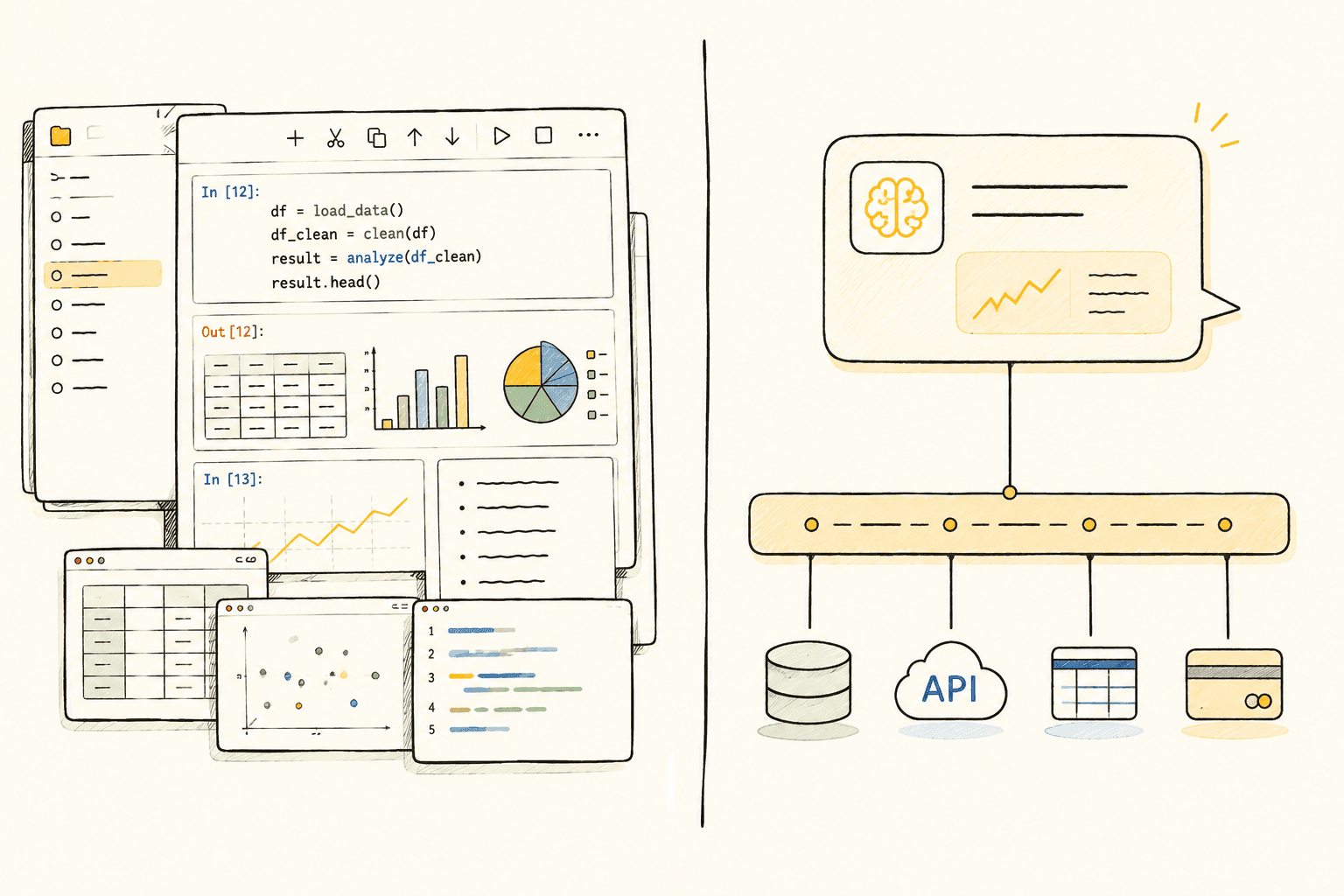
Contextflo connects your database to Claude and supplies the context an LLM needs to answer questions in plain English. Hex offers Threads, a conversational AI that does something similar. So what is the difference?
How I tested this. I set up both on the same data and ran the same questions through each, then compared setup time, how accurate the answers were, and who on a team could actually use them. This is from using both, not from their marketing.
What Hex is
Hex is an AI data platform built around collaborative notebooks. Data teams use it to write SQL and Python, build visualisations, and create interactive data apps. It is a powerful workspace for analysts and data scientists.
Hex has two AI modes:
- Notebook Agent helps data teams write SQL and Python faster, debug errors, and build dashboards from prompts
- Threads is a conversational interface where a non-technical user types a question and gets an answer, backed by governed notebooks
Pricing starts free, then runs $36–75 per editor per month, with AI credits charged on top. Enterprise is custom-quoted.
What Contextflo is
Contextflo does the jobs you open an analytics tool for: dashboards, scheduled reports, governed metric definitions, and table-level access control with every query attributed to a user and logged. What it adds is where the asking happens. Instead of a bot locked inside one more app, your team asks in the Claude or ChatGPT they already use, and the model writes and runs real SQL against your data through MCP. Connect the database, generate context, start asking. Setup is about ten minutes.
Pricing starts at $75 per user per month. No AI credits, no per-query charges, no usage metering.

The key difference: what has to happen before anyone gets an answer
Hex Threads is powerful, but it does not work out of the box. Threads is grounded in endorsed data and semantic models your data team sets up: endorsing tables, defining relationships, governing what the AI can reach. It answers questions by running against what the data team has curated.
Contextflo does not need a data team to set up. You connect the database and the platform generates table relationships, column descriptions and metric definitions. Your team starts asking the same day.
| Hex + Threads | Contextflo | |
|---|---|---|
| Before anyone asks a question | Data team builds notebooks, data model, governance | Connect database, context generated (~10 min) |
| Needs a data team? | Yes, to build and maintain semantic models | No |
| Data sources | Warehouses and databases | Warehouses plus APIs (Stripe, Amplitude, GA, HubSpot) in one conversation |
| Where it lives | The Hex platform, another app to log into | Inside Claude |
| AI pricing | AI credits charged per use, on top of seats | $75/user/month, unlimited queries, no credits |
The row that actually decides this is the first one. Everything else follows from whether somebody on your team is going to own a curated model, because Threads is only as good as what has been endorsed for it.
When to use Hex
Hex is the right choice when you have a data team that wants a modern workspace:
- Your analysts write SQL and Python daily and want AI to speed that up
- You need collaborative notebooks for exploratory analysis
- You want to build interactive data apps for stakeholders
- Your data team is in place and can maintain the notebooks that power Threads
If that describes you, Hex is genuinely good and this is not a close call.
When to use Contextflo
Contextflo is the right choice when you want governed analytics your whole team can reach without logging into another app:
- Everyone gets dashboards, scheduled reports and ad-hoc answers in the Claude or ChatGPT they already have open
- Analysts, ops, marketing and founders all need answers, and you want table-level access control deciding who can query what, with every query logged
- You want to ask across warehouses and SaaS sources in one conversation
- You want it running this week rather than after a notebook and modelling project
At Tilt, a live-auction marketplace for limited-edition goods, most of the team self-serves their own analytics through Claude, running around 6,000 queries a month against governed, access-controlled data, with no AI credits adding up per question.
Can you use both?
Yes, and this is more common than picking one. If your data team uses Hex for deep analysis, Contextflo covers the other side: giving everyone else fast answers without adding to the analysts' queue. The data team keeps doing data work. Everyone else stops waiting.
That split is worth considering before you treat this as an either-or decision. The analysts keep their notebooks; everyone else gets governed answers in the tool they already use.
Here is a more in-depth look at Contextflo and how it works.
What is Contextflo?
Contextflo is a governed context layer between your data and the AI your team already uses. Connect your warehouse once, and your team asks questions in their own Claude or ChatGPT. The model writes and runs the SQL; Contextflo supplies the definitions, the per-user access control, and the audit that make the answers trustworthy. Your data never moves, and you do not need a data team.
How it works
Your team queries in their own Claude or ChatGPT over MCP, so you bring any agent rather than a locked-in bot, and every answer comes back with the SQL shown and access enforced per user.
Find out if Contextflo is the right fit for you.
See how teams use Contextflo

Related posts

Keep reading
Conversational analytics: 5 ways to set it up, compared
7 min read
How to connect Claude to BigQuery? What works and what doesn't in 2026
8 min read
How to connect Claude to Postgres without giving it write access
7 min read

How to build a BI dashboard with Claude that your team can actually trust
8 min read
How to give Claude read-only access to your database (it isn't always the default)
7 min read

You connected your warehouse to Claude, now what?
5 min read
The official Postgres server for Claude is archived. Here's what to use instead.
7 min read
Why is the team missing sprint goals? How to analyze Jira data with AI
8 min read
Are my ads actually profitable? How to analyze Facebook and TikTok ads together with AI
7 min read