CSV MCP server: how to query a spreadsheet over MCP with Claude
Hi, this is Vivek, building Contextflo. I share practical notes on getting answers from your data, a couple of times a month.

A CSV MCP server is a small program that sits between Claude (or ChatGPT) and a CSV file, letting the model run real queries against that file instead of reading it as raw text. MCP is the plug that connects the two. The server exposes your spreadsheet as something the model can ask questions of, and the answer comes back from actual computation rather than from skimming a wall of numbers.
That is the whole idea. The rest of this is what MCP actually is, the real ways to query a CSV over it, and where each one stops being worth it.
What is MCP, for people who haven't touched it
MCP stands for Model Context Protocol. Anthropic put it out in late 2024, and by now most of the big model providers support it. Think of it as a USB port for AI. Before, if you wanted Claude to talk to your database or your files or some API, you wrote custom glue for that one thing. MCP is a common shape everyone agreed on, so the glue is reusable.
An MCP server is the thing on the other end of the port. It says here are the tools I offer, and here is how to call them. A weather MCP server might offer get_forecast. A database MCP server offers something like run_query. Claude reads the menu, picks a tool, calls it, and uses what comes back.
So a CSV MCP server is just an MCP server whose one job is to let the model query a CSV. Nothing more exotic than that.
Why not just paste the CSV into the chat?
You can. For a small file you are looking at once, that is the right move. Drop it in, ask your question, move on. Free and simple.
It falls apart when the file gets big or the question gets real. Paste a 200,000-row export and you blow through the context window, or the model starts averaging numbers by eyeballing them and quietly gets it wrong. "Sum revenue where region = APAC and month = March" is a thing a computer should do exactly, every time. A language model reading text is guessing.
That is the gap a CSV MCP server fills. The model writes a query, the server runs it against the file, and the math is the file's math rather than the model's impression of it.
Option 1: write your own. It's about 100 lines.
I want to be honest here, because a lot of posts on this topic pretend the DIY path does not exist so they can sell you something.
If you are a developer, you can build a CSV MCP server yourself in an afternoon. The MCP Python SDK does the protocol handshake for you. You write one tool that takes a SQL string, points DuckDB or pandas at your CSV, runs it, and returns the rows. Register the tool, run the server over stdio, point Claude Desktop's config at it. Done. It really is close to 100 lines.
For a solo dev with one file on their laptop, this is genuinely the answer. You control it, it costs nothing, and you learned how MCP works while doing it. I would tell a friend to just do this.
The catch shows up later, and it is not the code. It is everything around the code. Where does the file live so your teammate can use it too? What happens when someone drops in a new version? How do you keep a coworker from querying the file they should not see? Your 100 lines do not answer any of that, and answering it is a real project.
Option 2: an existing open-source or point server
You do not have to write it either. There are community CSV MCP servers on GitHub you can clone and run. Some vendors ship read-only connectors that speak MCP over a file or a folder, CData's connector being one people mention. These save you the afternoon.
They land in the same place as the DIY version, though. You are still the one running the process, keeping it up, and handling the moment it needs to be more than one person and one file. They solve the querying. They do not solve the team.
For more on the tradeoffs of running your own, we wrote a whole piece: DIY MCP vs Contextflo.
Option 3: a managed one, for when the file has to stick around and be shared
This is the part Contextflo does, and it is worth being clear about who it is for. It is for teams without a data person, where the spreadsheet is not a throwaway. It is the source of truth for costs, or targets, or a client's numbers, and more than one person needs to ask it questions next week.
You upload the CSV. It becomes a table. Anyone on your team can query it in Claude, and we run the MCP server so nobody has to. Under the hood the file goes into an S3 bucket only your org can reach, and at query time we load it into DuckDB and Claude runs real SQL against it. The same DuckDB you would have reached for building it yourself, we just host it.
The reason to bother, over the DIY server, is two things you cannot easily get on your own:
- It joins your warehouse. If revenue is in Postgres or BigQuery and costs are in the CSV, Claude can pull from both and hand you margin by product in one answer. A standalone CSV server cannot see your database. (We cover the warehouse side in connecting Claude to Postgres.)
- It is governed and shared. The file lives in one place with access control, not in one person's chat history. A new hire can ask it things on day one. If you do not want that person seeing a table, they do not.
Here is the honest tradeoff, since a feature list with no downside is a lie. If you have one CSV, you are one person, and you never need to touch your warehouse, a managed server is more than you need. Write the 100 lines, or paste it in the chat, and keep your money. Contextflo earns its keep when the file is shared, sticks around, or has to sit next to your other data. Below that bar, DIY wins, and I will say so.
If you want the deeper version of the managed path, we walk through it in querying your CSVs in Claude.
FAQ
What is a CSV MCP server? It's an MCP server that lets Claude or ChatGPT query a CSV file with real queries instead of reading it as text. The model writes a query, the server runs it against the file, and returns the result. That means exact math on large files, not the model guessing at a block of numbers.
Can I query a CSV over MCP without any code? Yes. A managed service like Contextflo lets you upload a CSV and query it in Claude with no server to run. If you'd rather build it, the DIY route is roughly 100 lines of Python with the MCP SDK and DuckDB.
Is a CSV MCP server better than just uploading the file to a chat? For a small, one-off file, no. Just paste it in. A server is worth it when the file is large, gets queried repeatedly, needs to be shared across a team, or has to be combined with data from a database.
Can Claude join a CSV with my database over MCP? Not with a standalone CSV server, since it only sees the file. With a setup that hosts both, like Contextflo, Claude can query the CSV and your warehouse and combine the results into one answer.
Most people asking about a CSV MCP server want one file to behave for one afternoon. Build it. The ones who should pay are the ones who realise the file was never really about the file.
See it on your own data.
Connect your warehouse and your team can ask Claude about it the same day, without waiting on a data team. Want a walkthrough first? Grab 20 minutes.
Book a 20-minute callSee how teams use Contextflo

Related posts


Keep reading
Conversational analytics: 5 ways to set it up, compared
7 min read
How to connect Claude to BigQuery? What works and what doesn't in 2026
8 min read
How to connect Claude to Postgres without giving it write access
9 min read

How to build a BI dashboard with Claude that your team can actually trust
8 min read
How to give Claude read-only access to your database (it isn't always the default)
7 min read

You connected your warehouse to Claude, now what?
5 min read
How to use Claude to identify user fraud
6 min read
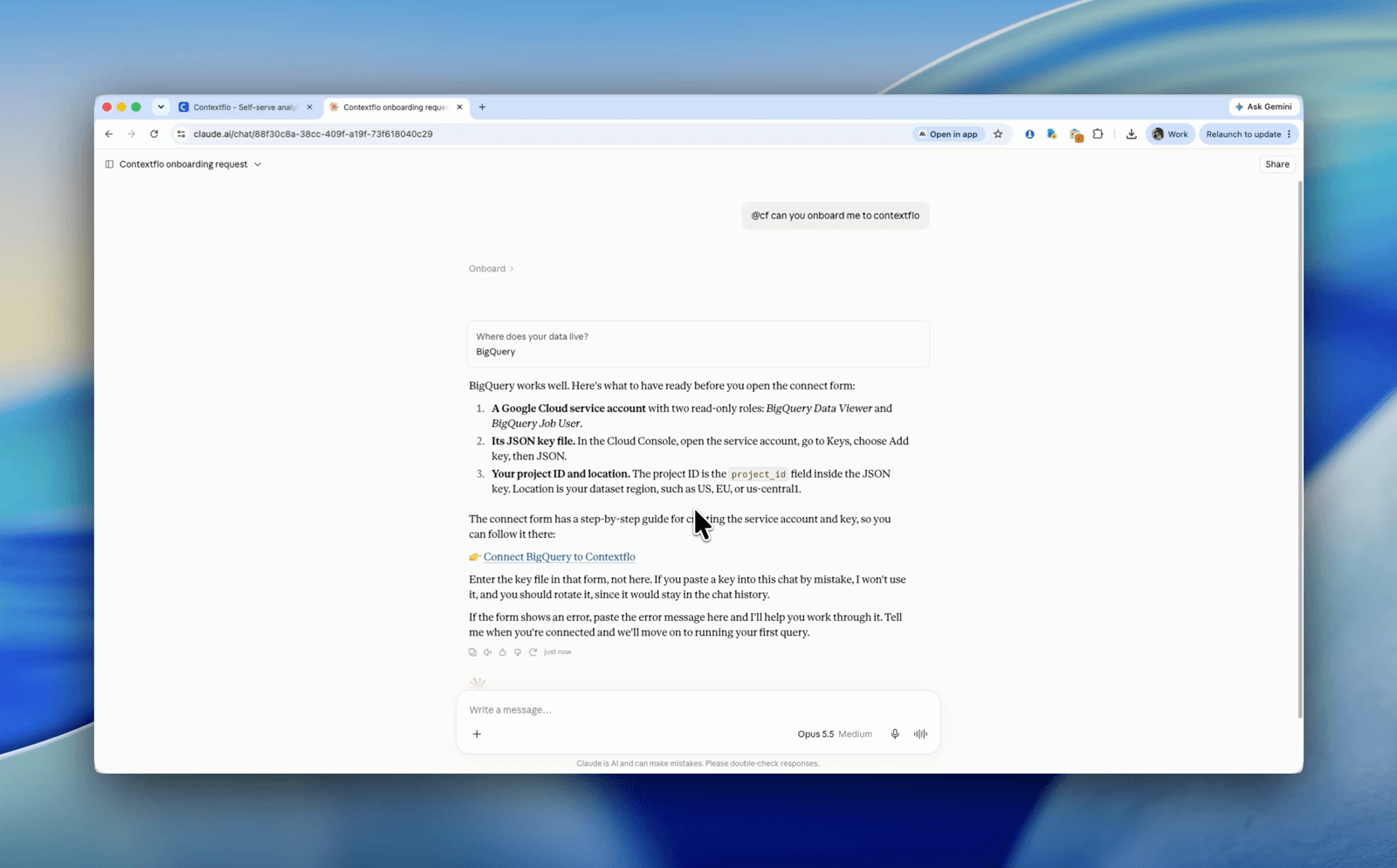
Set up Contextflo from inside Claude: onboarding is now a conversation
3 min read
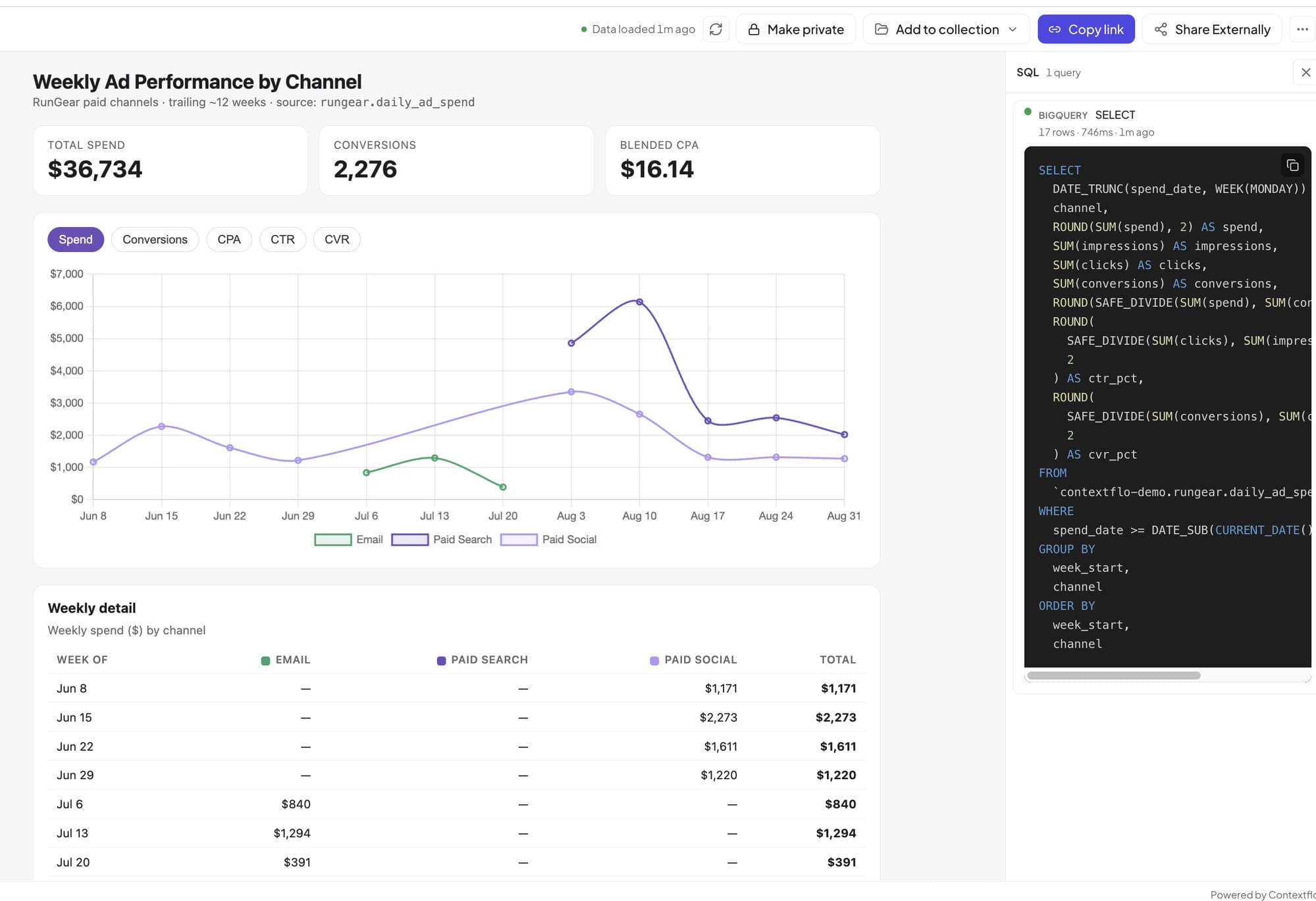
How to host and share Claude artifacts with your whole team
3 min read