What is a database MCP server? (and how to set one up)
Hi, this is Vivek, building Contextflo. I share practical notes on getting answers from your data, a couple of times a month.

A database MCP server is a small program that sits between Claude (or ChatGPT) and your database and lets the model run real SQL against it instead of guessing. MCP is the standard plug that connects the two. The server exposes your database as tools the model can call, so when you ask a question, Claude writes a query, the server runs it, and the answer comes back from your actual data.
That's the whole idea. The rest of this is what MCP is, how a database server actually works, the ways to get one running, and where each way stops being worth it.
What MCP is, for people who haven't touched it
MCP stands for Model Context Protocol. Anthropic released it in late 2024, and by now most of the big model providers support it. Think of it as a USB port for AI. Before, if you wanted Claude to reach your database or your files or some API, you wrote custom glue for each one. MCP is a common shape everyone agreed on, so the glue is reusable.
An MCP server is the thing on the other end of the port. It announces "here are the tools I offer" and "here's how to call them." A weather server might offer get_forecast. A database server offers something like list_tables, describe_table, and run_query. Claude reads the menu, inspects your schema, writes SQL, calls the tool, and reads back the rows.
Why not just describe the database in the chat?
You can paste a schema and a few rows into Claude and ask about them. For a quick look at a small table, that's fine. It falls apart the moment the question needs real data. Claude can't sum a column it can only see a sample of, and it will happily invent a plausible number. "Total revenue in Q2 for the EMEA region" is a thing a database should compute exactly, every time. A model reading pasted text is guessing.
A database MCP server closes that gap. The model writes the query, the server runs it against the live database, and the math is your database's math, not the model's impression of it.
Option 1: run an open-source server
You don't have to build anything. There's an open-source MCP server for every major database: Postgres, MySQL, BigQuery, Snowflake, and more. You create a read-only database user, hand the server that connection string, start it, and point Claude at it. Some databases even ship their own managed server, so there's nothing to run.
For one technical person querying their own database, this is the right answer. It's free, you control it, and you can read every query Claude writes. We walk through the exact steps per database in our guide to connecting Claude to a database with MCP.
Option 2: build your own
If you're a developer with an unusual database or specific needs, you can write one. The MCP SDK handles the protocol handshake. You write a tool that takes a SQL string, runs it through your database driver, and returns the rows. It's not a huge amount of code.
The code was never the hard part, though. The hard part is everything around it. Where does it run so a teammate can use it too? How do you stop one person from querying a table they shouldn't? How do you know what got asked when a wrong number shows up in a meeting? Your server doesn't answer any of that, and answering it is a real project. We break down that build-vs-buy line in DIY MCP vs Contextflo.
Option 3: a managed server, for when the team needs it
This is what Contextflo does, and it's worth being clear about who it's for. It's for teams where more than one person, technical or not, needs reliable answers from the database, and where a wrong number would actually cost something.
You connect the database once with read-only credentials. Contextflo auto-generates the context (what your tables and columns mean) from your schema, your code, and your docs, and runs the MCP server so nobody on your team has to. On top of the raw "run a query" that a bare server gives you, you get two things you can't easily build alone:
- Shared, correct definitions. "Revenue" and "active user" are defined once, so two people asking the same question get the same number instead of the model re-guessing your columns every session.
- Governance. Each person signs in individually, access is scoped per user, and every query is logged. New hire joins and can ask on day one. Someone shouldn't see a table, they don't.
The honest tradeoff, since a feature list with no downside is a lie: if all you want is a plain connection and you're solo with no team ever, a raw open-source server is simpler, run it and keep your money. But even for one person, a raw server just runs queries; it doesn't know what your columns mean. If you want Claude to answer accurately from real context (your schema, code, and docs), that's what Contextflo adds. Just MCP is not enough.
FAQ
What is a database MCP server?
It's an MCP server that lets Claude or ChatGPT query a database with real SQL instead of guessing from pasted text. The model writes a query, the server runs it against the database, and returns the rows, so the math is exact and comes from your live data.
Do I need to code to run a database MCP server?
No. There are open-source MCP servers for every major database you can run as-is, and managed services with nothing to run at all. You only write code if you want to build a custom server for an unusual setup.
Is a database MCP server safe?
It's as safe as you configure it. Connect with a read-only user against a replica so the model can never write or slow production. For a team, a governed layer adds per-user access control and a query log on top.
What's the difference between a database MCP server and a governed layer?
A bare server gives one person the ability to run queries. Contextflo is an AI analytics tool that adds shared metric definitions, per-user access control, individual sign-in, and an audit trail, which is what a team needs once more than one person relies on the answers.
Here is a more in-depth look at Contextflo and how it works.
What is Contextflo?
Contextflo is a governed context layer between your data and the AI your team already uses. Connect your warehouse once, and your team asks questions in their own Claude or ChatGPT. The model writes and runs the SQL; Contextflo supplies the definitions, the per-user access control, and the audit that make the answers trustworthy. Your data never moves, and you do not need a data team.
How it works
Your team queries in their own Claude or ChatGPT over MCP, so you bring any agent rather than a locked-in bot, and every answer comes back with the SQL shown and access enforced per user.
See it on your own data.
Connect your warehouse and your team can ask Claude about it the same day, without waiting on a data team. Want a walkthrough first? Grab 20 minutes.
Book a 20-minute callSee how teams use Contextflo

Related posts


Keep reading
Conversational analytics: 5 ways to set it up, compared
7 min read
How to connect Claude to BigQuery? What works and what doesn't in 2026
8 min read
How to connect Claude to Postgres without giving it write access
9 min read

How to build a BI dashboard with Claude that your team can actually trust
8 min read
How to give Claude read-only access to your database (it isn't always the default)
7 min read
You connected your warehouse to Claude, now what?
5 min read
How to use Claude to identify user fraud
6 min read
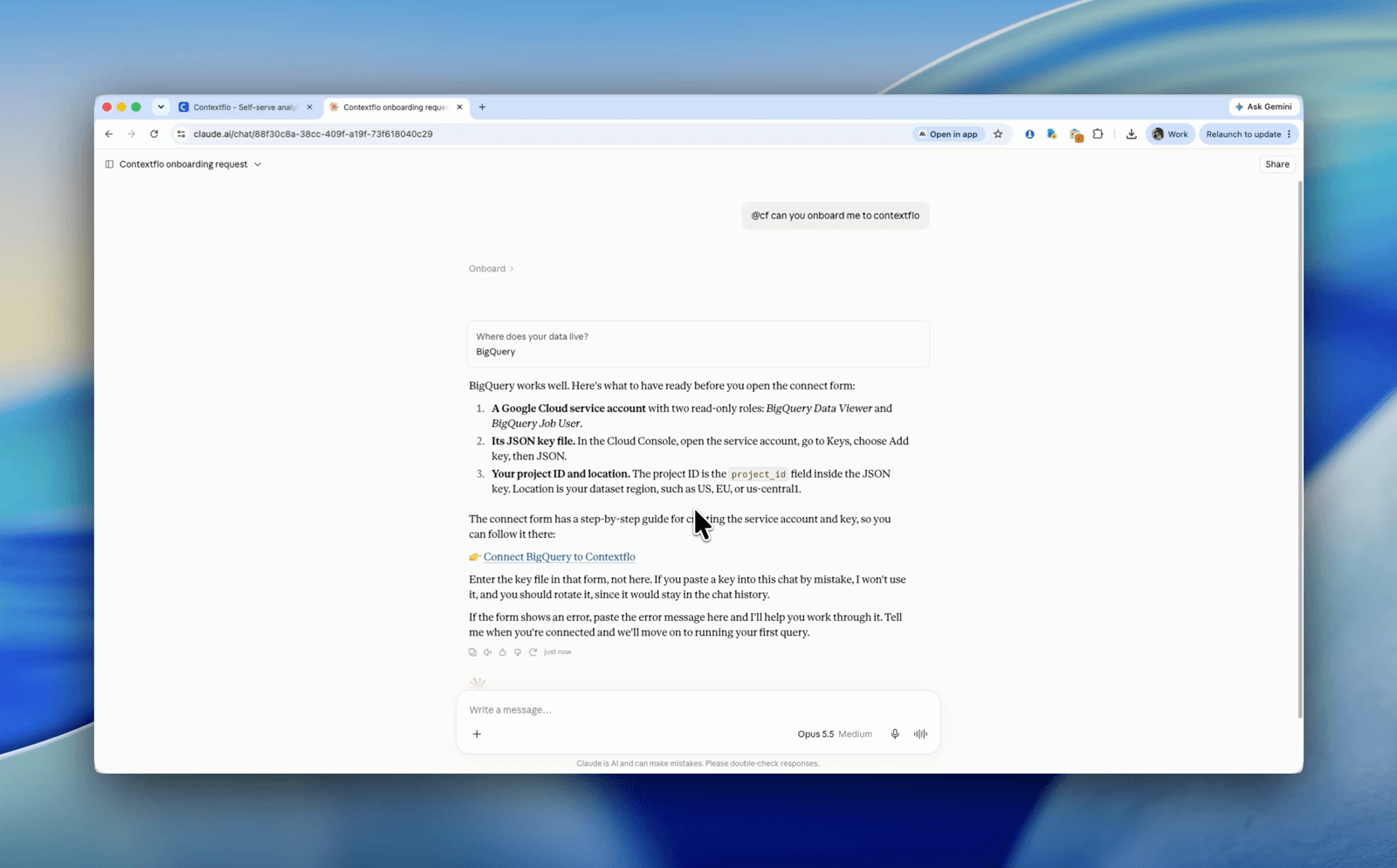
Set up Contextflo from inside Claude: onboarding is now a conversation
3 min read
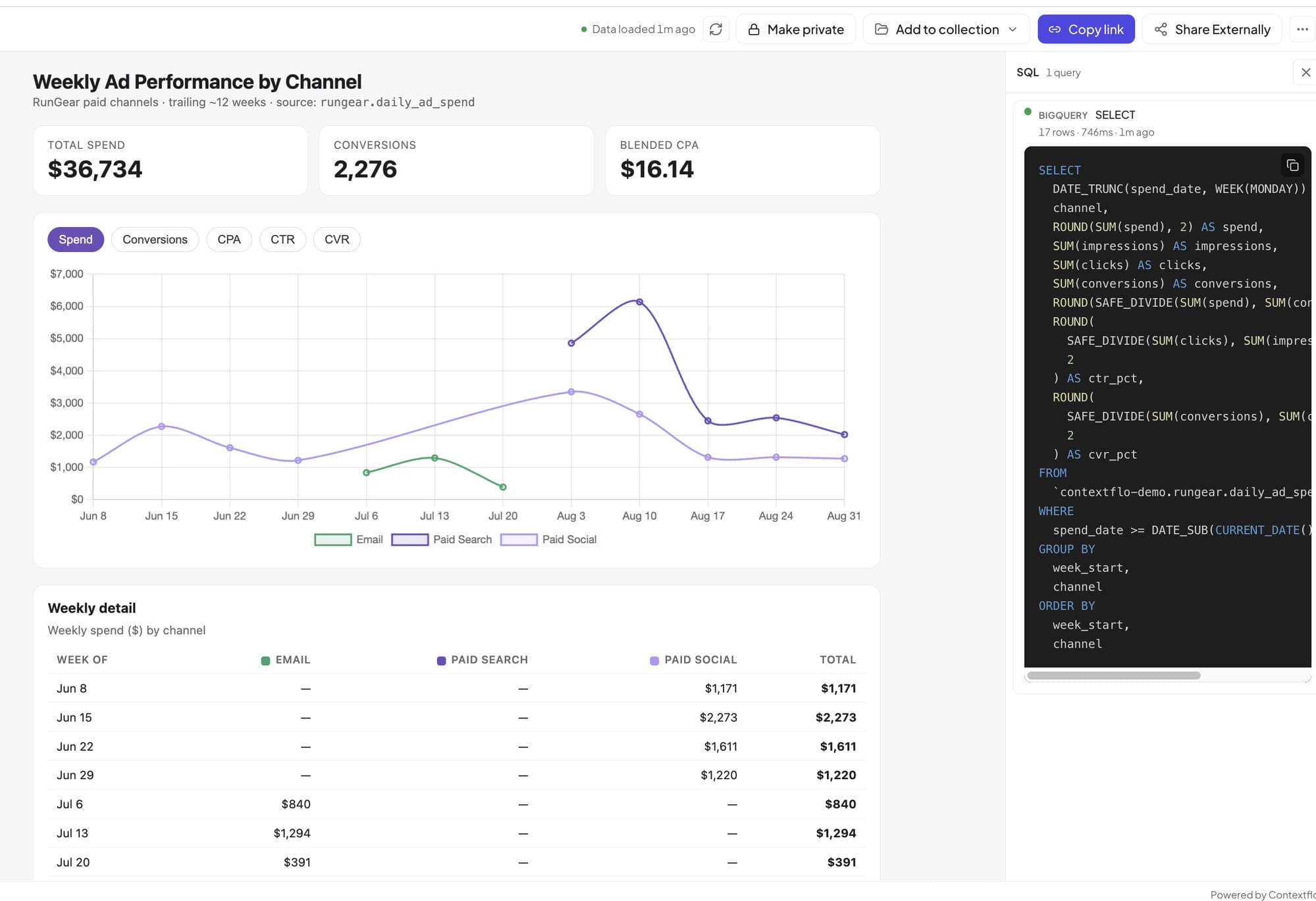
How to host and share Claude artifacts with your whole team
3 min read