AI analytics works on day one. What keeps it useful on day 100?
AI analytics gets harder after launch, when definitions drift and new questions arrive. See how to find the gaps and fix them once.
Jump to a section
The first week of AI analytics is exciting. Connect the warehouse, ask a question, get an answer. The harder test comes later, when two people ask the same thing and get two different numbers.
The problem
That usually isn't a model problem. The business changed, the definitions didn't, or nobody had written one down in the first place. New questions arrive, and the agent fills the gap with its own interpretation.
Your marketing lead asks for last month's revenue and gets $1.42M. Finance asks an hour later and gets $1.51M. One answer included refunds, the other didn't. No one had written down which version of revenue the company meant.
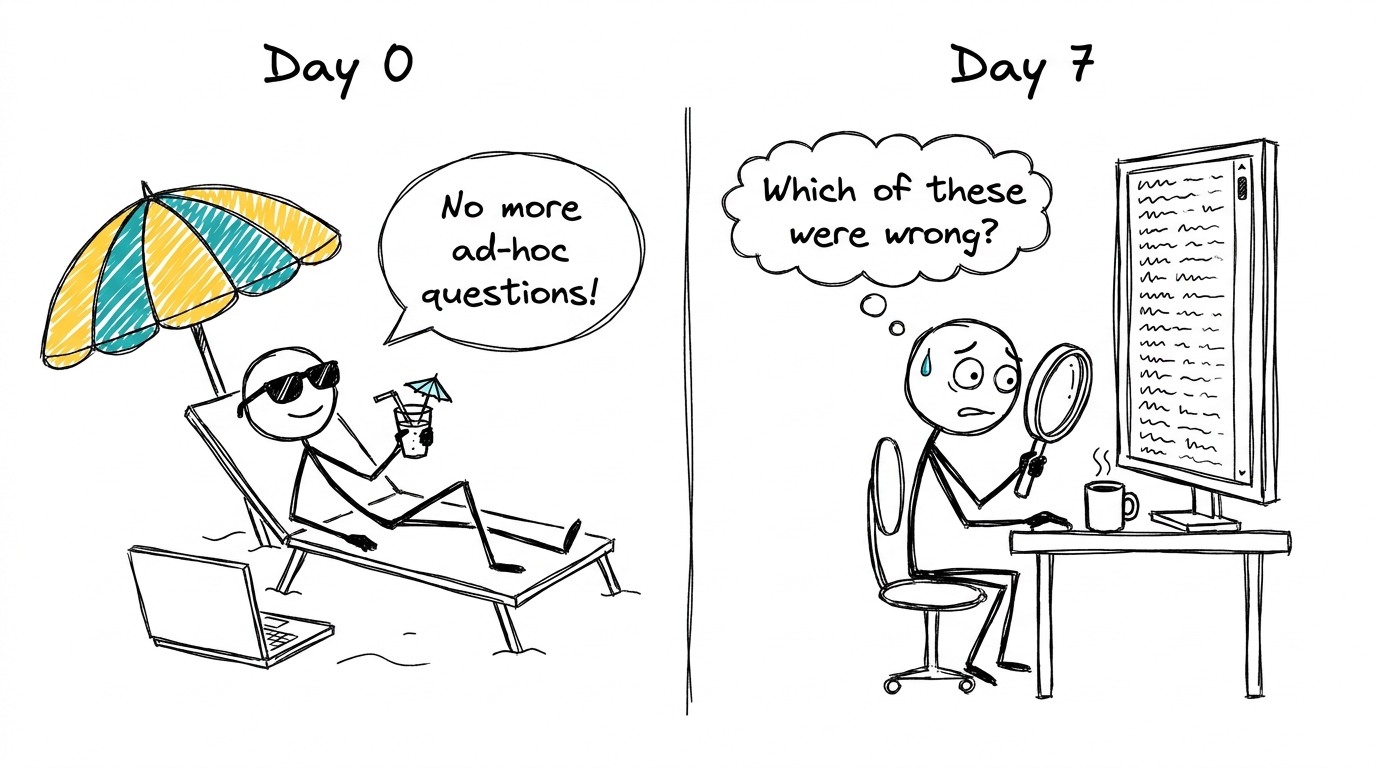
Now both people have a reason to doubt the next answer, too. They go back to asking the data lead. The AI rollout is still there, but the ad-hoc queue is back.
The data lead could open sessions one by one to find out what happened. But that turns maintaining AI context into another job, and it rarely gets done consistently.
Find the gap without reading every log
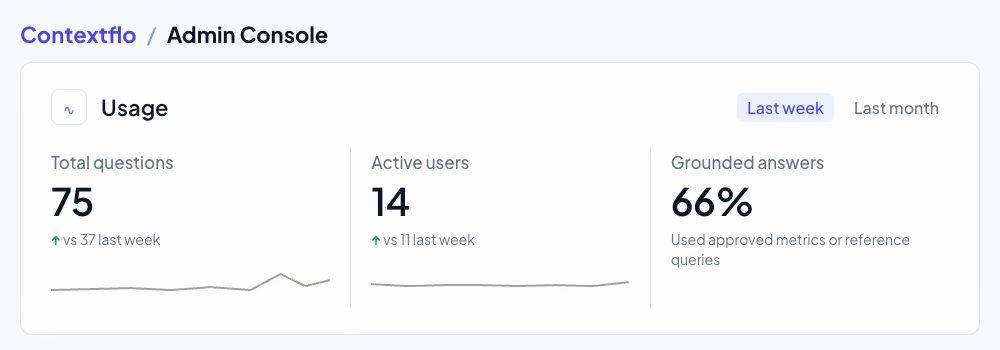
Contextflo puts the useful signal on the home page: which conversations cited an approved metric or reference query, and which ones didn't. Click into the uncited conversations to see what the team asked and open the full session.
It works because every agent interaction that goes through Contextflo is logged and annotated, whichever agent your team uses:
| For each conversation | What it tells you |
|---|---|
| Approved metrics or reference queries cited | Which conversations started from logic your team approved |
| Tables and context consulted | What the agent looked at before answering |
| The full session | What was asked, what the agent tried, and where it got stuck |
The Grounded answers score shows the share of conversations where the agent cited an approved metric or reference query. It is measured per conversation, so an agent can explore first and still count once it cites approved logic while answering.
Click the score to get Answers without grounding: the conversations that didn't cite approved logic, who asked, when, a short summary, and a link to the full session. In the activity log, grounded sessions carry an Approved definition chip.
Putting everything together
The point isn't another score to monitor. It's a short path from a missed definition to a reusable one:
- Open a conversation without grounding.
- Ask your agent whether an approved metric or reference query would have helped.
- If one is missing, have it draft the definition.
- Review and save it for next time.
Review these conversations without grounding. For each, tell me whether an
approved metric or reference query would help. If one is missing, draft it for
me to review.
Your agent can pull the conversation details into chat, so you can investigate the pattern without opening every session yourself.
When a definition is saved, the next person asking that question can start from the same agreed logic. A 45% score with five approved definitions isn't a verdict on the AI. It shows how many questions still need a shared answer, and the uncited list gives you the next ones to tackle.
The data lead still owns the definitions. They shouldn't have to discover every gap by reading sessions manually.
But what is Contextflo and who's it for?
The score only works because Contextflo already sits between your team's AI and your data. Contextflo connects Claude and ChatGPT to your company's data, with shared definitions, saved queries and access control, so your team gets the same trusted answer whichever AI they ask. It works with your warehouse, databases and spreadsheets (Snowflake, BigQuery, Redshift, Postgres, Databricks, uploads), and setup takes about 10 minutes.
Contextflo connects Claude and ChatGPT to your company data, with shared definitions, saved queries, and access control. Your team gets answers in the AI tools they already use, while the data lead can see where those answers need better definitions.