How to give your team AI access to your database without compromising security
Hi, this is Vivek, building Contextflo. I share practical notes on getting answers from your data, a couple of times a month.

Your team wants to use Claude or ChatGPT to query company data. Your job is to make sure that happens without exposing sensitive tables, leaking credentials, or letting someone accidentally run a query that takes down production.
I've set this up for multiple teams now. The connection part is easy. The safety part is where most setups fall apart. Here's what you actually need to think about.
Read-only is the baseline, not the ceiling
Every guide starts with "use a read-only database user." That's correct but insufficient. Read-only prevents writes. It doesn't prevent:
- Expensive queries. A SELECT with no LIMIT against a billion-row table will saturate your read replica, or spike your warehouse bill.
- Sensitive data exposure. Read-only on the entire database means the AI can query your payroll table, your PII columns, your internal pricing data. Everyone on the team sees everything.
- Credential sprawl. If each person configures their own connection, the database password lives in plaintext JSON files on 10 laptops. One stolen laptop and you're rotating credentials for everyone.
Read-only is step one. Not the whole solution.
The seven things you need
- Read-only connection to a replica. Never point AI queries at your production primary. Use a read replica. Even read-only queries can cause lock contention and affect your app.
- Table-level access controls. Not everyone should see every table. Your marketing team queries campaign tables. Your finance team queries revenue tables. Nobody should accidentally stumble into employee compensation or customer PII. This needs to be configurable per user or per group, layered on the read-only connection rather than juggled as separate database roles for every person.
- Centralized credentials. One connection, managed by the admin. Individual users authenticate through the platform, not by pasting a connection string into a config file. When someone leaves, you revoke their access in one place, instead of rotating a shared database credential off everyone's laptops.
- Query logging. Every question asked, every SQL query generated, and who asked. If someone asks something they shouldn't have access to, you know. If a query returns wrong results, you can trace what happened.
- Shared business context. This isn't a security feature but it prevents a different kind of damage. Without shared metric definitions, two people ask "what's revenue" and get different numbers. One of those numbers ends up in a board deck. That's a trust problem that's hard to recover from.
- No raw database access for end users. Users should interact through the AI tool (Claude, ChatGPT) with the context layer in between. They should never see a connection string, never configure a local MCP server, never touch database credentials.
- Result limits and query timeouts. A read-only SELECT with a bad join can still saturate your replica or run up a big warehouse bill. Cap result size and kill long-running queries so one careless question doesn't stall everyone's dashboards.
What most teams do instead
Most teams skip the safety layer entirely. They share a connection string in Slack, everyone configures their own MCP server, and the data engineer hopes nothing goes wrong.
It works for a while. Then someone queries a table they shouldn't see. Or the connection string gets committed to a repo. Or the AI runs a cartesian join that runs up a $400 warehouse bill. And the data engineer either shuts down access entirely or spends a week building a custom wrapper.
Neither outcome is good. Shutting it down kills the productivity gain. Building a custom wrapper is weeks of work that has to be maintained forever.
How Contextflo handles this
Contextflo is the layer between your database and the AI tools your team uses. You connect your database once with read-only credentials. Your team authenticates through Contextflo, not through database credentials.
Here's what you get:
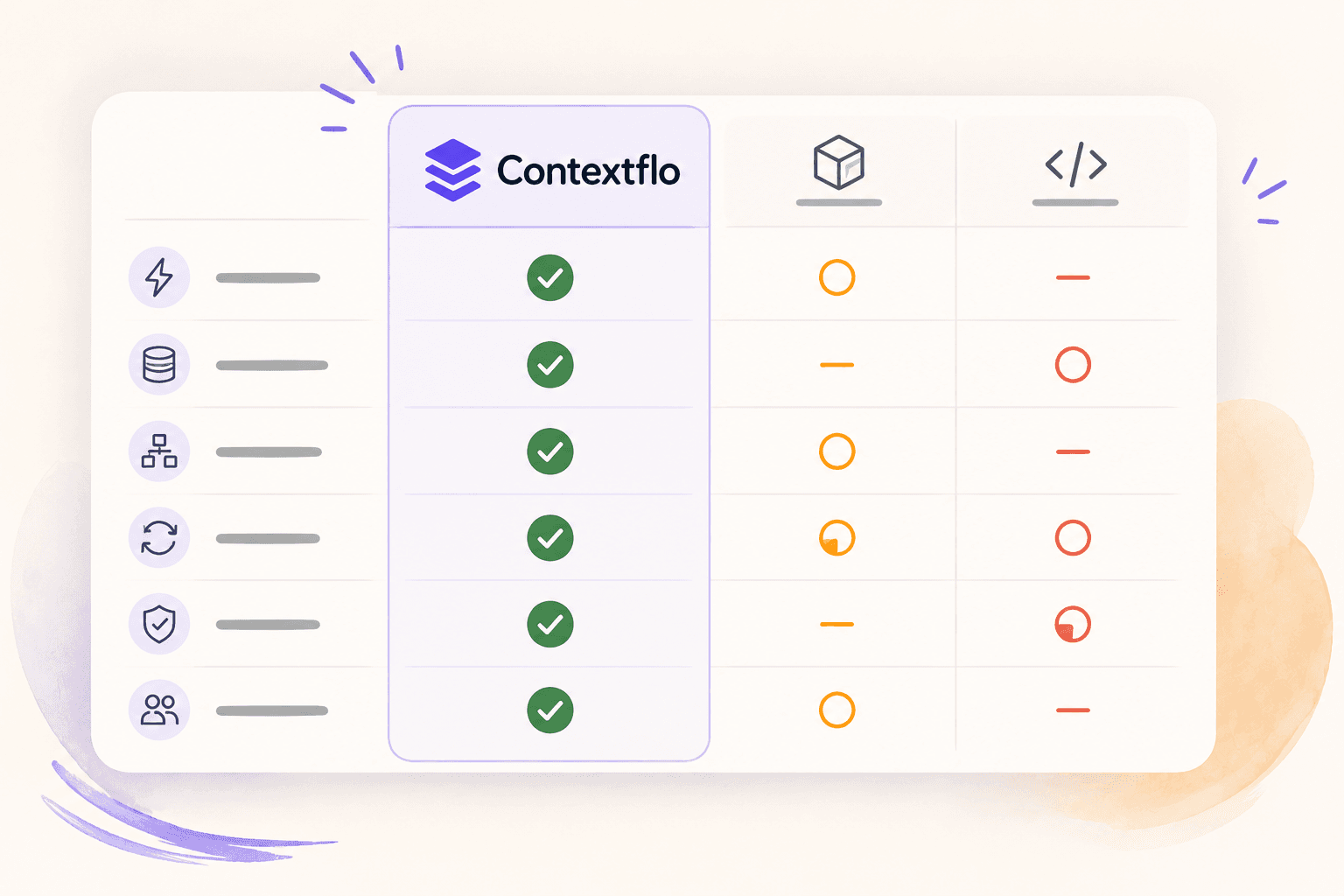
| Concern | Raw MCP | Contextflo |
|---|---|---|
| Credentials | On every laptop | Centralized, never exposed to users |
| Table access | Everyone sees everything | Per-user, per-group table scoping |
| Query logging | None | Every question and query logged |
| Offboarding | Rotate DB password for everyone | Revoke one user's access |
| Metric consistency | Each person's prompt notes | Shared definitions for everyone |
| Runaway queries | No limits | Result limits and query timeouts |
Works with Postgres, Snowflake, BigQuery, Redshift, MySQL, ClickHouse, and Databricks. Setup takes about 15 minutes.
Here is a more in-depth look at Contextflo and how it works.
What is Contextflo?
Contextflo is a governed context layer between your data and the AI your team already uses. Connect your warehouse once, and your team asks questions in their own Claude or ChatGPT. The model writes and runs the SQL; Contextflo supplies the definitions, the per-user access control, and the audit that make the answers trustworthy. Your data never moves, and you do not need a data team.
How it works
Your team queries in their own Claude or ChatGPT over MCP, so you bring any agent rather than a locked-in bot, and every answer comes back with the SQL shown and access enforced per user.
Find out if Contextflo is the right fit for you.
See how teams use Contextflo

Related posts

Keep reading
Conversational analytics: 5 ways to set it up, compared
7 min read
How to connect Claude to BigQuery? What works and what doesn't in 2026
8 min read
How to connect Claude to Postgres without giving it write access
7 min read

How to build a BI dashboard with Claude that your team can actually trust
8 min read
How to give Claude read-only access to your database (it isn't always the default)
7 min read
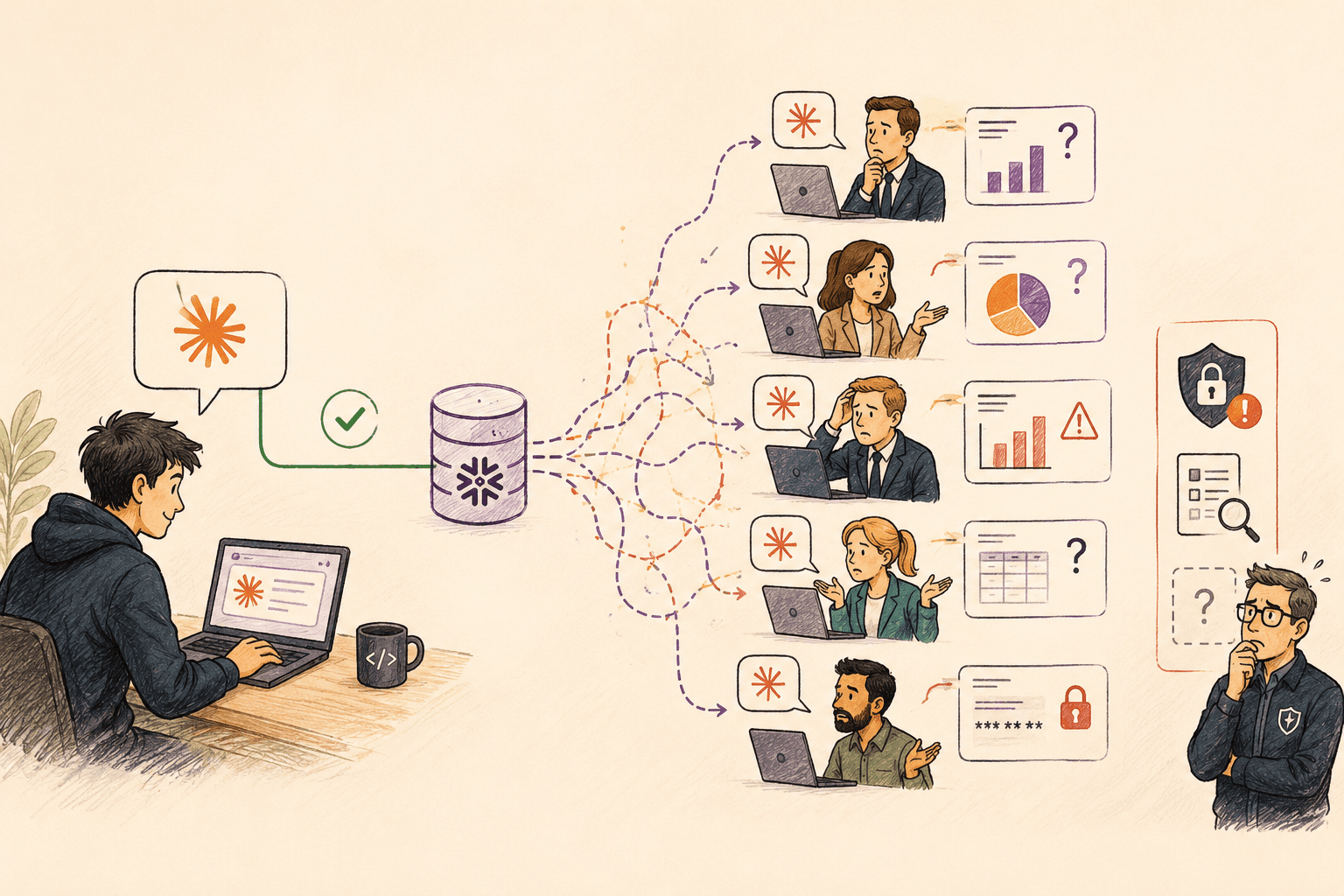
You connected your warehouse to Claude, now what?
5 min read
The official Postgres server for Claude is archived. Here's what to use instead.
7 min read
Why is the team missing sprint goals? How to analyze Jira data with AI
8 min read
Are my ads actually profitable? How to analyze Facebook and TikTok ads together with AI
7 min read