Access control lists get treated as a compliance checkbox. Something you bolt on before an enterprise deal closes. But if you're building agentic analytics, ACL is doing something far more valuable than governance: it's making your agent smarter.
The governance case (what everyone already knows)
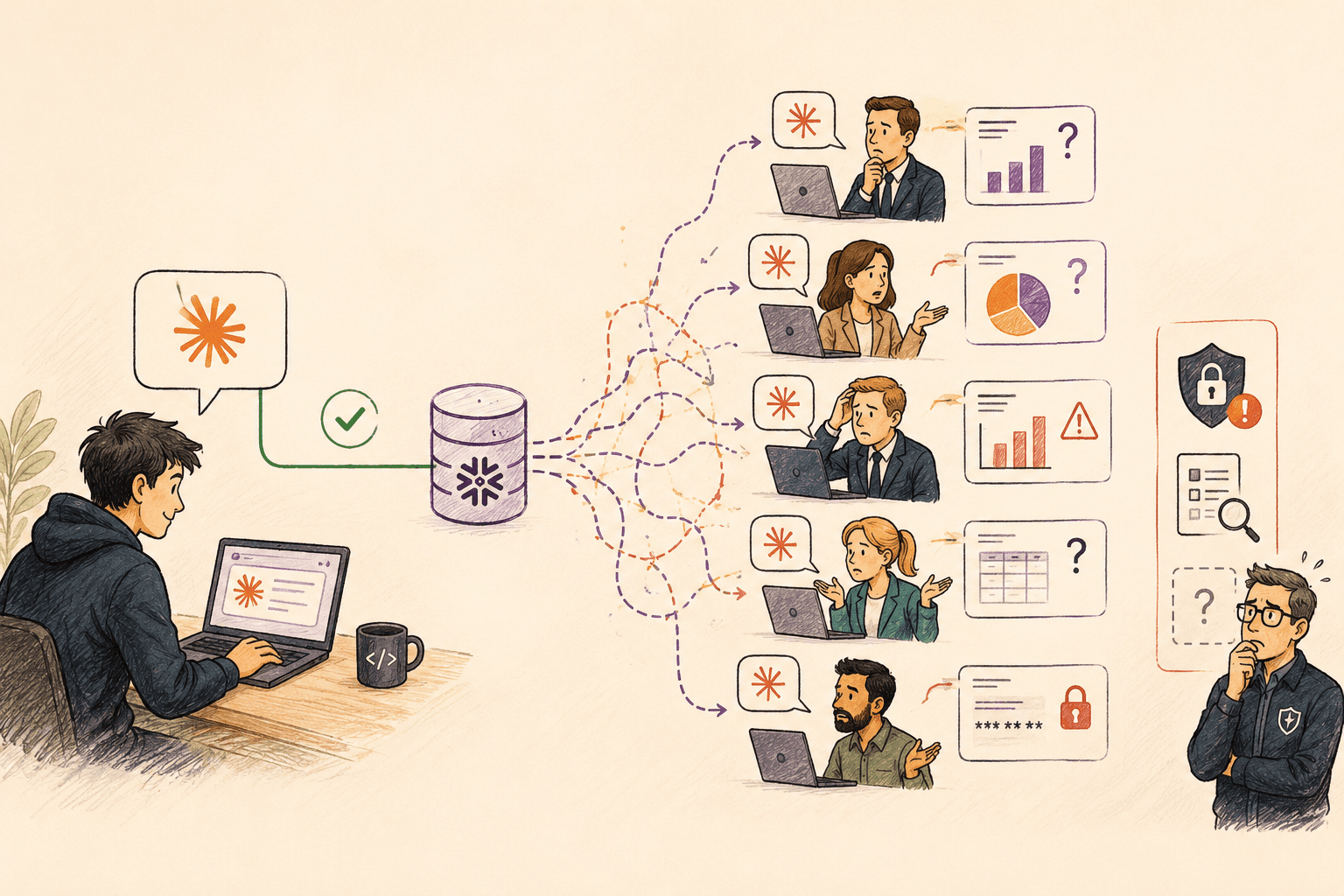
When you connect an LLM to your data warehouse, it uses a single service account. Everyone gets the same access. The marketing intern and the finance director run queries with identical permissions. You need access controls to prevent unauthorized data access. This is table stakes for any production deployment.
Most teams get this. It's the first thing security reviews flag. But if governance is all you see in ACL, you're missing the bigger opportunity.
The part people miss: ACL as context narrowing
Anthropic recently published their approach to building self-serve analytics internally. One of the hardest problems they describe is context navigation: how does the agent find the right tables and metrics to answer a question when it's looking at hundreds or thousands of options?
Their solution is a sophisticated retrieval skill system. Domain-specific context gets loaded on demand through routing logic that decides which tables and metrics are relevant before the agent starts writing SQL. It works. But it's complex engineering, and it costs tokens at every query because the routing itself requires LLM calls.
There's a simpler way to achieve much of the same narrowing: access control rules. If someone in marketing only has access to marketing tables, the agent's search space is already scoped before it starts reasoning. No retrieval step needed for that narrowing. No routing logic. No extra tokens spent figuring out which domain the question belongs to.
This has real advantages over retrieval-based narrowing:
- Deterministic. Retrieval can fail quietly, returning irrelevant context or missing the right table. ACL-based scoping fails loudly instead: a table outside your scope is simply unreachable, so you get a visible gap, not a subtly wrong answer.
- Token-cheap. No routing LLM call, no embedding lookups, no context selection logic consuming tokens on every query.
- Already required. You need ACL for governance anyway. Getting context narrowing as a side effect means you're solving two problems with one mechanism.
Less context means fewer irrelevant tables. Fewer irrelevant tables means the agent spends less time reasoning about what's relevant and more time answering the question. The answers get better because the agent isn't distracted by tables it shouldn't be considering in the first place.
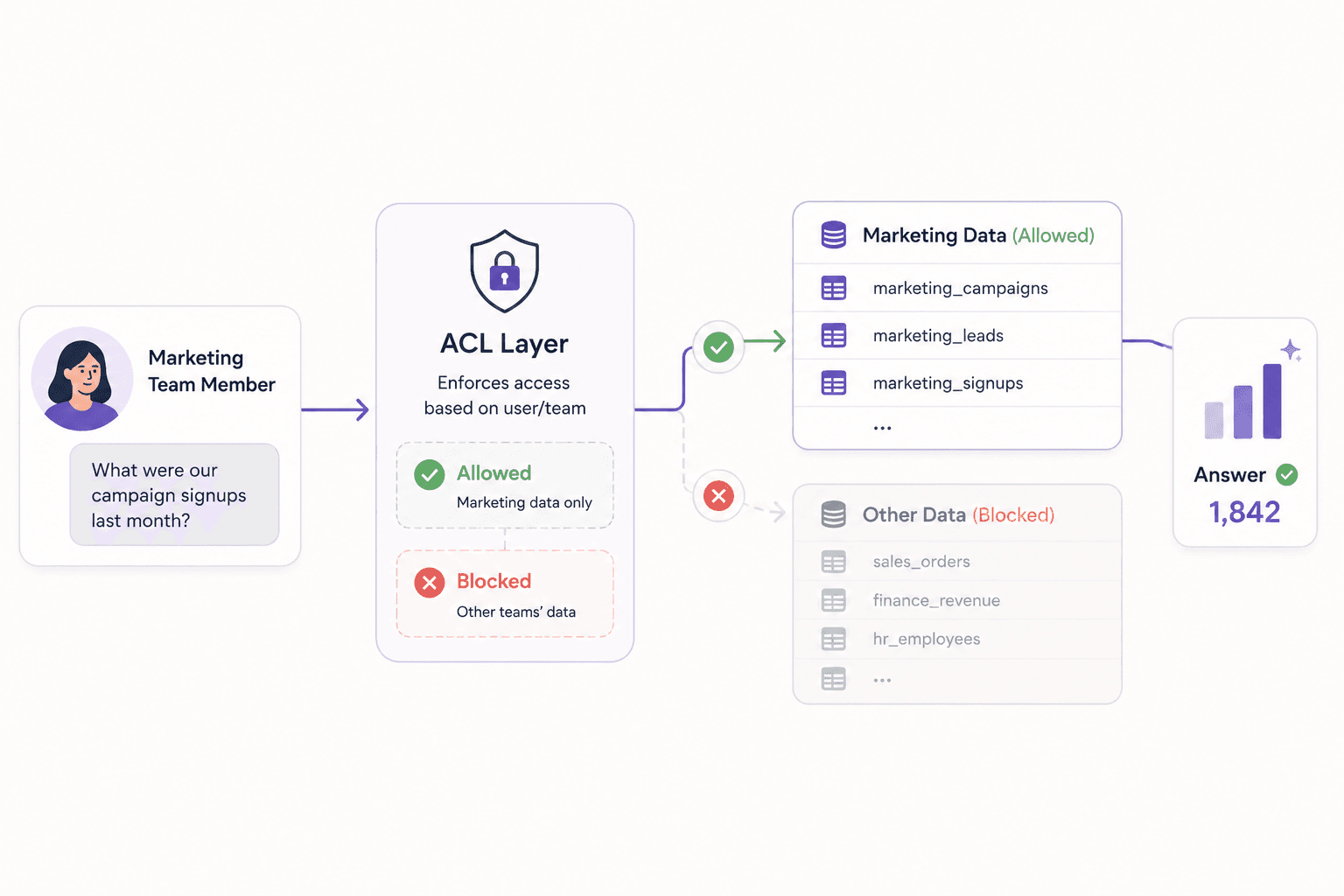
For power users who need cross-domain access (a CEO, a data admin, an analyst who works across teams), you layer additional context management on top. But for most users, who work within a single domain, ACL handles the narrowing automatically. The expensive retrieval infrastructure becomes an optimization for edge cases, not a requirement for every query.
How Contextflo implements this
Contextflo sits between the LLM and your data warehouse. Your warehouse keeps a single service account. Governance and context scoping happen at the Contextflo layer.
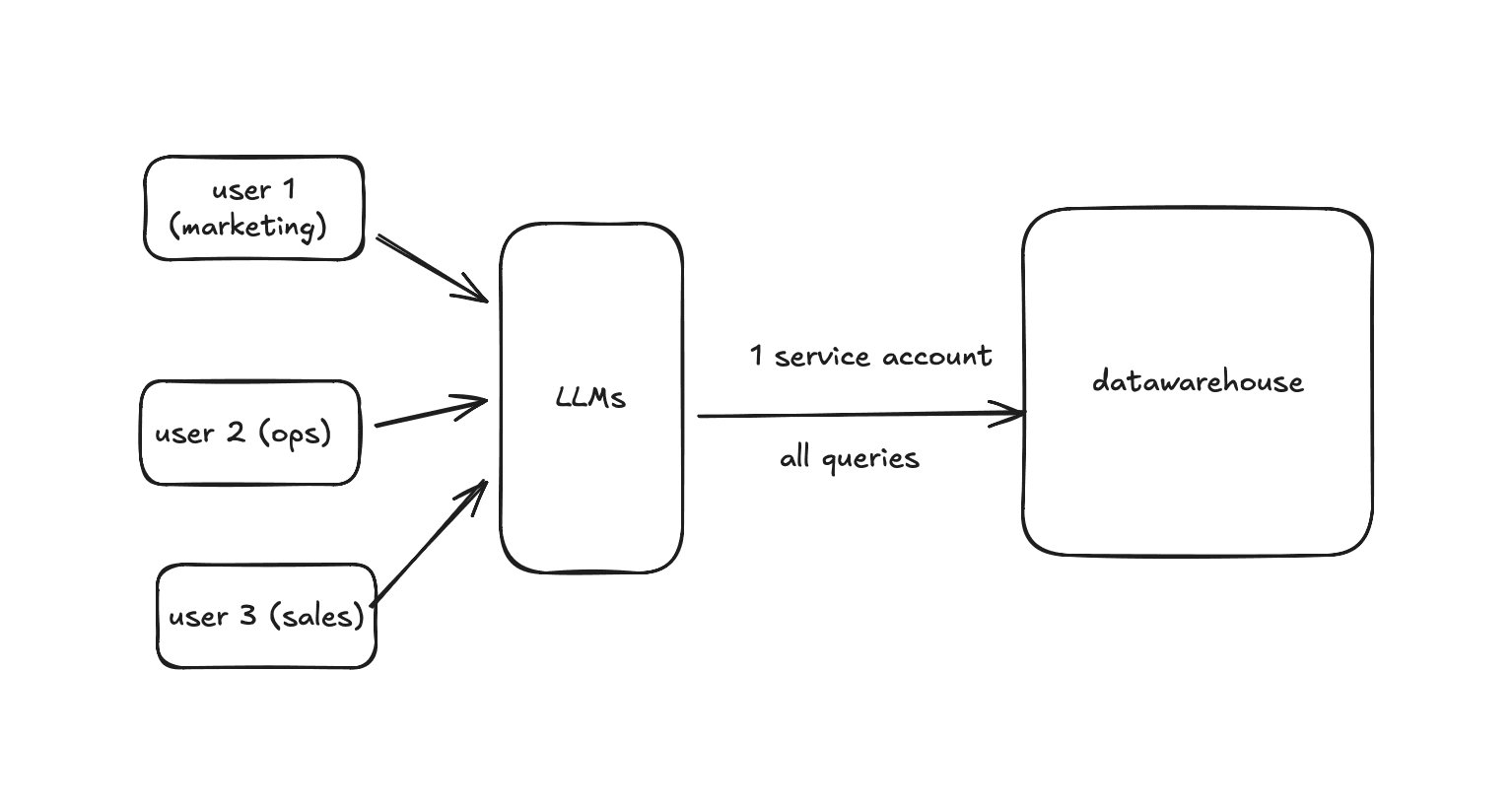
Without an access layer, every user gets the same unrestricted access and the agent sees every table.
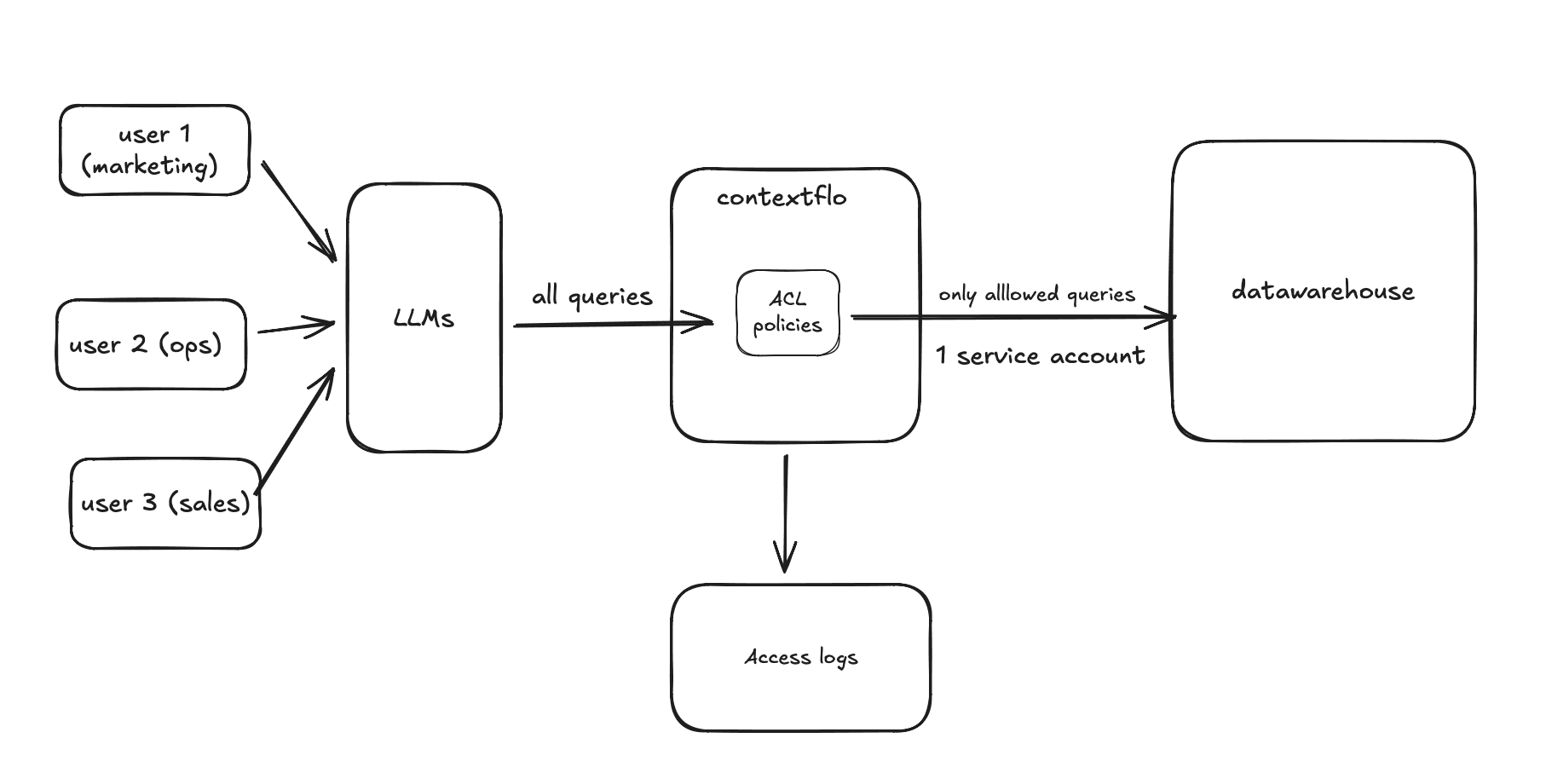
With Contextflo, access groups scope what the agent discovers per user.
Access groups
Admins define who sees which tables using namespace patterns. Allow marketing tables, deny finance tables. New users inherit defaults from their group. Deny always takes precedence. No per-user warehouse credentials to manage.
Context scoping from the start
When a user asks a question, the agent calls Contextflo's discovery endpoints to find relevant tables and metrics. Contextflo applies the user's ACL rules and only returns resources the user is permitted to access, so by default the agent never even sees tables outside their scope. That default is what improves accuracy and avoids surfacing sensitive tables by accident. The actual security boundary sits at query time: even if a user tells the agent to query a specific table directly, Contextflo rejects any query that touches tables outside their scope. So the agent can invent a table name that doesn't exist, but it can never read one the user isn't permitted to.
A marketing analyst asks:
"What's our CAC by channel this quarter?"
What happens:
- The agent calls Contextflo's discovery endpoint to find relevant tables and metrics
- Contextflo checks the user's access group and returns only marketing tables: spend, campaigns, attribution
- Finance, HR, and sales compensation tables are never returned, so the agent doesn't know they exist
- The agent writes the SQL, calls Contextflo's query endpoint to execute it, and returns the answer
Contextflo serves the discovery and query endpoints. The agent does the reasoning and execution. Fewer tables in the agent's context means less ambiguity and faster, more accurate answers.
Query logs
Every interaction is logged: the question asked, the SQL generated, and the tables accessed. Admins have full visibility into what each user and team is querying, making it straightforward to spot context gaps and refine business definitions over time.
Start with ACL from day 1
ACL is not just a governance feature. It narrows the agent's context, which directly improves accuracy and reduces token costs. If you are setting up agentic analytics, build ACL in from day one. You need it for governance anyway, and it makes the agent better at its job.
Here is a more in-depth look at Contextflo and how it works.
What is Contextflo?
Contextflo is a governed context layer between your data and the AI your team already uses. Connect your warehouse once, and your team asks questions in their own Claude or ChatGPT. The model writes and runs the SQL; Contextflo supplies the definitions, the per-user access control, and the audit that make the answers trustworthy. Your data never moves, and you do not need a data team.
How it works
Your team queries in their own Claude or ChatGPT over MCP, so you bring any agent rather than a locked-in bot, and every answer comes back with the SQL shown and access enforced per user.
See it on your own data.
Connect your warehouse and your team can ask Claude about it the same day, without waiting on a data team. Want a walkthrough first? Grab 20 minutes.
Book a 20-minute callSee how teams use Contextflo
Related posts

Keep reading
Conversational analytics: 5 ways to set it up, compared
7 min read
How to connect Claude to BigQuery? What works and what doesn't in 2026
8 min read
How to connect Claude to Postgres without giving it write access
9 min read

How to build a BI dashboard with Claude that your team can actually trust
8 min read
How to give Claude read-only access to your database (it isn't always the default)
7 min read
You connected your warehouse to Claude, now what?
5 min read

How to set up Claude with Snowflake semantic views, step by step
14 min read
How to use Claude to identify user fraud
6 min read
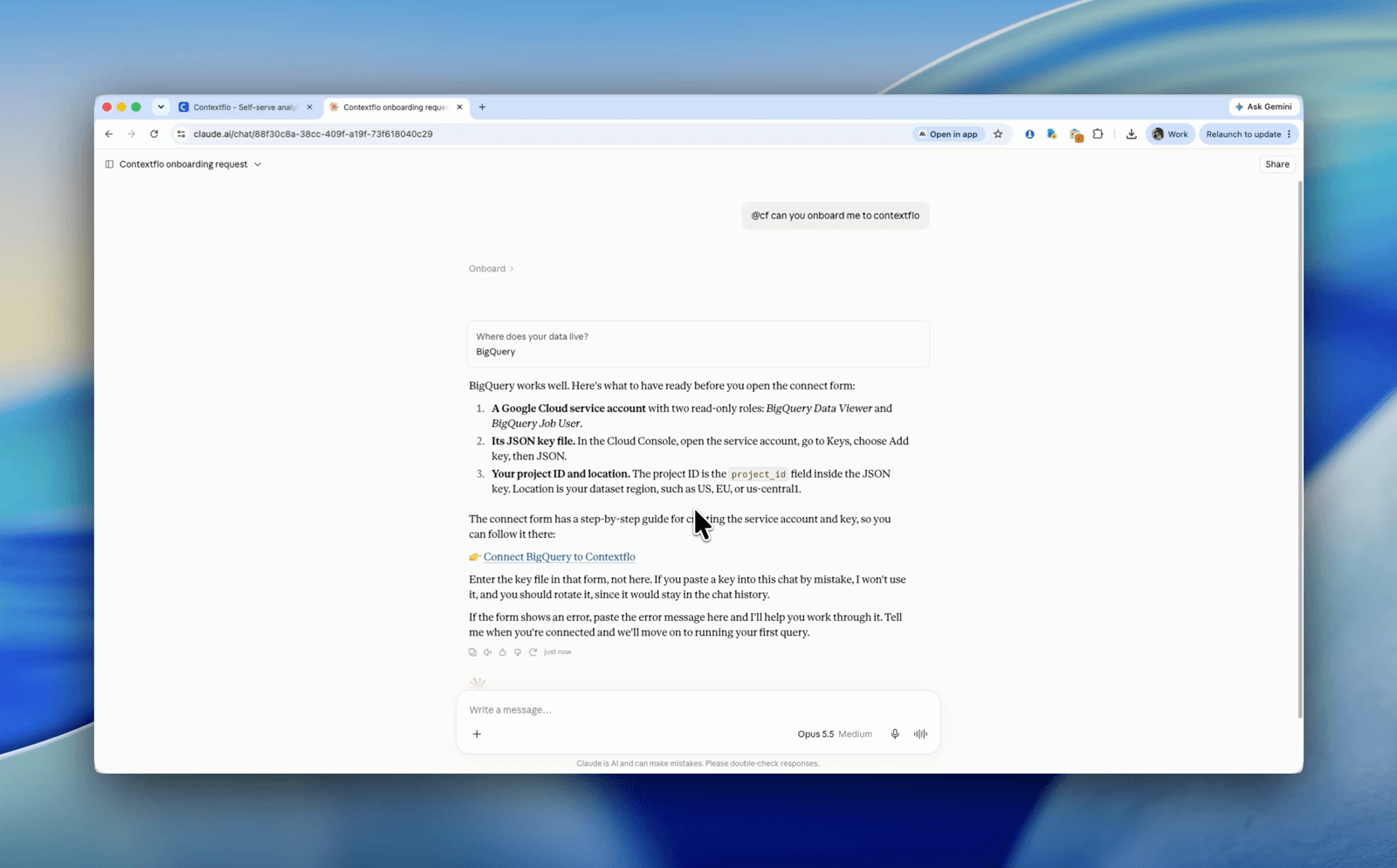
Set up Contextflo from inside Claude: onboarding is now a conversation
3 min read