You connected your warehouse to Claude, now what?
You connected your warehouse to Claude or ChatGPT. Now hand it to 20 people. Here's what breaks and what you actually need: shared definitions, access controls, audit trails, and gap detection.
You connected your warehouse to Claude. It works. You can ask questions in English and get SQL results back. That's genuinely useful, for you, the person who set it up, querying a schema you already know.
Now try handing it to your marketing lead. Or your CEO. Or 20 people across three departments. That's where it breaks.
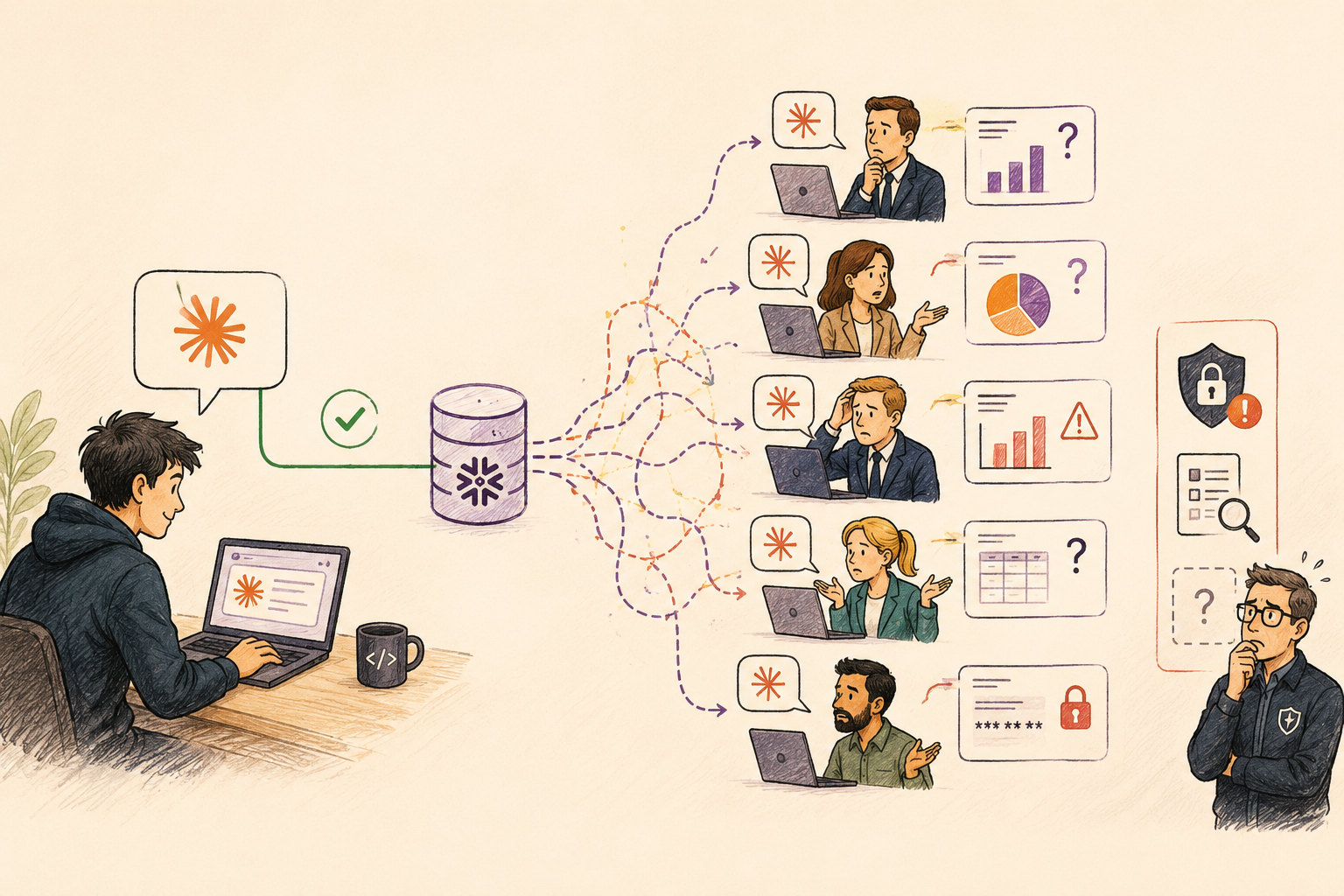
The demo works. The team doesn't.
A raw MCP connection gives Claude the ability to run SQL against your warehouse. That's it. No shared definitions, no access controls, no audit trail. Here's what happens when your team starts using it:
- Two people ask the same question, get different answers. "What's our churn rate?" depends on how Claude interprets "churn." Without a shared definition, it guesses based on phrasing.
- Everyone sees everything. The intern can query salary data. The marketing team can see raw financial tables. There's no scoping.
- You have no idea what people are asking. No audit trail means no visibility into which questions are being asked, which queries are running, or where answers are wrong.
- Corrections don't stick. You fix a wrong calculation in one conversation. Tomorrow, someone else hits the same wrong answer. Every conversation starts from scratch.
- Setup is per-person. Everyone needs to configure their own MCP connection, manage credentials, and figure out the schema themselves.
This isn't a Claude problem. It's a context problem. The AI is doing exactly what you'd expect with the information it has, which is just a raw database schema.
What a team actually needs
Going from "one engineer querying" to "20 people across departments" requires five things that a raw MCP connection doesn't have:
1. Shared business definitions
"Revenue" means gross revenue to the CTO, net revenue to the CFO, and contracted ARR to the sales lead. The AI needs one source of truth. Define "revenue" once, and everyone gets the same number regardless of how they phrase the question.
2. Access controls
Not everyone should see every table. Marketing sees marketing data. Finance sees finance data. Nobody accidentally queries PII or salary tables. This needs to happen at the application level, not the database level, because you don't want to manage separate database users for every team member.
3. An audit trail
Who asked what, when, and what SQL was generated. Not for surveillance, for quality. If five people are asking about churn and getting different numbers, you need to see that. If someone's asking about tables they shouldn't have access to, you need to know.
4. Persistent context
When a query gets corrected, that correction should apply to everyone, not just one conversation. Saved queries, verified calculations, and business concepts that the AI references every time, not just when you remember to paste them into the prompt.
5. Gap detection
When someone asks a question the system can't answer well, because a business term isn't defined or a table relationship is unclear, you need to know about it. Not after someone complains, but proactively.
This is the actual work
The connection step takes 10 minutes. The five things above are what take a team from "cool demo" to "this is how we work now."
You can build all of this yourself. It'll take a quarter, minimum. And then you have to maintain it. Every schema change, every new metric, every new team member.
Or you can use a tool that does it for you. That's what Contextflo is: the layer between your warehouse and your AI that handles context, access controls, audit trails, and gap detection. It works with Snowflake, BigQuery, Postgres, MySQL, Redshift, Databricks, and ClickHouse. It connects to Claude, ChatGPT, or any MCP-compatible agent.
Tilt went from a 3-5 day data backlog to their entire team querying data independently through Claude against their Snowflake warehouse. Quark Expeditions, a polar expedition cruise operator, opened the same self-serve querying to its non-technical marketing and ops teams. The connection was the easy part. The context layer is what made it stick.
Here is Contextflo in action.
Contextflo is the context layer that takes a warehouse connection from "works for me" to "this is how the team works now." Free for one user and one data source.