Omni vs Hex: I Tried Both for Self-Serve Analytics
Hi, this is Vivek, building Contextflo. I share practical notes on getting answers from your data, a couple of times a month.
Omni and Hex both get filed under "AI data platform," but they are built for different people, and you feel it the minute you open either one. Omni is a governed BI platform. Hex is a notebook workspace. If you are choosing between them, the useful question is not which is better but which shape of tool your team actually needs, so this walks through both and then a third path that changes the question.
What Omni is
Omni is a modern BI platform that replaces Looker and Tableau. The team came out of Looker, it raised $120M in April 2026 at a $1.5B valuation, and the product is built around a governed semantic model: your metrics live in one central definition, you model your data once, and everyone's dashboards inherit that model. You get dashboards, workbooks, SQL, spreadsheet-style formulas, and an AI assistant on top.
Omni's AI assistant uses Claude via AWS Bedrock, with a bring-your-own-model option, and it is grounded in a three-layer semantic model: Schema, which mirrors your database; Shared, for governed global metrics; and Workbook, an ad-hoc sandbox. You can also query Omni's governed data from outside tools like Claude, ChatGPT and Cursor through its MCP server.
The catch is the one every real BI platform has. Someone has to build that semantic model, and someone has to keep it alive as your data changes. From people who have implemented it, that is measured in months and dedicated resources, not an afternoon. Omni does not publish pricing; it is custom enterprise quotes.
What Hex is
Hex is an AI data platform built around collaborative notebooks. Data teams use it to write SQL and Python, build visualisations, and ship interactive data apps for stakeholders. It is a workspace for analysts and data scientists, and that is who it is aimed at.
Hex has two AI modes worth separating, because they serve different people:
- Notebook Agent helps data teams write SQL and Python faster, debug errors, and build dashboards from prompts.
- Threads is a conversational interface where a non-technical user types a question and gets an answer, backed by governed notebooks.
Threads is the mode a business stakeholder touches, and it is grounded in endorsed data and semantic models your data team sets up. It answers by running against what has been curated for it. Pricing starts free, then runs $36 to $75 per editor per month, with AI credits charged on top, and enterprise is custom-quoted.
Where Omni and Hex actually differ
If you are deciding between the two, ignore the shared "conversational AI" marketing for a second and look at the core shape.
Omni is a dashboard-and-semantic-model platform. Its centre of gravity is a governed model that finance and the board can trust, with workbooks and spreadsheet-style formulas for the people who live in cells. Hex is a notebook, and its centre of gravity is exploratory analysis: SQL and Python and narrative in one document, which is where a data scientist wants to be and where a marketer never will be.
So the honest split is about who does the daily work. If your analysts write Python and want a modern place to explore and publish, Hex is the more natural home. If your goal is governed reporting that stays consistent across the company and does not depend on anyone opening a notebook, Omni is the shape you want.
The thing they have in common
Here is the part that matters if a non-technical person is the reason you are shopping at all. Both tools put a conversational AI in front of your team, and both make that AI only as good as a foundation a data team builds first. Omni's assistant is grounded in the semantic model someone models by hand. Hex Threads is grounded in the notebooks and semantic models someone endorses. In both cases the answer a stakeholder gets on day one depends on work that has not happened yet on day one.
That is not a flaw. Governed answers come from governed foundations, and that is what these platforms are. It is just the cost to keep in view: if you do not have a data team to build and maintain that layer, the conversational part does not light up.
A third path: Contextflo
This is where the question changes rather than gets a third contestant of the same kind. Contextflo starts from the opposite assumption: that you do not have someone to build and maintain a modelling layer, and you want answers anyway.
Instead of a data team hand-writing a semantic model, Contextflo connects to your database and generates the context an LLM needs, table relationships, column descriptions and metric definitions, from your schema, your source code and your docs. Those definitions are then served to the Claude or ChatGPT your team already has open, the model writes and runs real SQL against your data through MCP, and the answer comes back with the query shown so you can check it. Setup is about ten minutes. It does the jobs you open a BI tool for as well: dashboards, scheduled reports, governed metric definitions, and table-level access control with every query attributed to a user and logged. The team tier is $75 per user per month for unlimited queries, and it is free for one user and one data source if you want to point it at a database and see what it does.
At Tilt, a live-auction marketplace for limited-edition goods, most of the company self-serves this way, running around 6,000 queries a month against governed, access-controlled data, with no data team standing up a model first.
Two honest limits, because this is not a free win. Contextflo is not a notebook: if your analysts want to write Python, explore, and build data apps, that is exactly what Hex is for and Contextflo does not replace it. And the generated context is a draft. It is usually right about structure and often wrong about business meaning, because no schema records that orders before a migration used a different status vocabulary, so someone who knows the business still reviews it before it carries a number onto a board deck. What changes is that reviewing a draft is a couple of hours instead of a modelling project that runs for weeks.
Side by side
| Omni | Hex | Contextflo | |
|---|---|---|---|
| What it is | Governed BI platform, replaces Looker/Tableau | Collaborative notebook workspace | BI jobs plus a bring-your-own-agent layer |
| Built for | Data team plus business stakeholders | Analysts and data scientists | Anyone on the team, in Claude or ChatGPT |
| Conversational AI | Assistant grounded in the semantic model | Threads, grounded in endorsed notebooks | Ask in your own Claude/ChatGPT, SQL shown |
| Before anyone asks | Data team builds a three-layer semantic model (weeks to months) | Data team builds and endorses notebooks | Connect database, context generated (~10 min) |
| Needs a data team? | Yes | Yes | No |
| Notebook / Python exploration | No, workbooks and spreadsheet formulas | Yes, SQL and Python notebooks | No, asks in chat instead |
| Data sources | Warehouse-centric | Warehouses and databases | Warehouses plus SaaS APIs and CSVs |
| AI model | Claude via AWS Bedrock, plus a BYOM option | Hex's AI, credits charged per use | Connects to your own Claude subscription |
| Pricing | Custom enterprise quotes | Free tier, then $36–75/editor/mo plus AI credits | $75/user/mo unlimited, free for 1 user and 1 source |
The notebook row is the one that keeps Hex and Contextflo from being substitutes. If exploratory data science is a daily job on your team, no amount of conversational answering replaces a place to write Python.
Which one do you have?
Choose Omni if you are replacing Looker or Tableau, you have a data team to build and maintain a governed semantic model, and you need versioned, finance-signed-off reporting the board will trust.
Choose Hex if your analysts and data scientists want a modern workspace to write SQL and Python, explore, and publish data apps, and you have the people to keep the notebooks that power Threads current.
The reason to look past both is narrower and worth naming plainly: you want your whole team getting answers this week, in the tool they already use, and nobody is going to spend the next few months standing up and babysitting a model or a notebook library. That is the gap the third path is built for, and it is also the failure mode both platforms share when the person who owned the foundation moves on and the curated layer quietly goes stale.
If you are still not sure, start with the cheaper or faster option for the shape you picked. It is far easier to graduate into a full platform later than to unwind a rollout you did not need.
Here is a more in-depth look at Contextflo and how it works.
What is Contextflo?
Contextflo is a governed context layer between your data and the AI your team already uses. Connect your warehouse once, and your team asks questions in their own Claude or ChatGPT. The model writes and runs the SQL; Contextflo supplies the definitions, the per-user access control, and the audit that make the answers trustworthy. Your data never moves, and you do not need a data team.
How it works
Your team queries in their own Claude or ChatGPT over MCP, so you bring any agent rather than a locked-in bot, and every answer comes back with the SQL shown and access enforced per user.
Find out if Contextflo is the right fit for you.
See how teams use Contextflo

Related posts

Keep reading
Conversational analytics: 5 ways to set it up, compared
7 min read
How to connect Claude to BigQuery? What works and what doesn't in 2026
8 min read
How to connect Claude to Postgres without giving it write access
7 min read

How to build a BI dashboard with Claude that your team can actually trust
8 min read
How to give Claude read-only access to your database (it isn't always the default)
7 min read
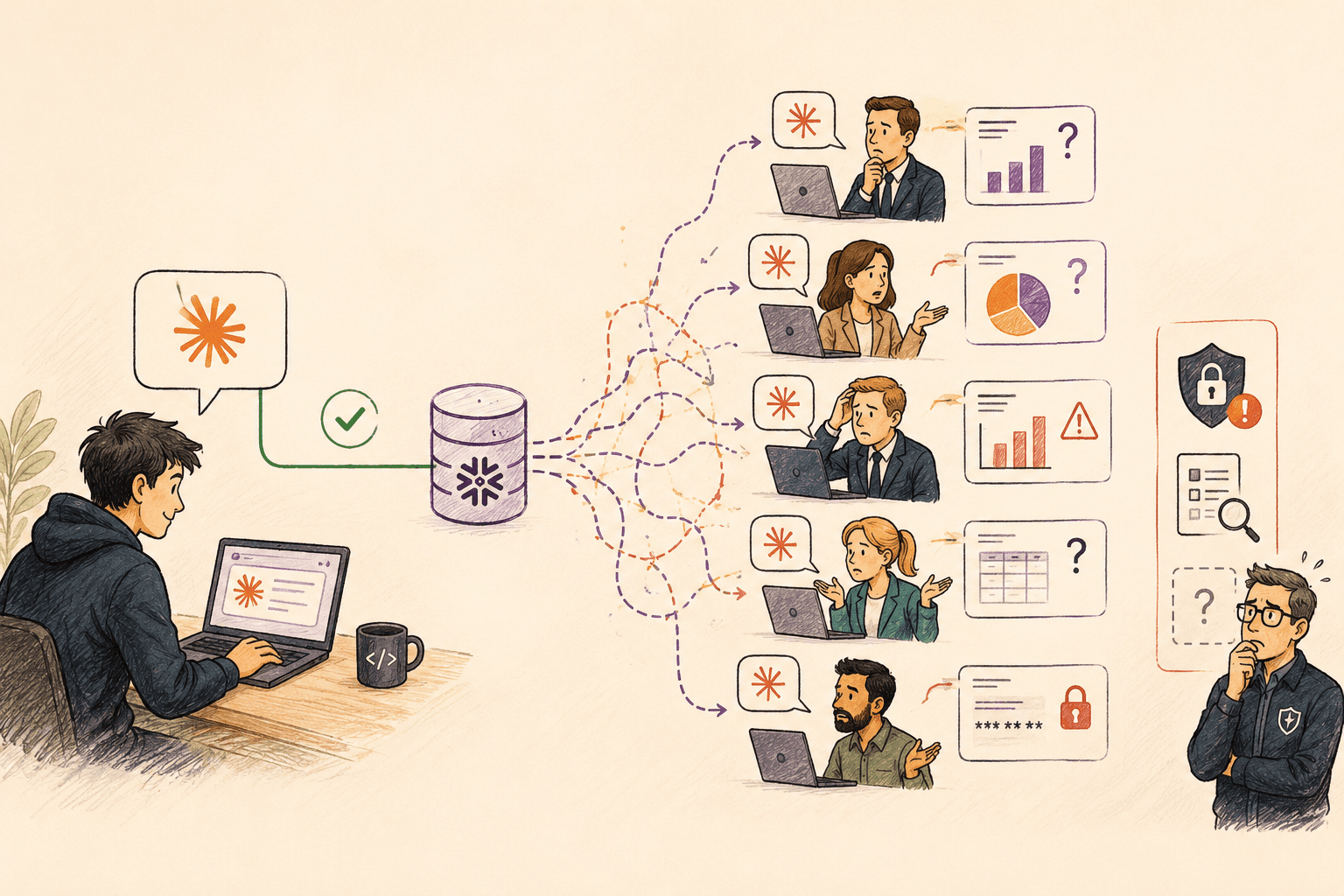
You connected your warehouse to Claude, now what?
5 min read
The official Postgres server for Claude is archived. Here's what to use instead.
7 min read
Why is the team missing sprint goals? How to analyze Jira data with AI
8 min read
Are my ads actually profitable? How to analyze Facebook and TikTok ads together with AI
7 min read