Zenlytic vs Contextflo: what's the difference?
Hi, this is Vivek, building Contextflo. I share practical notes on getting answers from your data, a couple of times a month.
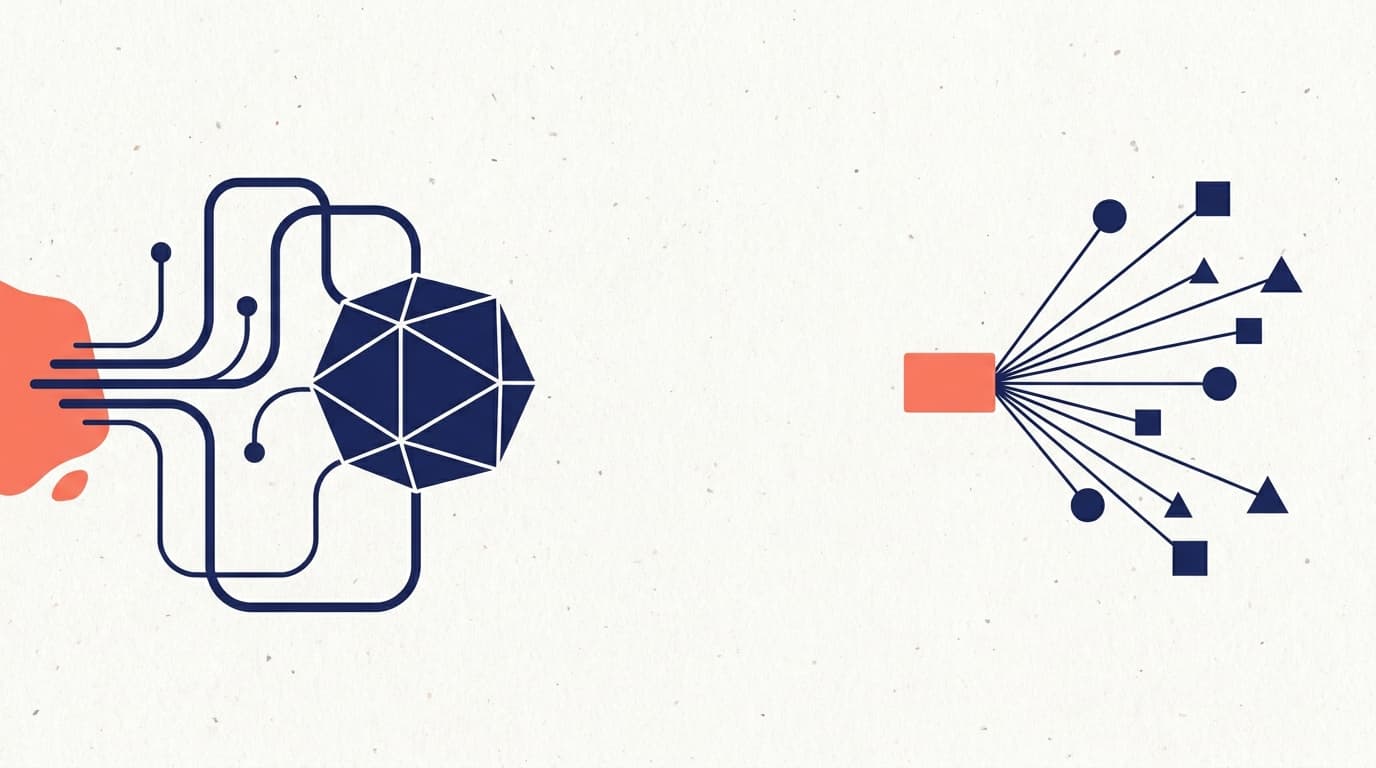
Zenlytic and Contextflo both promise the same relief: stop building dashboards, just ask your data a question and get a trustworthy answer back. They get there by opposite routes. Zenlytic gives you a new analyst to trust, an AI agent named Zoë that reasons over a semantic layer it builds and governs. Contextflo gives you no new analyst at all; it hands the reasoning to the Claude or ChatGPT your team is already in. I run Contextflo, so read the rest knowing that, but the two products genuinely suit different teams, and the split is easy to see once you know where to look.
What Zenlytic is
Zenlytic calls itself "The AI Data Analyst for Your Entire Org," and that framing is exact. The product is Zoë, an AI analyst that connects to your warehouse, works out which tables matter, and builds a semantic layer in the background. Its May 2026 release, Zoë Self-Learning, leans hard on this: no six-month data-model buildout, no hand-written YAML, an answer in under an hour from a connected warehouse.[1]
The pitch that sets Zenlytic apart is verification. Zoë "doesn't give you data to interpret," the site says; she investigates the question, explains what she found, and returns an analysis with citations and a visual representation a business user can check.[2] That is a real answer to the thing everyone fears about AI on data, which is a confident wrong number. Zenlytic is built to show its work.
The tradeoff sits in the same sentence. Zoë is the analyst, and she reasons over Zenlytic's semantic layer. Even when the answer lands in Slack, Teams, or a Claude window, you have adopted a new analyst and, underneath her, a governed model that Zenlytic owns. For a lot of teams that is the point. For others it is one more system to run.
The fork: one analyst to trust, or your own agent with context
Before comparing features, get this straight, because everything downstream follows from it. Do you want a purpose-built analyst that owns the reasoning, or do you want the agent your team already uses to do the reasoning with better context?
Zenlytic is the first shape. Zoë is a deliberate, governed intermediary. She reads your question, plans against a semantic model, and returns a verified result. You are buying an analyst and trusting her method.
Contextflo is the second shape. There is no analyst in the middle. Your Claude or ChatGPT connects to your data through MCP, and Contextflo supplies what the model needs to be right: context generated from your schema, source code, and docs, the metric definitions, the saved queries, and the access rules. The model writes the SQL, runs it, and shows you the query so you can check it yourself. What you govern is the data and the context, not a vendor's analyst.
Neither is the beginner option or the enterprise option. It is a question of what you want to own.
Side by side
| What you're comparing | Zenlytic | Contextflo |
|---|---|---|
| The agent | Zoë, Zenlytic's own AI analyst, reasons over its semantic layer | Your Claude or ChatGPT is the agent; it writes and runs the SQL |
| Where answers show up | In Zenlytic, or Zoë posts into Slack, Teams, Claude, ChatGPT | In the Claude or ChatGPT window your team already works in |
| Access control | Role-based with row-level permissions, SSO/SAML, SOC 2 Type II | Query-time, table-level (Users to Groups to Rules), enforced before the warehouse, every query logged to a user |
| Context | Zoë builds and governs a semantic layer from your warehouse; imports dbt and Looker models | Generated from schema, source code, and docs; a draft you review that your agent reads |
| Sources and setup | 12-plus warehouses, answer in under an hour | Warehouses plus SaaS APIs (Stripe, Amplitude, GA, HubSpot) and CSV upload, roughly ten-minute setup |
Where Zenlytic wins
If a wrong number in a board deck is the failure you lose sleep over, Zenlytic is built around that fear in a way Contextflo is not. Zoë's whole design is verification: every answer carries citations and a deterministic visual representation a non-technical person can sanity-check, and it comes off a governed semantic layer she reasons against rather than free-handing SQL each time.[2] When the same metric has to mean the same thing every time an exec asks, a maintained semantic model with an analyst enforcing it is a strong way to get there.
Zenlytic also governs finer than we do. Its role-based access includes row-level permissions, so one user can query a table and see only their region's rows while another sees all of it.[2] Contextflo's access control is table-level, so if row-level filtering is a hard requirement today, Zenlytic goes where we currently do not.
And it is a polished, end-to-end product. Zoë produces finished artifacts, dashboards, Excel models, Word reports, PowerPoint, off the same governed layer, with SSO/SAML and SOC 2 Type II for buyers who need the checklist.[2] If you want one owned surface that takes a question all the way to a deck, that is what Zenlytic is.
Where Contextflo wins
The reason Contextflo exists is that most teams do not want to adopt and maintain a new analyst. They want the tool already open on everyone's screen to get smarter about their data.
Contextflo connects Claude or ChatGPT to your warehouses, plus SaaS sources like Stripe and Amplitude and any CSV you upload, through MCP. Nobody learns a new interface, because the interface is the chat they already use. The agent is the one your team already trusts for everything else, so there is no second analyst whose judgment you have to learn to trust.
Access control runs at query time. Admins set which schemas and tables each person or group can reach, the rule is enforced before anything touches the warehouse, and every query is attributed to a real user and logged. That audit trail is per user and it spans the bring-your-own agent, which is the piece a proprietary analyst tends not to expose.
The context is the other difference. Zenlytic's Self-Learning reads your warehouse to build its model, which is a genuinely good on-ramp. Contextflo reads more than the warehouse: your schema, your source code, and your docs all feed the context, so the definition of rev_usd can come from the comment in the code that computes it, not just the column name. And that context is a draft you review before it goes live, not a black box.
Contextflo also does the ordinary BI jobs you would otherwise keep another tool for: dashboards, scheduled reports, governed metric definitions, and saved queries your team reuses. Team pricing is $75 per user per month for unlimited queries, with no meter running while people explore, and it is free for one user and one source if you want to try it first.
The honest limit
Here is where Contextflo is the wrong call. If you need one blessed, versioned definition of every metric that finance and the board will sign off on, an analyst enforcing a governed semantic model is describing exactly what you want, and Contextflo's generated context is a draft someone still has to review rather than a finance-approved system of record. Our access control is table-level, not row-level, so a team that must slice a single table by row today should look hard at Zenlytic. Contextflo shows and logs the query and gives your agent strong context; it does not put a proprietary analyst between the model and the answer, and for some teams that intermediary is the reassurance they are buying.
How to choose
Answer two questions and the decision mostly makes itself.
Who should own the reasoning? If you want a purpose-built analyst that plans against a governed model and defends every number, Zenlytic is built for that, and the verification story is real. If you would rather the Claude or ChatGPT your team already uses do the reasoning, with context and access control wrapped around it, that is Contextflo.
How fine does access control need to be, and where should the answer appear? If you need row-level permissions inside a governed product, Zenlytic goes finer. If you need per-user query logging across your own agent and want the answer in the chat window that is already open, Contextflo fits.
If you are torn, the cheaper mistake is the reversible one. It is easier to graduate into a heavier governed analyst later than to unwind one you did not end up needing.
FAQ
Is Zenlytic the same as Contextflo? No. Zenlytic is an AI data analyst named Zoë that reasons over a semantic layer Zenlytic builds and governs, then delivers verified answers with citations. Contextflo connects your own Claude or ChatGPT to your data and supplies the context the model needs to write and run the SQL itself, so the agent is the one you already use rather than a proprietary analyst.
Does Zenlytic work with Claude and ChatGPT? Zenlytic lists Claude and ChatGPT among the surfaces its analyst Zoë can reach, alongside Slack and Microsoft Teams. The distinction is who does the reasoning. In Zenlytic, Zoë answers off Zenlytic's semantic layer. In Contextflo, your Claude or ChatGPT is the agent that writes and runs the query, with Contextflo providing context and access control.
Which one governs data access more tightly? They govern differently. Zenlytic offers role-based access with row-level permissions inside its own layer. Contextflo enforces access at query time, table by table, before anything hits the warehouse, and attributes every query to a user in an audit trail. If you need row-level filtering today, Zenlytic goes finer; if you want per-user query logging across your own agent, Contextflo fits better.
Do I need to build a semantic layer for either one? Neither makes you hand-write one from scratch anymore. Zenlytic's Zoë Self-Learning builds a semantic layer from your warehouse in the background. Contextflo generates its context from your schema, source code, and docs, and treats it as a draft you review. Zenlytic's output is a governed model Zoë reasons over; Contextflo's is context your own agent reads.
Here is a more in-depth look at Contextflo and how it works.
What is Contextflo?
Contextflo is a governed context layer between your data and the AI your team already uses. Connect your warehouse once, and your team asks questions in their own Claude or ChatGPT. The model writes and runs the SQL; Contextflo supplies the definitions, the per-user access control, and the audit that make the answers trustworthy. Your data never moves, and you do not need a data team.
How it works
Your team queries in their own Claude or ChatGPT over MCP, so you bring any agent rather than a locked-in bot, and every answer comes back with the SQL shown and access enforced per user.
Find out if Contextflo is the right fit for you.
See how teams use Contextflo
Related posts

Keep reading
Conversational analytics: 5 ways to set it up, compared
7 min read
How to connect Claude to BigQuery (and fix the errors you'll hit)
8 min read
How to connect Claude to Postgres (and keep it read-only)
7 min read

How to build a BI dashboard with Claude that your team can actually trust
8 min read
How to give Claude read-only access to your database (it isn't always the default)
7 min read

You connected your warehouse to Claude, now what?
5 min read
How to connect Google Sheets to Claude, and ask it alongside your warehouse
4 min read

A travel company's revenue team stopped opening Power BI every morning
3 min read
How finance and ops teams catch the numbers that don't match, before a customer does
4 min read