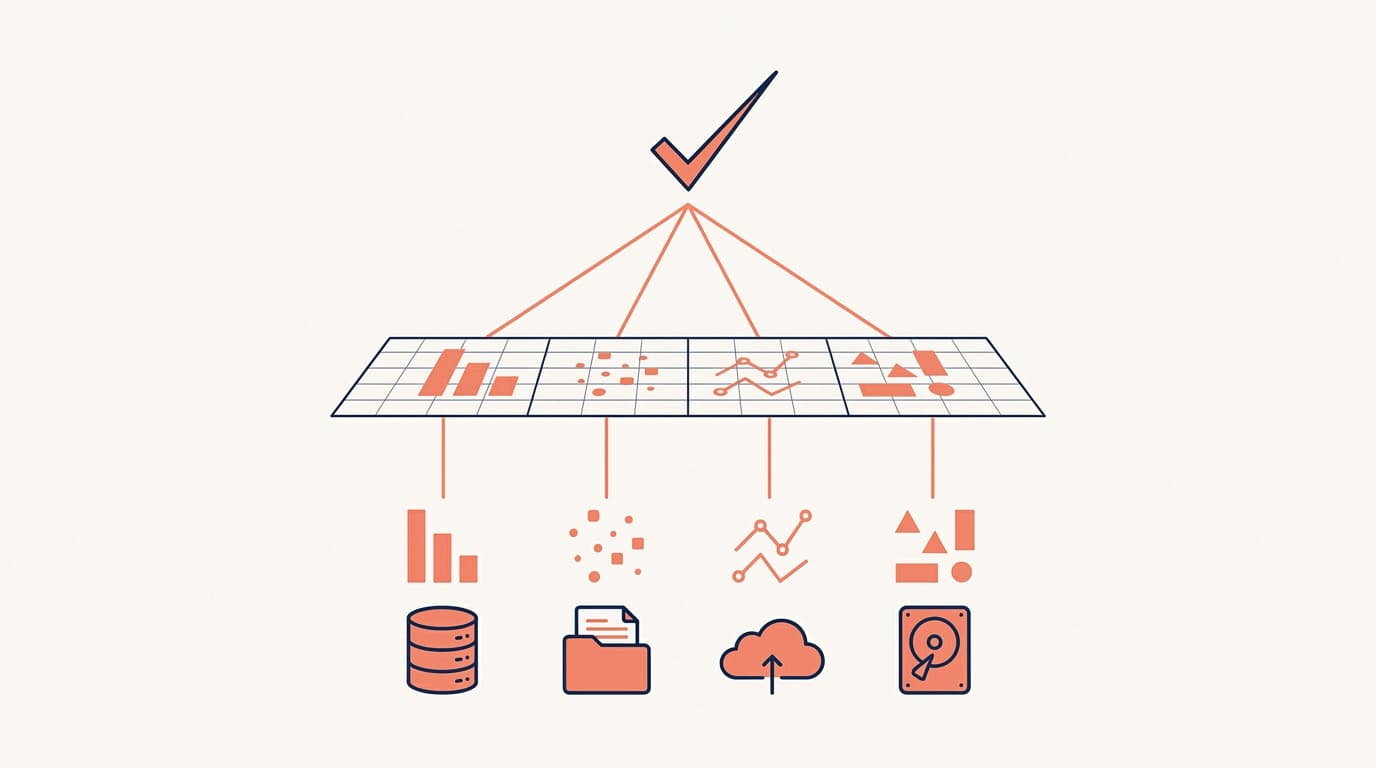
A data lead told me recently that AI would not really help his team until they had a properly modeled warehouse to layer context on top of. The same attribute lived in four different systems, he said, and there was no canonical source of truth for an AI to reason against. He is half right, and the half he gets right is the half most people skip. So let me give him that point first, then tell you where I think the conclusion goes wrong.
The part he gets right
Garbage in, garbage out is real. If "revenue" means four different things across four systems and nothing declares which one is correct, an AI writing SQL will pick one and sound completely confident about it. That is not a hallucination. It is the model faithfully answering an ambiguous question with an ambiguous source.
Point an AI at messy, undefined data and expect a clean answer, and you will be disappointed. Some amount of structure genuinely helps. I am not going to pretend otherwise, and any tool that tells you it will read your chaos perfectly is selling you something.
But "helps" is not "required"
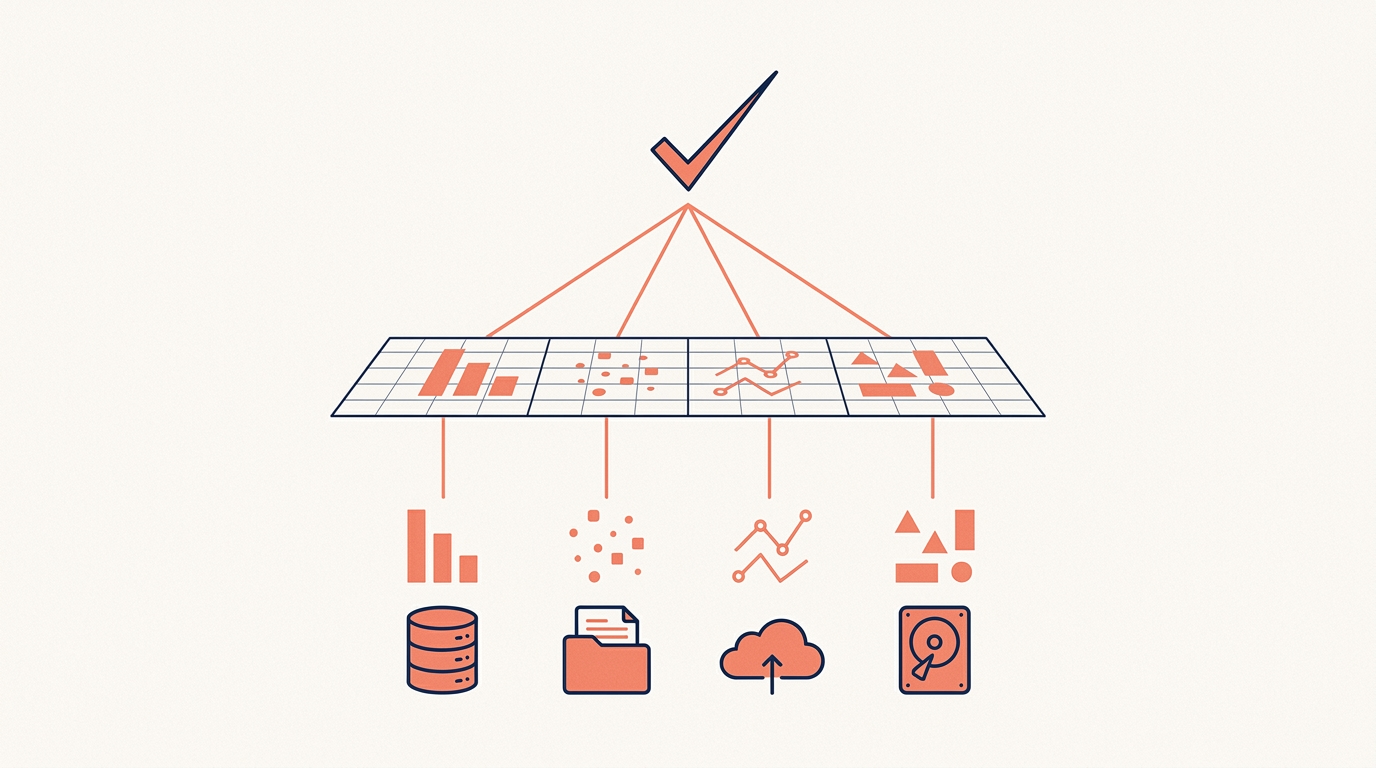
Here is where the conclusion goes wrong. "You need a properly modeled warehouse" quietly turns a helpful thing into a mandatory prerequisite for any useful answer. That is a false binary. The sharper claim is this: you do not need a fully modeled warehouse before AI can answer a useful question. You need trustworthy, queryable data and explicit semantics for the questions you actually care about. A context layer can supply those semantics before you invest in materialized models. It does not replace pipelines, cleansing, and governance when those are genuinely needed.
The work of deciding what "active customers" means does not disappear. It moves earlier and gets lighter. Instead of consolidating four systems into one modeled warehouse before anyone can ask a question, you write the definition down once, in a context layer the AI reads, and start asking. You still model later, for the cases that actually need it.
The real problem, named precisely
In this case, the immediate issue is not "unmodeled data." It is "no agreed definition."
Say "active customer" shows up in your product database, your billing system, your CRM, and a spreadsheet finance keeps. Each one counts it a little differently. The problem is not that these live in different places. The problem is that nobody has decided which definition wins. An AI cannot resolve that for you, because it is a business decision, not a technical one.
But once you have made the decision, you do not need to physically merge the four systems to act on it. You need to write the decision down somewhere the AI will use it.
What each approach actually solves
A context layer and a modeled warehouse are not two ways to do the same job. They solve different problems, and most teams eventually want some of both.
| Context definition | Modeled data | |
|---|---|---|
| Best for | Meaning, source precedence, joins | Cleaning, integration, testing, performance |
| Works quickly when | Existing tables are already queryable | Reusable transformations are required |
| Does not solve alone | Bad or inaccessible data | Ambiguous business terminology |
The lightweight, context-first path works when a few things are true:
- The relevant data is already queryable and reasonably trustworthy, whether that is an operational database, a read replica, or a governed view (not raw landing tables).
- The AI has secure, scoped query access to it.
- The joins you need can run in the query engine you already have.
- The metric mainly needs semantic clarification, not heavy transformation.
When those hold, defining the semantics gets you useful answers without a remodel. When they do not, because of malformed data, currency normalization, deduplication, or historical restatements, that is exactly where a pipeline earns its place, and no definition substitutes for it.
What each one actually looks like
Take signups, a metric that really is a source-selection problem: the same signup can show up in your product database, your CRM, and a marketing tool, with no accounting logic to reconcile. Assume the business has chosen the product users table as canonical, and that table is already queryable. There are now two ways to give an AI that definition, from the same starting point.
The modeled-warehouse way. You materialize the metric as a tested, scheduled model:
-- models/marts/signups.sql  (dbt)
select
  date_trunc('month', created_at) as month,
  count(*)                        as signups
from {{ ref('stg_app_users') }}   -- the source you chose as canonical
group by 1
Then the AI queries the finished signups table. This is the right move when the transformation is reused constantly, needs tests, has to stay fast at scale, or genuinely reconciles several sources. For a single already-clean source and a one-line definition, though, it is mostly overhead: a materialized table, a test suite, and a schedule to maintain, for something the definition alone already expresses.
The context-layer way. You skip the modeled table. You write the same decision down once, as a definition the AI reads before it answers anything:
Metric: signups (monthly)
  = COUNT(app_users.id) grouped by signup month
Excludes: internal and test accounts (email like '%@yourco.com')
Source of truth: the app users table (not the CRM lead count or the marketing form-fills)
Grain: month, via date_trunc('month', app_users.created_at)
Join: app_users.plan_id = plans.id, when a question breaks signups down by plan
Now when someone asks "how many signups last month," the AI has already been told what a signup means, which source counts, and how to break it down. It writes SQL against the surfaces it is permitted to query, a governed view or the operational users table, using that definition. No consolidated warehouse, no materialized model.
Be precise about what this does, though. Here you are selecting a source, declaring the product users table canonical and setting the CRM and marketing tool aside, not reconciling several systems into one number. That is a common and genuinely useful case. Revenue would not be: the moment a metric needs deduplication, refunds, contract terms, currency conversion, or manual accounting adjustments, you are past what a definition can do, and a transformation pipeline is the right answer. A definition can handle source selection. It cannot perform real reconciliation.
One more qualifier: for the definition to help, the AI has to see it during query planning, on every relevant question, not just once at the top of a thread. Give it the permitted tables and views with no context and it guesses. Give it the same surfaces plus the canonical definition and it plans the query the way someone who knew your business would. The SQL it writes still runs through your access controls and should be validated, like any query hitting production data.
The minimum modeling that actually matters
You do not need to model everything. You need to define the few things your questions actually depend on:
- Canonical metrics: define "revenue," "active customer," "churn" once, including which source and which formula.
- Key joins: how your main tables connect, orders to customers, events to accounts. Get the handful that matter right and leave the rest.
- Source of truth for shared attributes: for anything that appears in more than one system, decide which one wins and say so.
For questions that mainly need semantic clarity, that covers what the AI was missing, without a full remodel. The heavier work, cleaning and transformation, you add for the metrics that genuinely need it, when they need it.
Where a context layer fits
This is the thing we built Contextflo around. It generates a context layer from your schema, your source code, and your docs, then lets you correct it and add the canonical definitions on top. Claude or ChatGPT reads that layer and writes SQL that uses your definitions instead of its own guesses. For the many questions that were only ambiguous, not dirty, that is enough to get more reliable answers without building a warehouse first. The pipeline work stays available for the cases that actually need it.
It helps to be clear about how this differs from two things it gets compared to. A tested transformation model enforces a calculation: it physically produces the numbers and guarantees them. A context layer guides query generation: it tells the AI how to write the query correctly against sources it is allowed to touch. Those are complementary controls, not substitutes, and mature stacks run both. And unlike a traditional semantic layer that you hand-build and bind to one BI tool, this context is generated automatically from your existing schema, code, and docs, and served to whatever AI client your team already uses.
The honest boundary
Two things I will not claim. First, if your data is genuinely contradictory and nobody will decide what is canonical, no tool saves you. Someone still has to make the call. A context layer makes capturing that decision light. It does not make the decision for you.
Second, this does not replace the governed warehouse at the center of a serious analytics stack. Where transformation is complex, governance is strict, query volume is high, or numbers cross organizational boundaries and have to reconcile, a modeled warehouse earns its keep, and a context layer sits alongside it, not on top of it. The honest framing is complementary. Smaller teams can start answering questions before they have built a warehouse at all. Larger teams can cover the long tail of sources and domains that have not yet justified a place in their core models, without compromising the models they already trust. This is not warehouse replacement. It is useful answers before every domain is modeled.
Here is a more in-depth look at Contextflo and how it works.
What is Contextflo?
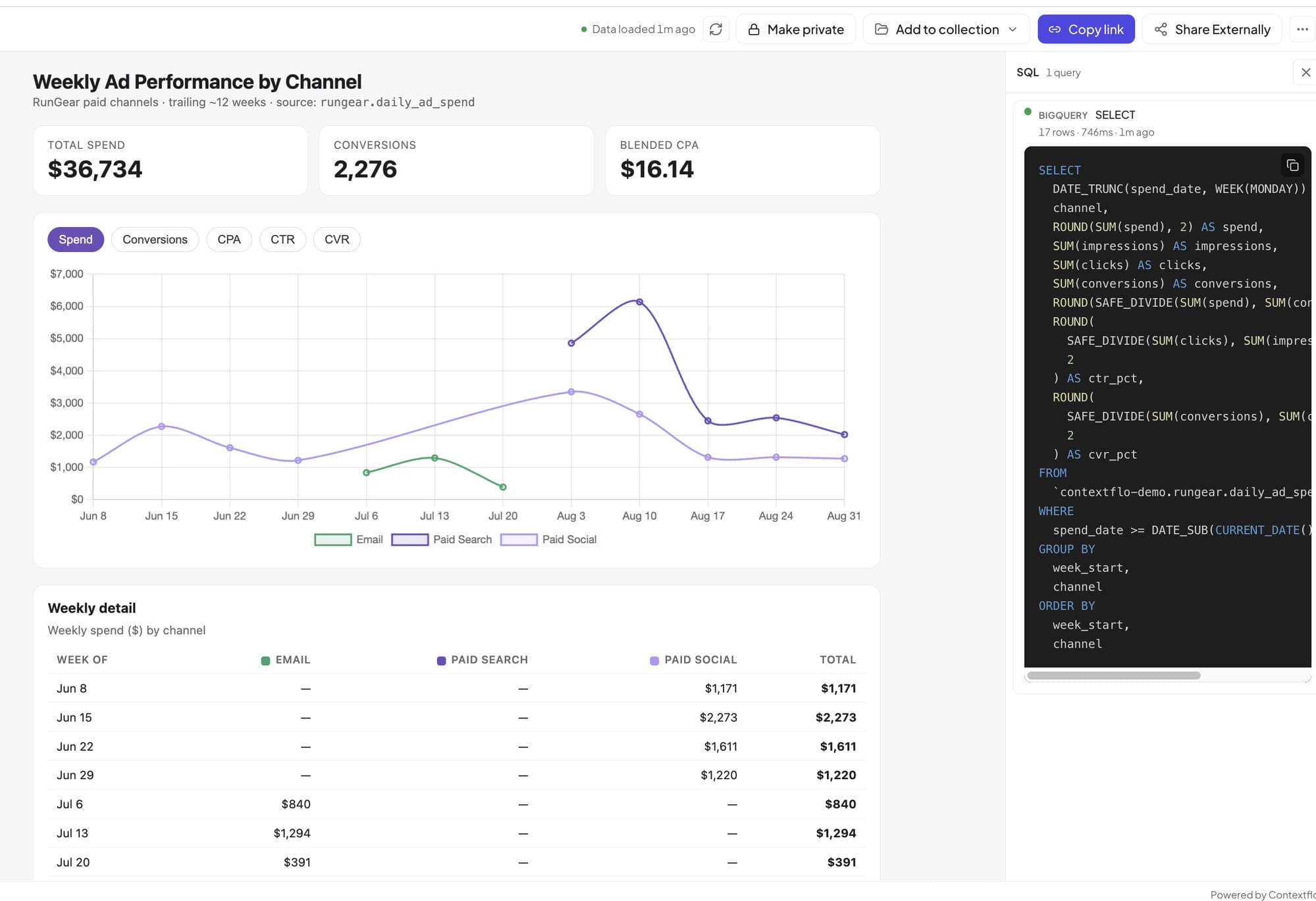
Contextflo is a governed context layer between your data and the AI your team already uses. Connect your warehouse once, and your team asks questions in their own Claude or ChatGPT. The model writes and runs the SQL; Contextflo supplies the definitions, the per-user access control, and the audit that make the answers trustworthy. Your data never moves, and you do not need a data team.
How it works
Your team queries in their own Claude or ChatGPT over MCP, so you bring any agent rather than a locked-in bot, and every answer comes back with the SQL shown and access enforced per user.
FAQ
Does AI need a data warehouse to analyze your data? AI does not inherently require a warehouse, but it does require secure access to queryable data and enough context to interpret that data correctly. If your data is already reachable and reasonably trustworthy, the missing piece is usually semantics: canonical definitions for terms like revenue or active customer, which can live in a lightweight context layer rather than a rebuilt warehouse.
Will AI give wrong answers on messy data? It can. If the same attribute is defined differently across several systems with no agreed source of truth, the model picks one and sounds confident about it, and deciding what is canonical fixes that ambiguity. But if the underlying records are malformed or require reconciliation, the data still needs to be cleaned or modeled: a definition resolves which source wins, not whether the data inside it is correct.
How much data modeling do you actually need for AI analytics? The minimum that questions depend on: your canonical metrics, the key joins between your main tables, and a decision about which system is the source of truth for attributes that appear in more than one place. You can leave the rest until a real question forces you to define it.
See it on your own data.
Connect your warehouse and your team can ask Claude about it the same day, without waiting on a data team. Want a walkthrough first? Grab 20 minutes.
Book a 20-minute callSee how teams use Contextflo

Related posts
Keep reading
Conversational analytics: 5 ways to set it up, compared
7 min read
How to connect Claude to BigQuery? What works and what doesn't in 2026
8 min read
How to connect Claude to Postgres without giving it write access
9 min read

How to build a BI dashboard with Claude that your team can actually trust
8 min read
How to give Claude read-only access to your database (it isn't always the default)
7 min read
You connected your warehouse to Claude, now what?
5 min read
ClickHouse MCP: how to connect ClickHouse to Claude, Cursor or Codex
6 min read
Query BigQuery from the Codex CLI with MCP
5 min read
Run ClickHouse queries from Codex with MCP
6 min read