Fabi.ai vs Contextflo: which one fits your team?
Hi, this is Vivek, building Contextflo. I share practical notes on getting answers from your data, a couple of times a month.

Both of these put AI between your team and your data, so it is easy to assume they compete for the same job. They mostly do not. Fabi.ai is a workspace an analyst operates. Contextflo is a way for everyone else to get an answer without one. I run Contextflo, so read the rest with that in mind, but the split is real and worth getting straight before you pick.
What Fabi.ai is
Fabi.ai is an AI-native analysis platform built around Smartbooks, its take on the data notebook. You write SQL and Python in reactive cells, lean on a built-in AI Analyst Agent to draft queries and charts, and then publish the notebook as a dashboard or an interactive data app for the rest of the company. It runs on DuckDB under the hood, so an analyst can crunch a few million rows without standing up Spark, and workflows push results out to Slack, email, or a spreadsheet on a schedule.
The center of gravity is the workspace. Someone who is comfortable in a notebook builds the analysis, wires up the app, and the AI speeds that person along. Non-technical colleagues mostly meet the output: the published report or the data app, not the raw notebook. Plans start free and move up through a per-builder-seat model, with AI requests metered on the lower tiers and warehouse plus SaaS connectors billed on top.
What Contextflo is
Contextflo connects your data to the Claude or ChatGPT your team already has open, through MCP. You ask in plain language, the model writes and runs real SQL against your warehouse, and the answer comes back in the chat with the query shown so you can check it. Under that sits the part a chat window cannot do on its own: table-level access control that decides which schemas and tables each person or group can query, applied before anything hits the warehouse, with every query attributed to a user and logged.
It also does the jobs you open an analytics tool for in the first place: dashboards, scheduled reports, and governed metric definitions. The context the model needs, which tables join to which and what each column actually means, is generated from your schema, source code, and docs rather than hand-authored and babysat. Connect a source, let context generate, start asking. Setup runs about ten minutes. Pricing is $75 per user per month for unlimited queries, with no per-request meter running while your team explores.
Who each one is for
The honest way to choose is not a feature count. It is who does the work.
Fabi.ai assumes a builder. If you have an analyst or a data scientist who lives in notebooks, wants Python and SQL side by side, and needs to ship a polished, interactive data app to stakeholders, that person will be happy in Fabi and productive fast. The AI makes them faster at work they were already going to do.
Contextflo assumes the opposite starting point. The people who need answers are in ops, marketing, finance, or the founder's seat, and they are not going to open a notebook. They want to ask in the tool already on their screen and trust that access control decides what they can see. There is no workspace for anyone to operate and nothing to publish first.
| Fabi.ai | Contextflo | |
|---|---|---|
| The AI | Built-in Analyst Agent inside Fabi | Your own Claude or ChatGPT, via MCP |
| Where an answer shows up | The Fabi workspace or a published data app you open | The Claude or ChatGPT window your team already uses |
| Who operates it | An analyst who builds notebooks and apps | Whoever has a question, no builder required |
| Access control | Workspace roles, SOC2, granular permissions | Query-time, table-level rules before the warehouse, every query logged per user |
| Context the AI uses | Grounded in the notebook and model an analyst builds | Generated from schema, source code, docs, and saved queries |
| Setup | Build the notebook or app first | Connect, generate context, ask (~10 min) |
Where Fabi.ai wins
If the output you want is a custom, code-driven data app, Fabi is built for exactly that and Contextflo is not. A reactive notebook where a chart updates as an upstream cell changes, Python for a transformation SQL cannot express, an interactive report with controls a stakeholder can play with: that is a real craft, and Fabi gives an analyst a good place to do it. Contextflo has dashboards and scheduled reports, but it does not hand you a notebook to construct a bespoke app cell by cell. When a skilled person wants to build something specific and shape every part of it, the workspace is the point, and Fabi is a strong one.
Where Contextflo wins
The moment the question is "let the whole team ask," the shape changes. Nobody has to build or maintain a notebook before a marketer can check last week's numbers. The asking happens in Claude or ChatGPT, so there is no extra app to log into and no proprietary bot to learn, and because you bring your own agent the answers sit next to whatever else your team runs in that same window. Access control is enforced at query time against tables, not left to who can open which workspace, and every query is attributed and logged, which is the part an auditor actually asks about.
At Tilt, a live-auction marketplace for limited-edition goods, most of the team self-serves this way, running around 6,000 queries a month against governed, access-controlled data, with no per-question meter adding up behind them.
One place Contextflo won't help
The context Contextflo generates is a first draft. It reads your schema, code, and docs and proposes the definitions, and someone who knows the business still has to review them before they are trustworthy for a board deck. Access control is table-level, not row-level, so "this manager sees only their region's rows" is not something it enforces today. If you need a finance-signed-off, versioned semantic model where every metric is blessed and locked, that is a different tool than this one, and I would rather you know that now than find out in month two.
How to actually decide
Here is a more in-depth look at Contextflo and how it works.
What is Contextflo?
Contextflo is a governed context layer between your data and the AI your team already uses. Connect your warehouse once, and your team asks questions in their own Claude or ChatGPT. The model writes and runs the SQL; Contextflo supplies the definitions, the per-user access control, and the audit that make the answers trustworthy. Your data never moves, and you do not need a data team.
How it works
Your team queries in their own Claude or ChatGPT over MCP, so you bring any agent rather than a locked-in bot, and every answer comes back with the SQL shown and access enforced per user.
Ask who is going to do the work. If the answer is an analyst who wants to build data apps and would enjoy a better notebook to do it in, look hard at Fabi.ai. If the answer is "everyone, in the AI they already use, without anyone building a thing first," that is the gap Contextflo was made for, and you can try it free for one user and one data source. Plenty of teams end up running both: the analyst keeps a workspace for deep, custom work, and everyone else stops waiting in that person's queue.
Find out if Contextflo is the right fit for you.
See how teams use Contextflo
Related posts

Keep reading
Conversational analytics: 5 ways to set it up, compared
7 min read
How to connect Claude to BigQuery (and fix the errors you'll hit)
8 min read
How to connect Claude to Postgres (and keep it read-only)
7 min read
How to build a BI dashboard with Claude that your team can actually trust
8 min read
How to give Claude read-only access to your database (it isn't always the default)
7 min read

You connected your warehouse to Claude, now what?
5 min read
What is a semantic layer?
5 min read
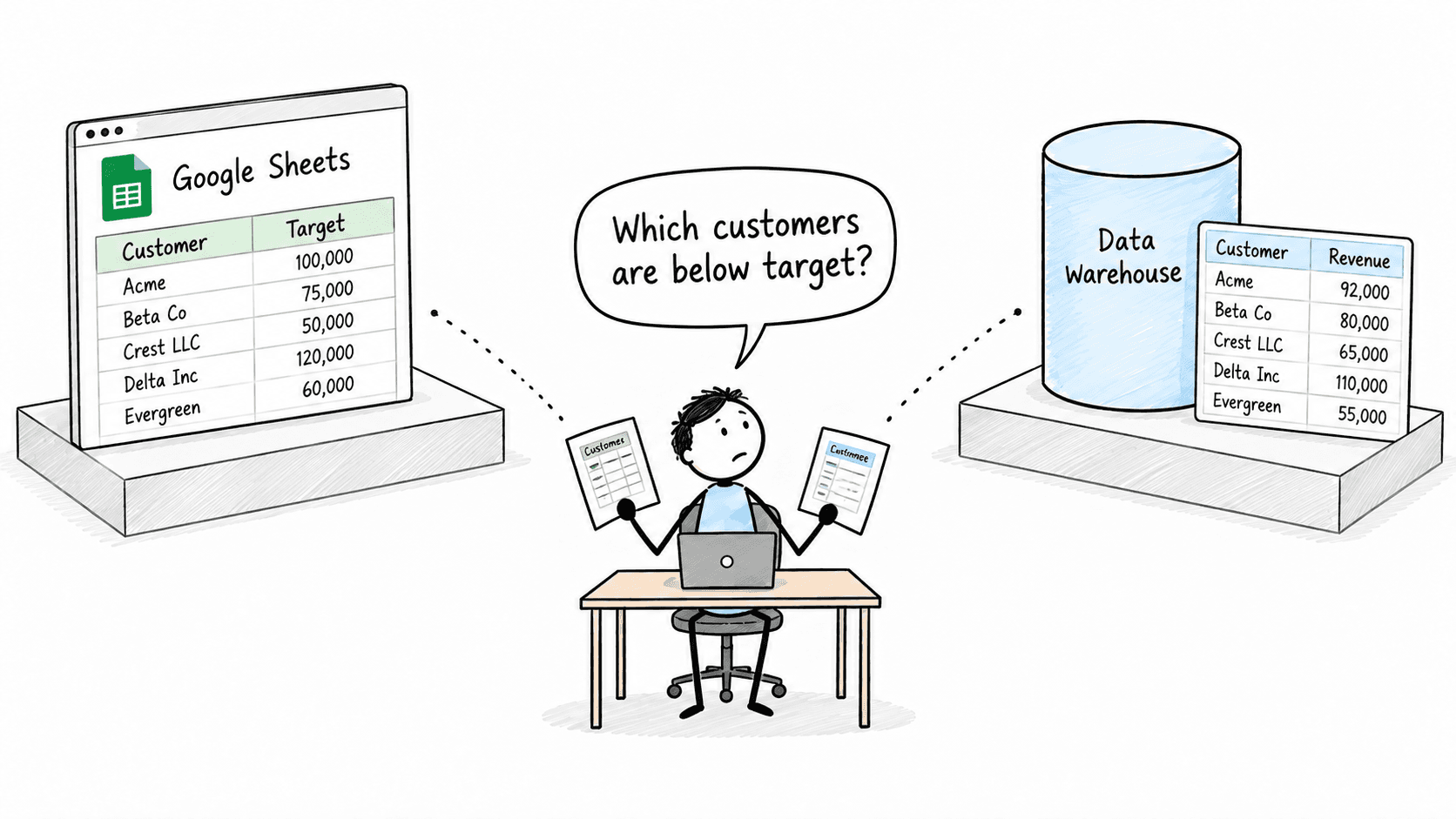
How to connect Google Sheets to Claude, and ask it alongside your warehouse
4 min read

A travel company's revenue team stopped opening Power BI every morning
3 min read