Snowflake Cortex Analyst Alternatives (2026): 12 Options Compared
Hi, this is Vivek, building Contextflo. I share practical notes on getting answers from your data, a couple of times a month.

The main alternatives to Snowflake Cortex Analyst are Snowflake CoWork (if you want to stay in Snowflake), Databricks Genie (if you're on Databricks), Cube and the dbt Semantic Layer (if you want to own a semantic layer across warehouses), Omni, Hex, ThoughtSpot and Zenlytic (if you want a BI platform with an AI analyst), Contextflo and Querio (if you want answers without building the model yourself), and WrenAI or Vanna (if you want to build on open source). Which one fits depends on what's bothering you about Cortex Analyst: the Snowflake-only scope, the semantic view someone has to write, the per-message billing, or the fact that it's an API you have to put an app on top of.
Cortex Analyst is a good product, and for some teams it's the right answer. So this guide starts with when to keep it, then compares twelve alternatives on facts taken from each vendor's own docs and pricing pages.
When Cortex Analyst is the right fit
Cortex Analyst is Snowflake's text-to-SQL service. You define a semantic view over your tables, and it turns plain-language questions into SQL that runs in your account.[1] It is worth keeping if most of these are true:
- All of your analytical data is in Snowflake, and you expect it to stay there.
- Someone on your team can own the semantic views. Snowflake now offers a Snowsight wizard and an AI-assisted Semantic View Autopilot that can start from a YAML spec, a Tableau file or a Power BI file, which shortens the first draft.[2]
- Governance has to stay inside Snowflake. The generated SQL follows Snowflake's role-based access control, and by default the models run inside Snowflake's governance boundary.[1]
- You're building an app. Cortex Analyst is exposed as a REST API, which suits a team that wants text-to-SQL inside its own Streamlit app, product or Slack bot.[1]
If that describes you, the cheapest alternative is often CoWork, which puts a finished chat app on the same engine.
When to look elsewhere
People usually go looking for a replacement for one of these reasons:
- Your data isn't all in Snowflake. Cortex Analyst works on structured data in Snowflake.[1] A Postgres production replica, a BigQuery export or Stripe data has to be loaded first.
- Nobody owns the semantic view. Autopilot helps with the draft, but the view still needs someone to review it, then update it when a column is renamed.
- The cost model is hard to predict. Direct API calls are billed per message, plus warehouse compute for the generated SQL. Through Cortex Agents the same work is billed on tokens.[3] Long conversations cost more, because the full history is reprocessed on each turn.[1]
- Your team doesn't want another app. Cortex Analyst is an API, and CoWork is a separate web and iOS app.[4] If people already live in Claude or ChatGPT, that's one more place to go.
Why every tool on this list asks for context
Whatever you pick, the model needs to know what your tables mean. We run a platform that sits between LLMs and company databases, and across 76,000+ AI-generated SQL queries in our logs, 71% of all errors were "invalid identifier": the model referencing a table or column that doesn't exist. The model wasn't bad at SQL. It was guessing at what the database means.
That's why Cortex Analyst insists on a semantic view, and it's right to. Every serious alternative below has its own version: a Cube model, dbt metrics, an Omni model, a Wren MDL file, a Querio rulebook, or context generated from your schema. The more useful way to compare them is by who writes that context, and whether it follows you if you leave Snowflake.
Cortex Analyst alternatives compared
| Tool | Data it queries | Where people ask | Where the context comes from | Published pricing |
|---|---|---|---|---|
| Cortex Analyst (baseline) | Snowflake only[1] | REST API, inside an app you build[1] | Semantic views, drafted by hand or with Autopilot[2] | Credits per message plus warehouse compute[3] |
| Snowflake CoWork | Snowflake[4] | CoWork web and iOS apps[4] | Semantic views, via Cortex Analyst[4] | AI Credits on tokens, additive across services it calls[3] |
| Databricks Genie | Unity Catalog data on Databricks[6] | Genie web and mobile[6] | Descriptions, instructions and sample queries per space[7] | Free for users through Jan 31, 2027; needs a pro or serverless SQL warehouse[7] |
| Cube | 20+ warehouses and databases, including Snowflake[10] | Cube's app, or Claude and Cursor over MCP[8] | Cubes and views you write in YAML or JavaScript | Cloud free tier, then $40 or $80 per developer per month; Core is open source[9][10] |
| dbt Semantic Layer + MCP | Snowflake, BigQuery, Databricks, Redshift, Postgres[12] | BI tool integrations, or Claude and Cursor over MCP[11][13] | Metrics and semantic models in YAML in your dbt project[12] | Requires a dbt Starter or Enterprise plan[11] |
| Omni | Snowflake, BigQuery, Databricks, Postgres and others[20] | Omni app, Slack, and ChatGPT or Claude over MCP[19] | A shared semantic model your team maintains | Not published |
| Hex | Your warehouse connections | Hex notebooks and Threads[15] | YAML semantic models, with an agent that can draft them[16] | $36 or $75 per editor per month; Enterprise custom[14] |
| ThoughtSpot | Your connected cloud data | ThoughtSpot app, mobile, Slack, Salesforce, and integrations for Claude and OpenAI[17] | Data models in ThoughtSpot's semantic layer[17] | From $25 per user per month; Pro at $0.10 per credit; Enterprise custom[18] |
| Zenlytic | Snowflake, BigQuery, Databricks and other warehouses[21] | Zenlytic app, Slack and Teams[21] | A context layer Zoë drafts, governed in Git[21] | Not published |
| Contextflo | Snowflake, BigQuery, Redshift, Databricks, Postgres, MySQL, ClickHouse, SaaS APIs, CSVs | Your own Claude or ChatGPT, over MCP | Generated from schema, code and docs, then reviewed | Free for 1 user and 1 source; $75 per seat; Team $500/mo for 10 seats[29] |
| Querio | Snowflake, BigQuery, Databricks, Redshift, Postgres, ClickHouse and others[30] | Querio app, Slack, MCP, API[28] | Business context and rulebook files in Git | Free to start with AI usage credits; no per-seat fee; cross-source queries on Enterprise[28] |
| WrenAI | 20+ data sources[23] | Wren app, or MCP clients[23] | MDL files in YAML you can version[23] | Free tier; $179/mo or $559/mo billed annually; self-hosted by quote[24] |
| Vanna | Postgres, MySQL, Snowflake, BigQuery and more[27] | A chat component you embed in your own app[27] | Configured in code by your developers | Cloud $50/mo or $500/mo; MIT repo archived Mar 29, 2026[25][27] |
Pricing and features change often. Everything above was checked on the vendors' own sites on September 25, 2026, and linked in the sources at the bottom.
If you want to stay inside a warehouse vendor
Snowflake CoWork
CoWork is what Snowflake Intelligence became at Summit in June 2026.[5] It's a ready-made chat app on web and iOS that uses Cortex Analyst for structured questions, and it inherits Snowflake's row access policies and column-level security.[4] It has since grown into a work agent that also acts in tools like Slack, Gmail and Jira.[5]
Pick it if the problem with Cortex Analyst was "we don't want to build an app." It won't help if the problem was the semantic views or the Snowflake-only scope, because it sits on the same foundation. There is a detailed comparison in Snowflake CoWork vs Contextflo.
Databricks Genie
Genie is the Databricks equivalent: a place to ask data questions in natural language, grounded in data governed by Unity Catalog.[6] Each user's Unity Catalog permissions apply, including row filters and column masks.[7] Genie usage is free for users through January 31, 2027, though it needs a pro or serverless SQL warehouse to run.[7] It's only an alternative if you run Databricks alongside or instead of Snowflake.
If you want to own a semantic layer across warehouses
Cube
Cube is an open-core semantic layer with an agentic analytics product on top. You model your data in YAML or JavaScript, and it connects to a long list of sources, including Snowflake, BigQuery, Redshift and Postgres.[10] Its hosted MCP server lets people ask from Claude or Cursor, and those queries respect Cube's row-level security.[8] Cube Core is open source and can be self-hosted with Docker.[10]
Cube fits a team with an analytics engineer who wants the model to be portable. It's the most direct answer to "the semantic layer shouldn't be locked to one warehouse," and it still needs someone to write it.
dbt Semantic Layer and the dbt MCP server
If you already use dbt, MetricFlow lets you define metrics in YAML inside your dbt project and query them from BI tools and spreadsheets.[11][12] The dbt MCP server exposes those assets to AI clients like Claude and Cursor, either self-hosted or as a remote server run by dbt.[13] MetricFlow itself is Apache 2.0, but querying the Semantic Layer requires a dbt Starter or Enterprise account.[11][12] For a closer look at how this compares with Cube, see Cube vs dbt vs Contextflo.
If you want a BI platform with an AI analyst
Omni
Omni is a BI platform built around a shared semantic model. Its MCP server works with ChatGPT, Claude, Cursor and Microsoft Copilot, and every MCP query runs with the permissions of the authenticated user.[19] It connects to Snowflake, BigQuery, Databricks, Redshift, Postgres and others.[20] Omni doesn't publish pricing. It suits teams that want dashboards and AI answers from the same governed model, and have people to maintain it. More in Omni analytics alternatives.
Hex
Hex is a notebook workspace for SQL and Python, with Threads for plain-language questions over semantic models and warehouse tables.[15] Semantic models are YAML, and a modeling agent can draft or update them from a description.[16] Pricing is public: $36 per editor per month on Professional, $75 on Team, custom on Enterprise.[14] Business users can ask in Threads, but the people who get the most out of Hex are analysts who already write Python, which is the main trade-off covered in Hex vs Contextflo.
ThoughtSpot
ThoughtSpot's Spotter agent answers questions over ThoughtSpot's semantic layer and learns from your data models and the Liveboards you already use.[17] It offers role-based, row-level and column-level security.[17] Pricing starts at $25 per user per month on Essentials, with a usage-based Pro tier and custom Enterprise.[18]
Zenlytic
Zenlytic's analyst, Zoë, reads your warehouse schema and interviews your team to build a context layer, which is then governed in Git with branches and pull requests.[21] It supports column-level access grants and row-level access filters.[22] People ask in the Zenlytic app, Slack or Teams. Pricing is by demo.
If you want answers without writing the model first
Contextflo
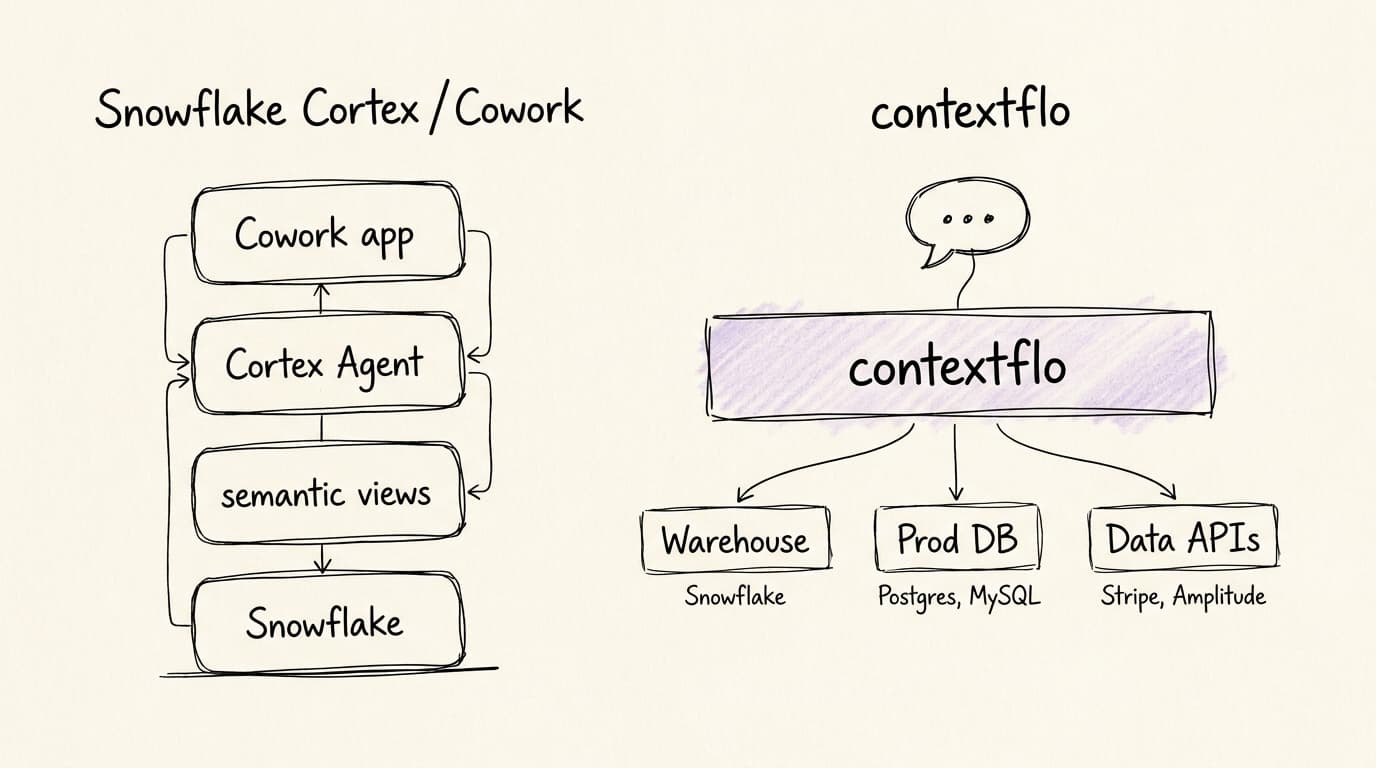
Contextflo is ours. It connects the Claude or ChatGPT your team already uses to your warehouse over MCP, and supplies the semantic context the model needs so nobody has to write it from scratch. The context is drafted from your schema, source code and docs, you review it, and the schema re-syncs daily. Admins set which tables each person or group can query, and every question and query is attributed to the person who asked. It's built for teams that don't have a data team to write and maintain a semantic view.
Where it's rough: generated context is a draft, and a person who knows the business still has to correct it. Access control is table-level, not row-level, so "each manager sees only their region's rows" belongs in the warehouse, not in Contextflo. Table-level access control and the audit history are on the Team plan, not the free or Starter tiers.[29] And your team needs Claude or ChatGPT, since Contextflo doesn't ship a chat app of its own. If you're weighing it against Cortex specifically, Cortex Analyst vs Contextflo goes row by row, and How to connect Claude to Snowflake has the exact role, warehouse and grants an admin runs to set it up.
Querio
Querio is an agentic notebook app with a Slack bot, an MCP server and an API.[28] Business context lives as files in Git, and it doesn't charge per seat. Plans come with AI usage credits, and querying across data sources is on the Enterprise tier.[28] Its integrations page lists fourteen databases and warehouses, Snowflake among them.[30] The Enterprise plan also includes embedded analytics, for putting charts in front of your own customers.[28] Contextflo is built for your internal team and has no customer-facing embedding, so if you need that, Querio is the one on this list to look at (Querio vs Contextflo).
If you want to build on open source
WrenAI
WrenAI is open-source text-to-SQL built on MDL, a set of YAML files that define models, relationships and calculated fields you can review and version.[23] The core is Apache 2.0.[23] Wren Cloud has a free tier, an Essential plan at $179 a month and an Enterprise plan at $559 a month billed annually, with row and column controls and MCP on Enterprise. A self-hosted Enterprise Plus tier, including air-gapped installs, is sold by quote.[24] If the requirement is "nothing leaves our network," this is one of the few options on the list that can meet it outside Snowflake (Wren AI vs Contextflo).
Vanna
Vanna is a framework for building your own SQL agent, with a chat component you embed in your app. Vanna 2.0 supports row-level security based on the user context your auth provides.[26] Two things to know before you start: the MIT-licensed GitHub repo was archived on March 29, 2026,[25] and the hosted plans start at $50 a month.[27] More in Vanna vs Contextflo.
How to choose
Three questions get you most of the way:
- Is all your data in Snowflake, and will it stay there? If yes, start with CoWork, or keep Cortex Analyst behind your own app. If no, rule out the Snowflake-native options early, because their semantic views don't travel.
- Who will write and maintain the context? An analytics engineer can own a Cube, dbt, Omni or Wren model. If nobody has that time, look at tools that draft it for you (Zenlytic, Contextflo) and budget for someone to review the draft.
- Where should the answer show up? In a BI app (Omni, Hex, ThoughtSpot, Zenlytic), in Slack, in Claude or ChatGPT (Contextflo, and Cube, dbt, Omni or Wren over MCP), or inside a product you're building (Cortex Analyst, Vanna, WrenAI).
The expensive mistake is picking on accuracy benchmarks alone. Every tool here gets more accurate once the context is right, so the one that wins is usually the one whose context your team will actually keep up to date.
If you'd like a second opinion on a shortlist, book 20 minutes with me, whichever tool you end up with. Contextflo also has a free tier for one user and one source if you want to compare it against Cortex on your own schema.
FAQ
What is the best alternative to Snowflake Cortex Analyst? It depends on what pushed you away from it. If you want to stay inside Snowflake with a finished app, Snowflake CoWork is the closest option. If your data spans more than Snowflake and you want to own a semantic layer, Cube or the dbt Semantic Layer fit. If you want a BI platform with an AI analyst, look at Omni, Hex, ThoughtSpot or Zenlytic. If you want your team to ask in Claude or ChatGPT without a data team writing the model, look at Contextflo. If you want to build your own agent, WrenAI and Vanna are the open-source starting points.
Does Cortex Analyst work with data outside Snowflake? No. Snowflake's documentation describes Cortex Analyst as answering business questions over structured data in Snowflake, using semantic views defined on Snowflake tables. Data in Postgres, BigQuery or a SaaS tool has to be loaded into Snowflake first.
How is Cortex Analyst priced? Called directly through its REST API, Cortex Analyst is billed in credits per message, counting only successful responses, plus the warehouse compute to run the SQL it generates. Called through Cortex Agents, it uses the token-based AI Credit model instead. Snowflake publishes the credit rates in its Service Consumption Table.
Do I need a semantic view to use Cortex Analyst? Yes. Cortex Analyst generates SQL against a semantic view (or an older semantic model YAML file) that defines tables, dimensions, metrics and relationships. Snowflake offers a Snowsight wizard and an AI-assisted Semantic View Autopilot to help build one, but someone still has to review and maintain it.
Is Snowflake Intelligence the same as CoWork? Yes. Snowflake renamed Snowflake Intelligence to Snowflake CoWork at Summit in June 2026. CoWork is the ready-made chat app, and it uses Cortex Analyst under the hood for questions about structured data.
Sources
- Cortex Analyst, Snowflake documentation (accessed September 25, 2026)
- Overview of semantic views, Snowflake documentation (accessed September 25, 2026)
- Snowflake AI pricing, Snowflake documentation (accessed September 25, 2026)
- Overview of Snowflake CoWork, Snowflake documentation (accessed September 25, 2026)
- Snowflake CoWork, Snowflake product page (accessed September 25, 2026)
- Genie, Databricks documentation (accessed September 25, 2026)
- Set up a Genie space, Databricks documentation (accessed September 25, 2026)
- MCP server, Cube documentation (accessed September 25, 2026)
- Cube Cloud pricing (accessed September 25, 2026)
- cube-js/cube, GitHub, and Cube data sources (accessed September 25, 2026)
- dbt Semantic Layer, dbt documentation (accessed September 25, 2026)
- About MetricFlow, dbt documentation (accessed September 25, 2026)
- About dbt MCP server, dbt documentation (accessed September 25, 2026)
- Hex pricing (accessed September 25, 2026)
- Threads, Hex documentation (accessed September 25, 2026)
- Semantic authoring, Hex documentation (accessed September 25, 2026)
- Spotter, ThoughtSpot product page (accessed September 25, 2026)
- ThoughtSpot pricing (accessed September 25, 2026)
- MCP server, Omni documentation (accessed September 25, 2026)
- Omni integrations (accessed September 25, 2026)
- Zenlytic product (accessed September 25, 2026)
- Access grants and filters, Zenlytic documentation (accessed September 25, 2026)
- Canner/WrenAI, GitHub, and What is MDL (accessed September 25, 2026)
- Wren AI pricing (accessed September 25, 2026)
- vanna-ai/vanna, GitHub (accessed September 25, 2026)
- Authentication and permissions, Vanna documentation (accessed September 25, 2026)
- Vanna pricing and vanna.ai (accessed September 25, 2026)
- Querio pricing (accessed September 25, 2026)
- Contextflo pricing (accessed September 25, 2026)
- Querio integrations (accessed September 29, 2026)
Find out if Contextflo is the right fit for you.
See how teams use Contextflo

Related posts
Keep reading
Conversational analytics: 5 ways to set it up, compared
7 min read
How to connect Claude to BigQuery? What works and what doesn't in 2026
8 min read
How to connect Claude to Postgres without giving it write access
7 min read

How to build a BI dashboard with Claude that your team can actually trust
8 min read
How to give Claude read-only access to your database (it isn't always the default)
7 min read

You connected your warehouse to Claude, now what?
5 min read
The official Postgres server for Claude is archived. Here's what to use instead.
7 min read
Why is the team missing sprint goals? How to analyze Jira data with AI
8 min read

Are my ads actually profitable? How to analyze Facebook and TikTok ads together with AI
7 min read