DataGPT vs Contextflo
Hi, this is Vivek, building Contextflo. I share practical notes on getting answers from your data, a couple of times a month.

DataGPT is fast in a way that is hard to argue with, because it does not ask a general model to be clever about your database. It loads your data into an engine it built for exactly this, then runs thousands of queries against it to tell you why a number moved. I run Contextflo, so read the comparison with that in mind, but the two products make opposite bets about where your data should sit and which AI should answer, and most people typing "DataGPT vs Contextflo" are really deciding between those two bets.
So let us make the bet legible.
What DataGPT is
DataGPT is a conversational AI data analyst. You connect a warehouse, DataGPT ingests the data into its own analytics database, and from then on people ask questions in plain language inside DataGPT's app and get answers back as charts and short written explanations. The speed comes from the part it built in-house: a Lightning Compute engine that runs full SQL in milliseconds against a memory-mapped store, paired with an analytics engine that fires thousands of statistical tests at once. A bundled model turns the results into sentences. It is a specialized stack tuned for one job rather than a general LLM guessing at your schema.
That one job is worth naming, because DataGPT is unusually good at it: figuring out why a metric changed. Ask what happened to revenue last week and it will run key-driver and segment analysis across your dimensions and hand back the movers, with anomalies flagged and confidence attached. It can push the same analysis proactively, as daily summaries and alerts. If your work is watching a defined set of KPIs and constantly asking what moved them, this is a strong tool.
The shape of the bet is the tradeoff. Your data lives in DataGPT's engine, so there is an ingestion step and a second copy to keep current, and the analysis happens in DataGPT's app rather than in whatever your team already has open. The engine is tuned for metric and driver questions over the data you loaded, which is most of what a lot of teams ask, and also not everything.
Who each one is for
DataGPT fits a team with a clear set of metrics it monitors, that is comfortable moving that data into DataGPT's engine, and that wants the fastest possible answer to "what moved and why," delivered in a dedicated analytics app. Under those conditions it is excellent.
Contextflo fits teams whose data did not consolidate into one place, who would rather ask in the Claude or ChatGPT window they already keep open than log into another tool, and who do not want to run and maintain an ingestion pipeline into a vendor engine before they can ask a question. If you want to join something in your warehouse to a charge in Stripe or an event in Amplitude in a single question, that reach is the gap this closes.
The five things that actually differ
| DataGPT | Contextflo | |
|---|---|---|
| The agent | DataGPT's bundled AI analyst, running on its own model | Your own Claude or ChatGPT, over MCP |
| Where answers land | The DataGPT app | The chat window your team already has open |
| Where your data sits | Ingested into DataGPT's Lightning analytics engine | Queried where it lives: Snowflake, BigQuery, Redshift, Postgres, Databricks, SaaS APIs, and CSV uploads |
| Context | A model configured inside DataGPT | Generated from your schema, source code, and docs, then reviewed |
| Access control | Managed inside the DataGPT app | Query-time, table-level rules per user or group, with every query attributed to a person and logged |
Where DataGPT is the better call
Give DataGPT its due plainly: for repeated key-driver and anomaly work, a purpose-built compute engine beats a general model writing SQL, and it is not close on speed. Claude and ChatGPT are flexible, but neither runs thousands of statistical tests against a memory-mapped store in milliseconds, and neither returns segment impact with confidence intervals as a native motion. DataGPT does. If your day is watching a dashboard of KPIs and asking what moved them, that specialization is real, and the proactive alerts mean you often get the answer before you thought to ask. A team that wants a fast, self-contained analyst for a defined metric set will be happy here.
Where Contextflo is the better call
Contextflo connects Claude or ChatGPT to your data through MCP, across warehouses (Snowflake, BigQuery, Redshift, Postgres, Databricks) plus SaaS sources and CSVs you upload. You ask in plain language, the model writes and runs real SQL against the data where it already lives, and the answer comes back in the chat with the query shown so you can verify it. You skip the ingestion pipeline and the second copy of your data that has to stay in sync, and the answer shows up where you already work.
Reach is usually what decides it. One question can join an order in your warehouse to a payment in Stripe and a signup event in Amplitude, because Contextflo queries all of them in place rather than analyzing whatever was loaded into a single engine. Your team also asks in the tool they already use all day, instead of learning where DataGPT's buttons live. And the governance travels with the query: admins set which schemas and tables each person or group can reach, the rule is enforced at query time before it hits the warehouse, and every query is attributed to a user and logged, so an audit can answer who asked what across every connected source.
The context layer is what keeps the answers honest. Contextflo generates that layer from your schema, your source code, and your docs, so the model knows that rev_usd is revenue and which table joins to which, without you hand-writing it. It is a draft you review, not a modelling project you run, and setup takes about ten minutes. Contextflo also does the ordinary BI jobs, dashboards, scheduled reports, and governed metric definitions, so the AI layer sits on top of real reporting rather than replacing it. Team pricing is $75 per user per month for unlimited queries, with no meter running while people explore.
The honest limit
Contextflo does access control at the table level, not the row level. If your governance depends on masking individual rows for a given user, that is a real gap, and you should weigh it. Two more things worth saying straight: the generated context is a draft someone still has to check, and this is not a pixel-perfect, finance-signed reporting suite for a board deck. A general model writing SQL is also not a substitute for DataGPT's dedicated driver-analysis engine if that specific, repeated analysis is the bulk of your work. Those are the cases where the other shape earns its keep.
If you want to try asking across your whole stack in the AI you already use, Contextflo is free for one user and one data source, so you can point it at a warehouse and ask a question in Claude before deciding anything.
FAQ
Does DataGPT move my data into its own system? Yes. DataGPT loads your data into its own analytics database so its Lightning Compute engine can run thousands of queries in milliseconds. That is where its speed comes from. Contextflo takes the other approach: it queries your data where it lives, across Snowflake, BigQuery, Redshift, Postgres, Databricks, SaaS APIs, and CSV uploads, without standing up a second copy.
Can I use Claude or ChatGPT with DataGPT? No. DataGPT answers inside its own app, using a bundled model it runs itself. Contextflo is the reverse: you bring your own agent through MCP, so Claude or ChatGPT writes and runs the SQL, with the query shown so you can check the number.
What is DataGPT best at? Explaining why a metric moved. Its analytics engine runs thousands of statistical tests to surface the drivers and anomalies behind a change, and it can push those as daily summaries and alerts. For a team that watches a fixed set of KPIs and repeatedly asks what moved them, that purpose-built engine is fast and genuinely good.
When should I pick DataGPT over Contextflo? When your analysis is mostly key-driver and anomaly work over a defined set of metrics, you are fine loading that data into DataGPT's engine, and you want its speed and proactive alerts. That is what DataGPT is built for, and it is good at it.
Here is a more in-depth look at Contextflo and how it works.
What is Contextflo?
Contextflo is a governed context layer between your data and the AI your team already uses. Connect your warehouse once, and your team asks questions in their own Claude or ChatGPT. The model writes and runs the SQL; Contextflo supplies the definitions, the per-user access control, and the audit that make the answers trustworthy. Your data never moves, and you do not need a data team.
How it works
Your team queries in their own Claude or ChatGPT over MCP, so you bring any agent rather than a locked-in bot, and every answer comes back with the SQL shown and access enforced per user.
Find out if Contextflo is the right fit for you.
See how teams use Contextflo
Related posts

Keep reading
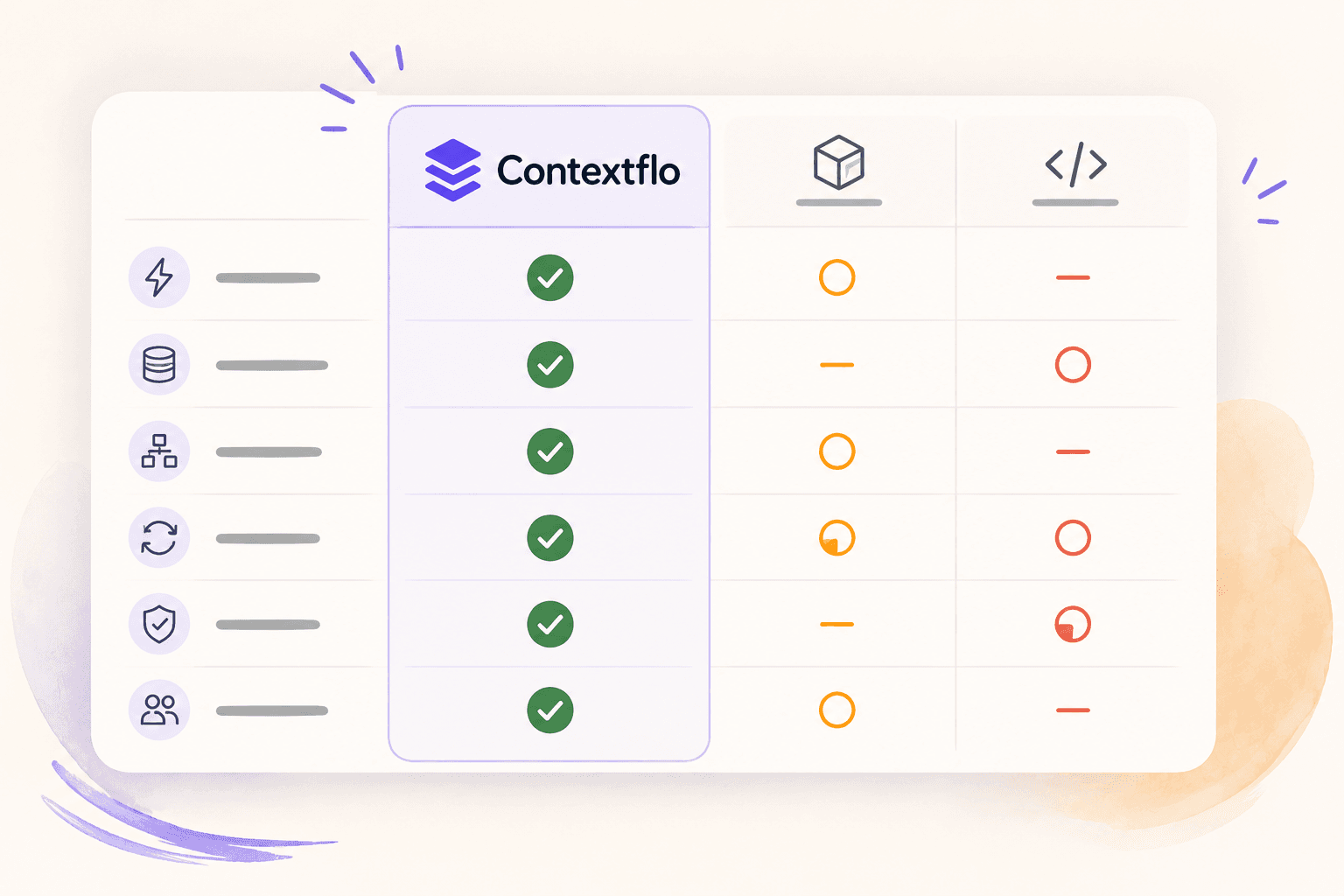
Conversational analytics: 5 ways to set it up, compared
7 min read
How to connect Claude to BigQuery (and fix the errors you'll hit)
8 min read
How to connect Claude to Postgres (and keep it read-only)
7 min read

How to build a BI dashboard with Claude that your team can actually trust
8 min read
How to give Claude read-only access to your database (it isn't always the default)
7 min read

You connected your warehouse to Claude, now what?
5 min read
What is a semantic layer?
5 min read
How to connect Google Sheets to Claude, and ask it alongside your warehouse
4 min read

A travel company's revenue team stopped opening Power BI every morning
3 min read