Tableau Alternatives I Tried So You Don't Have To
Hi, this is Vivek, building Contextflo. I share practical notes on getting answers from your data, a couple of times a month.

Most "Tableau alternatives" posts are written by a competitor who wants your seat. This one will try to be more useful than that. I run Contextflo, so I have a stake here, but the people typing this phrase want different things, and the right answer depends on which one you are. Some of you want a cheaper or simpler dashboard tool than Tableau. Some of you do not want a dashboard tool at all, you want an answer to a question without building a chart first. I will map both, and say where Contextflo is the wrong call as plainly as where it is the right one.
So let us sort out what you actually need.
Why people look past Tableau
Tableau earned its place. Drag-and-drop visual analysis, the depth of what you can build, the polish of the output. If your job is to explore data visually and hand someone a considered chart, few tools match it. That is worth saying before any of the reasons to leave.
The reasons to leave are familiar to anyone who has run it. Creator seats are expensive, and the cost stacks up fast once more than a couple of people need to build rather than view. The learning curve is real, so the tool tends to concentrate in a few power users while everyone else waits on them. And it is viz-first by design, which is a mismatch when what you wanted was a number, not a dashboard. A lot of Tableau questions are really "what was revenue last week," and building a worksheet to find out is the long way around.
Salesforce, which owns Tableau, has been moving on the last point. Tableau Pulse pushes automated metric summaries at you, and Tableau Agent (formerly Einstein Copilot for Tableau) lets you ask in natural language inside the product. Those close some of the gap. They also keep the answer inside Tableau, which matters if the reason you are shopping is that your team does not want to live in Tableau.
The fork that decides everything
Before you compare logos, settle one thing, because the rest follows from it: do you want a dashboard platform your team builds and maintains, or do you want answers in the tools your team already uses?
A dashboard platform is right when you need governed reporting that finance and the board trust, with shared definitions, permissions, and charts someone designs. Tableau fits here. So do the tools below in the first group. If that is what you are buying, buy one and do not feel bad about it.
The other shape is newer. Instead of building dashboards so people can go look at answers, you connect your data to Claude or ChatGPT and ask. You give up the pixel-perfect designed board deck. You get the answer the same week, in a tool your team already has open. Neither shape is the small-team option or the enterprise one. It is a question of what you want to own.
If you want a dashboard platform
You have decided you do want charts someone builds. Tableau is not the only one, and depending on your stack and budget another fits better.
Power BI is the one most Tableau shoppers land on. Microsoft-owned, priced well under Tableau for most teams, and a natural fit if your company already runs on Microsoft 365. It covers the bulk of the same ground. Where Tableau still tends to win is the depth and finish of genuinely complex visual analysis, so weigh how much of that your team actually does.
Looker is the heavyweight in the governed-model camp. Google-owned, built on its own modelling language, with metrics defined centrally so revenue means the same thing on every chart. It is powerful and it is a commitment. If you are deep in Google Cloud and have people to maintain the model, it is a natural look.
Sigma runs spreadsheet-style analysis directly on your cloud warehouse. Teams that live in spreadsheets and would rather not learn a modelling language tend to take to it. Worth a demo if that describes your crowd.
Metabase is the one I point budget-conscious teams at. It has an open-source edition you can self-host, plus a paid cloud version if you would rather not run it. It is the cheapest honest entry into real self-serve dashboards, and for many teams it is plenty. If someone tells you dashboards require enterprise money, Metabase is the counterexample.
I am keeping these high-level on purpose. Feature lists rot, and I would rather you demo the two that sound right than trust a one-liner.
If you want answers, not charts
Two of these lean less on building dashboards and more on getting to an answer.
ThoughtSpot is search-and-AI-first BI. You type a question and it returns a chart, rather than starting you on a blank canvas. It is the closest of the traditional BI vendors to the "ask, don't build" shape, and it still lives as its own destination your team logs into.
Hex is a notebook-style workspace for analysts who want to mix SQL, Python, and narrative in one place. It leans toward people who can code a little, which is either exactly what you want or exactly what you do not. I wrote up Hex vs Contextflo if that is the branch you are on.
Contextflo is the reason this post exists, so here is the honest version. It connects Claude or ChatGPT to your data (warehouses like BigQuery, Snowflake, Redshift, Databricks, and Postgres, plus SaaS sources and CSVs you upload) through MCP. You ask in plain language, the model writes and runs real SQL against your data, and the answer comes back in the chat with the query shown so you can check it. No worksheet to build, no modelling language to learn.
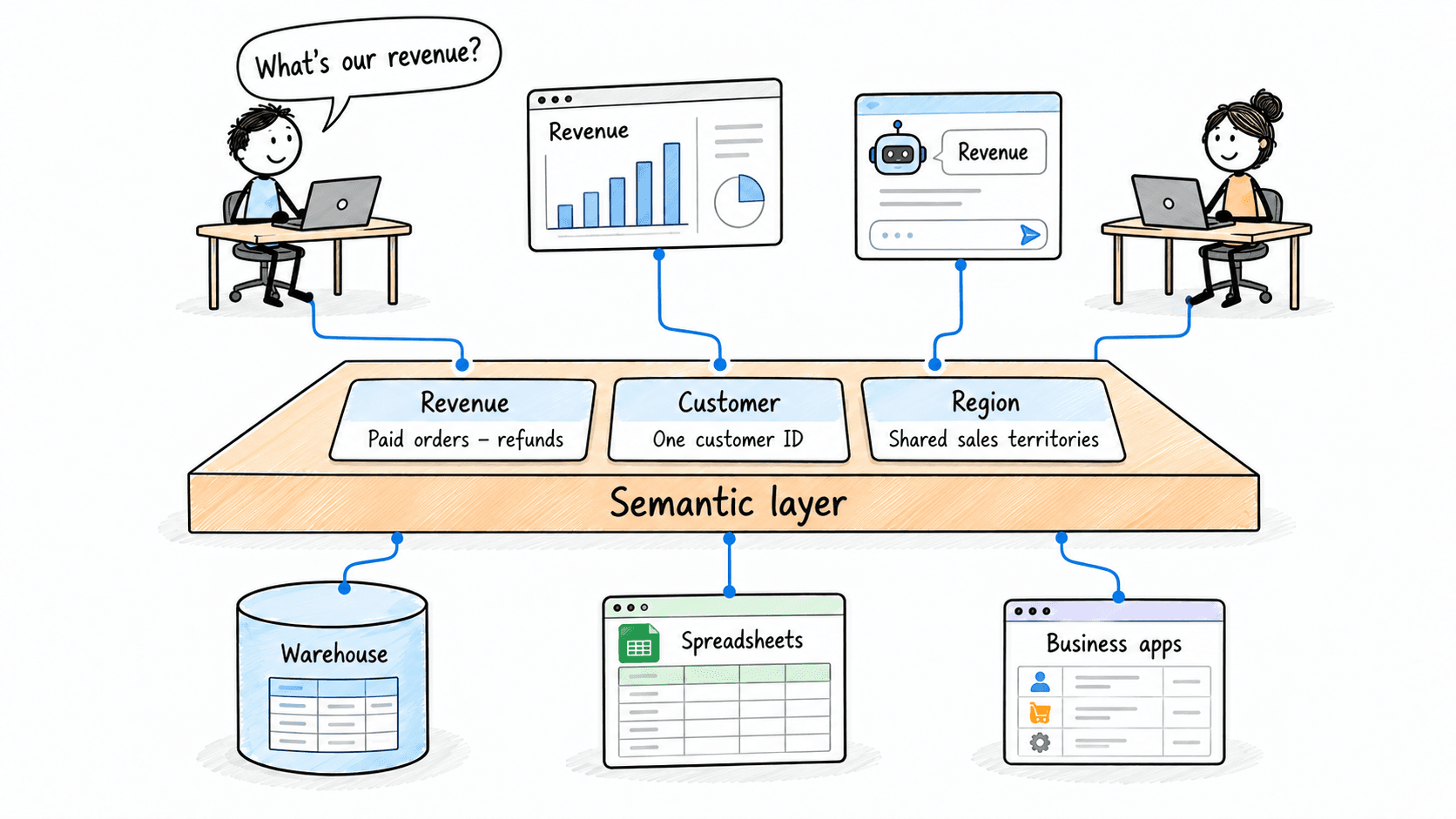
The part people do not expect is the context. Every BI tool needs some version of a semantic layer so the machine knows rev_usd is revenue and which table joins to which. In Tableau and Looker you build and maintain that. Contextflo generates it from your schema, source code, and docs, so you are not hand-writing a description of your own database. Setup runs about ten minutes.
It is not a thinner BI tool with the governance stripped out. It does the jobs you open a BI tool for: dashboards, scheduled reports, governed metric definitions, and access control where admins set which schemas and tables each person or group can query, with every query attributed to a user and logged. What it adds is asking across your whole stack in the AI your team already uses. Team pricing is $75 per user per month for unlimited queries, on the pricing page, with no meter running while your team explores.
Where Tableau still wins
Say this plainly, because it is true. If your work is deep, designed visual analysis, the kind where the chart itself is the deliverable and small formatting choices matter, Tableau is very hard to beat and you should keep it. The same goes for one governed, versioned, finance-signed-off set of definitions on a board deck. That is what a maintained semantic model is for, and a governed dashboard tool does it well.
The one place Contextflo is rough
Contextflo's context is generated, which means it starts as a draft someone reviews, not a definition finance has blessed and versioned. And access control is table-level, not row-level: an admin can decide who queries which tables, but not filter individual rows per user inside a table. If you need one canonical, audited semantic model or per-row permissions, a governed platform is the better tool and I would tell you so on a call.
How to actually choose
Skip the feature matrix. Answer two questions.
| The question | If yes | If no |
|---|---|---|
| Is a designed chart the deliverable? | Keep Tableau, or look at Power BI to cut cost | You may not need a dashboard tool at all |
| Do you want to maintain a governed model? | Looker or Sigma; Metabase if budget is tight | Answers in Claude or ChatGPT, no model to babysit |
If you are unsure, start with the cheaper or faster option. It is far easier to graduate from Metabase or Contextflo into Tableau later than to unwind a rollout you did not need. And if you came here from the semantic-layer side of things, the Omni alternatives guide walks the governed-model neighbourhood in more detail.
FAQ
What's the cheapest Tableau alternative? On the dashboard side, Metabase's open-source edition is the cheapest real option, since you can self-host it. Power BI is also priced well below Tableau's Creator seat for most teams. If you don't want a dashboard platform at all and just want to ask questions of your data in Claude or ChatGPT, Contextflo starts at $75 per user per month for unlimited queries.
Is Power BI a good replacement for Tableau? For a lot of teams, yes. Power BI covers most of the same dashboarding and visualization ground at a lower seat price, and it fits naturally if you already live in Microsoft 365. Tableau still tends to win on the depth and polish of complex visual analysis, which is why design-heavy analytics teams stay.
Do I need a data team to replace Tableau? It depends what you replace it with. Looker and Sigma assume someone maintains a governed model. Power BI and Metabase are lighter but still need someone to build and keep dashboards current. Contextflo generates the context layer automatically from your schema, code, and docs, so setup runs about ten minutes instead of a modelling project.
Is Contextflo a full BI platform like Tableau? Not in the pixel-perfect-dashboard sense, and for most questions that is the point. Contextflo does the jobs teams open a BI tool for, dashboards, scheduled reports, governed metric definitions, and table-level access control, and adds the part a dashboard can't: your team asks in the Claude or ChatGPT they already use. Tableau is the better fit when you need deep visual analysis or one finance-blessed board deck.
Whichever way you go, the expensive mistake is the same one: buying a platform because it looked complete, then watching it sit idle because nobody had time to build in it. Free for one user and one data source if you want to try the ask-in-Claude shape before you decide. Pick the tool that matches how your team actually wants to get answers.
Here is a more in-depth look at Contextflo and how it works.
What is Contextflo?
Contextflo is a governed context layer between your data and the AI your team already uses. Connect your warehouse once, and your team asks questions in their own Claude or ChatGPT. The model writes and runs the SQL; Contextflo supplies the definitions, the per-user access control, and the audit that make the answers trustworthy. Your data never moves, and you do not need a data team.
How it works
Your team queries in their own Claude or ChatGPT over MCP, so you bring any agent rather than a locked-in bot, and every answer comes back with the SQL shown and access enforced per user.
Find out if Contextflo is the right fit for you.
See how teams use Contextflo

Related posts

Keep reading
Conversational analytics: 5 ways to set it up, compared
7 min read
How to connect Claude to BigQuery (and fix the errors you'll hit)
8 min read
How to connect Claude to Postgres (and keep it read-only)
7 min read

How to build a BI dashboard with Claude that your team can actually trust
8 min read

How to give Claude read-only access to your database (it isn't always the default)
7 min read

You connected your warehouse to Claude, now what?
5 min read
What is a semantic layer?
5 min read
How to connect Google Sheets to Claude, and ask it alongside your warehouse
4 min read

A travel company's revenue team stopped opening Power BI every morning
3 min read