How to replace your BI tool with AI
Hi, this is Vivek, building Contextflo. I share practical notes on getting answers from your data, a couple of times a month.

Most advice about replacing your BI tool with AI quietly means "stop making dashboards." That is not this. Dashboards, scheduled reports, governed metrics, permissions, and an audit trail are jobs your company depends on, and none of them go away. What moves is where the work happens: out of a dashboard app a handful of people log into, and into the Claude or ChatGPT window your team already has open all day. This is a walk through each job a BI tool does and how it gets done the AI-native way, plus the cases where you should keep the old tool.
Separate the jobs from the app
A BI platform is really two things wearing one price tag. There is the pile of jobs it does for you, and there is the application you sit inside to do them. When people say a BI tool is too slow to change, or used by three people out of forty, they are complaining about the application. The jobs are fine. Everyone still needs to know what revenue was last week and to trust the number.
So the useful question is not "can AI replace BI." It is "can each job a BI tool does get done without making everyone visit a separate dashboard destination to do it." Job by job, the answer is mostly yes, and the last mile is honest about where it is not.
The jobs, and how each one gets done
Here is what a team actually opens a BI tool for, and what the AI-native version of each looks like. The setup I will describe is Contextflo, which connects your data to Claude or ChatGPT over MCP, but the shape of the argument holds for any tool built this way.
| What you use BI for | The AI-native way to do it |
|---|---|
| A dashboard someone opens | The model builds and pins a dashboard from a question. You still get one when you want it, but most questions get answered in chat and never need to become a dashboard. |
| Scheduled reports in your inbox | A saved question runs on a schedule and delivers the result, same as a subscription, without anyone maintaining a report canvas. |
| Governed metric definitions | Metric and business-concept definitions live in a context layer, so "active user" and "revenue" mean one thing on every answer. Reused, not re-derived per chart. |
| Table-level access control | Admins map users to groups to rules, enforced at query time before the warehouse runs anything. A person can only query the schemas and tables they are cleared for. |
| A per-user audit trail | Every question, the SQL it generated, and the person who asked are logged. You can answer "who pulled this and what did they run" after the fact. |
| The one-off ad-hoc question | Asked in plain language in the chat window, answered with real SQL against your data, with the query shown so you can check it. |
Two of those rows are the ones people do not expect to survive the move.
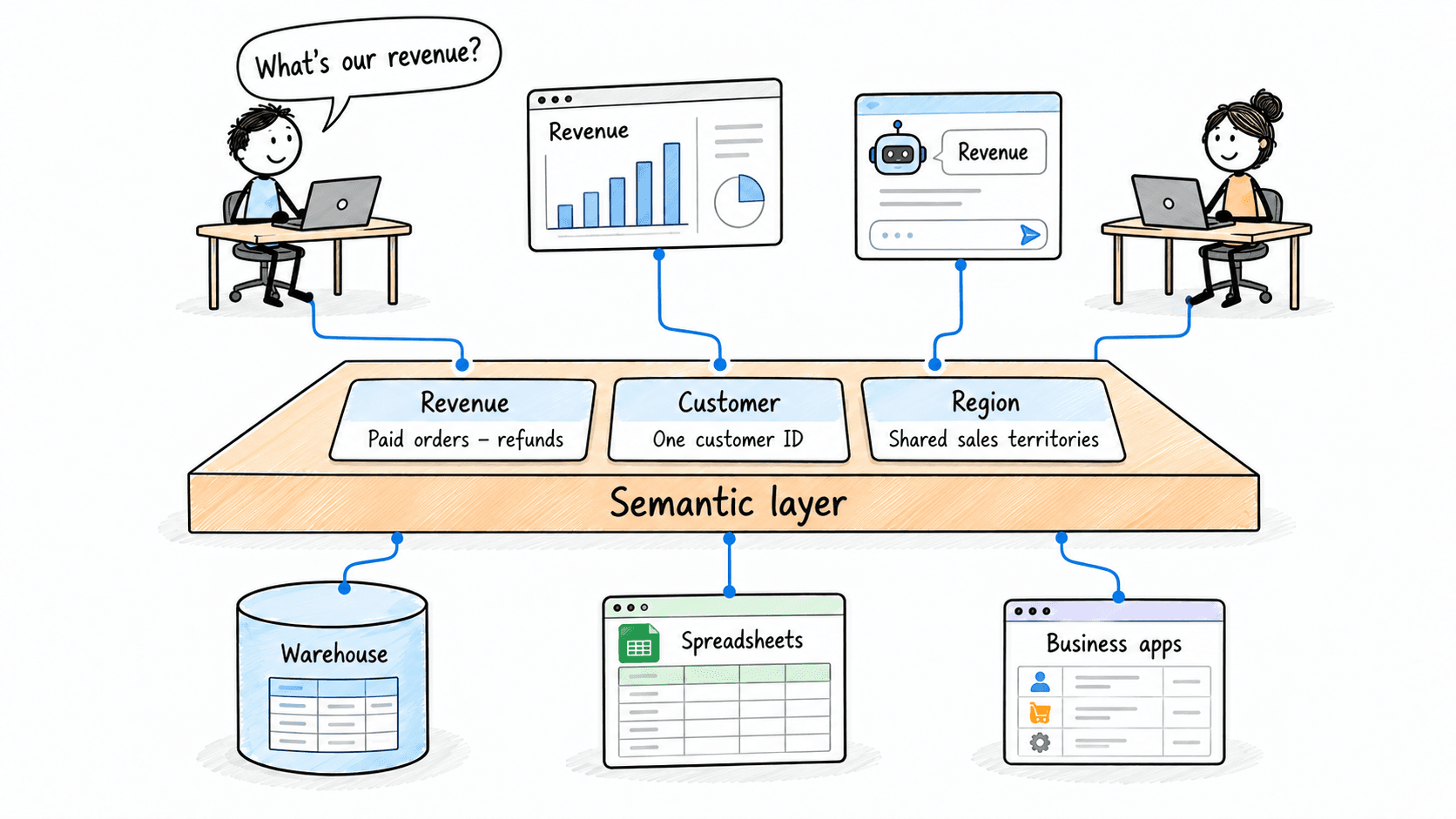
The first is governed metrics. Every BI tool needs some version of a semantic layer so the machine knows rev_usd is revenue and which table joins to which. In a traditional platform, someone builds and maintains that model by hand. In an AI-native setup the context is generated from your schema, your source code, and your docs, and it re-syncs as the schema changes rather than drifting until a human notices. You review the generated draft, correct what is wrong, and add the metric definitions and golden queries that matter. What you do not do is hand-author a modelling layer from a blank file and babysit it forever.
The second is access control, which is the part most "just point the AI at your database" setups get wrong. Handing Claude a warehouse connection hands it everything the connection can see. The governed version puts a gate in front of the warehouse: the same person asking the same question gets an answer scoped to what they are allowed to query, and the query is attributed to them in the log. That is table-level control enforced before execution, not a note in a wiki.
What changes for the person asking
The buyer feels the architecture. The person with the question feels something simpler: they stop context-switching.
Today, getting a number means leaving whatever they were doing, opening the BI tool, hunting for the right dashboard, discovering it does not quite answer the question, and filing a request with the data team. The AI-native version is that they ask in the same window where they were already drafting the doc or the Slack message. The answer comes back with the SQL attached, so a skeptical reader can see how the number was built instead of trusting a tile.
This is why adoption tends to move. At Tilt, a live-auction marketplace for limited-edition goods with a one-person data team, most of the team self-serves this way, on the order of 6,000 questions a month. Not because a dashboard tool got easier, but because the question and the answer now live where the work already happens.
Where a BI tool is still the right buy
Replacing BI with AI is the right call for the everyday flow of questions. It is the wrong call for a specific, real job: the finance-grade, versioned report.
When a finance team needs one blessed definition of every metric on a board deck, pixel-perfect and identical quarter to quarter, that is exactly what a hand-governed semantic model and a pixel-perfect reporting suite are built for. Generated context is a draft a human reviews, which is the right tool for exploration and the wrong tool for a number the board will hold you to. If that reporting is your center of gravity, keep the BI platform for it and layer the AI-native setup on top for everything else. The two are not mutually exclusive, and plenty of teams run both.
The honest limit worth stating plainly: Contextflo does access control at the table level, not the row level. If your governance requires that two people running the same query see different rows of the same table, an AI-native table-level gate does not do that today, and a mature BI platform with row-level security does.
How to actually make the switch
You do not rip out the BI tool on day one. You move the questions first and let the dashboards age out.
- Connect your warehouse or sources (Snowflake, BigQuery, Redshift, Databricks, Postgres, plus SaaS sources and CSVs) to Claude or ChatGPT. Setup runs about ten minutes, with no modelling project to complete first.
- Let the context generate from your schema, code, and docs, then review the draft and fix what it got wrong.
- Set the metric definitions and golden queries for the handful of numbers that must be exact.
- Map your access groups so each person can only query what they should.
- Point your team at the chat window and watch which dashboards nobody opens anymore. Those are the ones you were maintaining for no reason.
The dashboards people actually use, you rebuild as pinned Contextflo dashboards or keep in the old tool until you are ready. The steady stream of ad-hoc requests, the thing that ate most of a data person's week, is the part that moves first and matters most.
If you are weighing this against a specific incumbent, the honest guides go tool by tool: Looker, Tableau, Power BI, Metabase, and Omni. Each one covers where that tool is genuinely the better keep.
Contextflo is free for one user and one data source, and Team pricing is $75 per user per month for unlimited queries with no per-query meter, so you can point it at a real question before you decide anything.
FAQ
Can AI actually replace a BI tool? For most of what a team uses BI for, yes. The jobs a BI tool does (dashboards, scheduled reports, governed metric definitions, access control, audit) can all be done by an AI-native setup where your team asks questions in Claude or ChatGPT. The one place a traditional BI tool still wins is pixel-perfect, versioned reporting that finance signs off on for a board deck.
What happens to my existing dashboards if I replace BI with AI? You keep dashboards. An AI-native setup like Contextflo still builds and pins dashboards and scheduled reports, the model just assembles them for you from a question instead of you dragging fields onto a canvas. The difference is that most day-to-day questions get answered in chat and never need to become a dashboard in the first place.
How do I keep metric definitions and access control if I drop the BI platform? Those move into the context and governance layer, not the dashboard app. Contextflo holds governed metric definitions and saved queries so revenue means the same thing on every answer, enforces table-level access control at query time before the warehouse runs anything, and logs every query to a user. You do not lose governance by leaving the dashboard tool, you relocate it.
When should I keep my BI tool instead? When a finance team needs one blessed, versioned definition of every metric on a board deck, or when you need pixel-perfect embedded reporting that looks identical every quarter. That is what a traditional BI platform is built for, and an AI-native setup with generated context and table-level access control is not a drop-in replacement for it.
Here is a more in-depth look at Contextflo and how it works.
What is Contextflo?
Contextflo is a governed context layer between your data and the AI your team already uses. Connect your warehouse once, and your team asks questions in their own Claude or ChatGPT. The model writes and runs the SQL; Contextflo supplies the definitions, the per-user access control, and the audit that make the answers trustworthy. Your data never moves, and you do not need a data team.
How it works
Your team queries in their own Claude or ChatGPT over MCP, so you bring any agent rather than a locked-in bot, and every answer comes back with the SQL shown and access enforced per user.
Find out if Contextflo is the right fit for you.
See how teams use Contextflo
Related posts
Keep reading
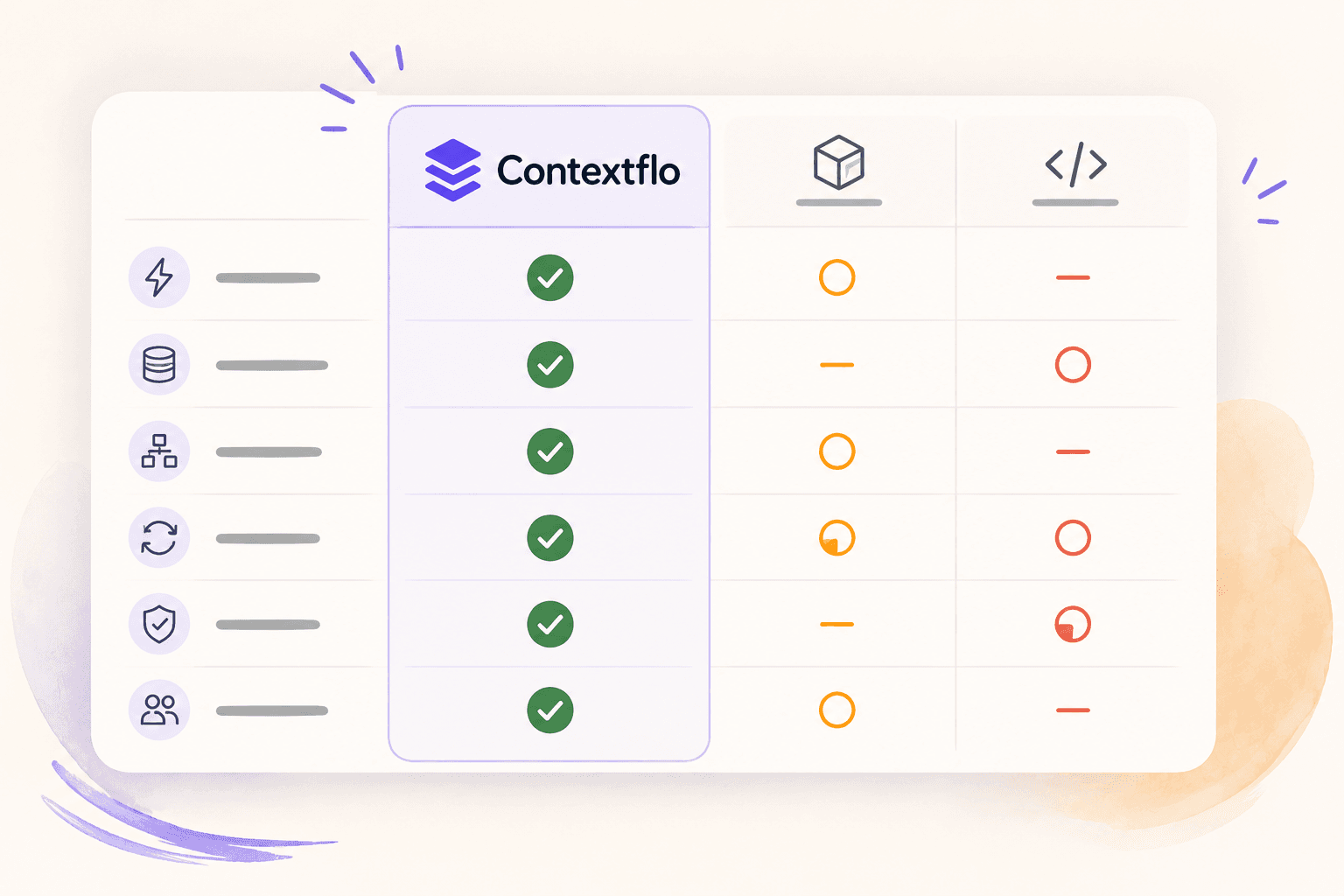
Conversational analytics: 5 ways to set it up, compared
7 min read
How to connect Claude to BigQuery (and fix the errors you'll hit)
8 min read
How to connect Claude to Postgres (and keep it read-only)
7 min read

How to build a BI dashboard with Claude that your team can actually trust
8 min read
How to give Claude read-only access to your database (it isn't always the default)
7 min read
You connected your warehouse to Claude, now what?
5 min read
What is a semantic layer?
5 min read
How to connect Google Sheets to Claude, and ask it alongside your warehouse
4 min read
How finance and ops teams catch the numbers that don't match, before a customer does
4 min read